
George Smith Clark, teenage entrepreneur behind Belfast’s other ‘wee’ shipyard
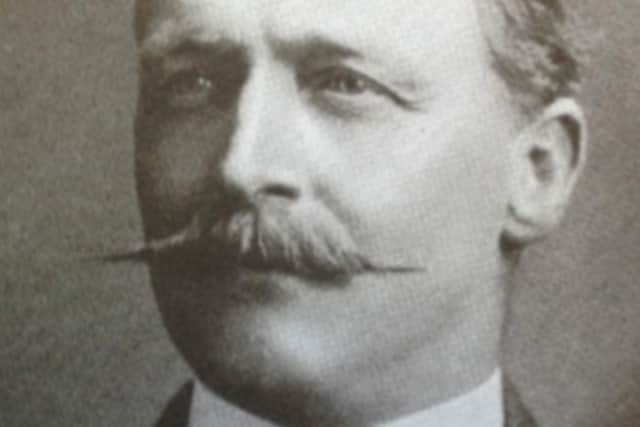
George Smith Clark was born in Paisley on November 8 1861 and was the second son of the thread manufacturer James Clark and Jane Smith. Jane was the daughter of a Glasgow ship-owner who had founded the City Line. George was educated at Merchiston Castle School in Edinburgh (where James Craig, Northern Ireland’s first prime minister, was also educated) and was apprenticed to Harland & Wolff.
In 1877 Clark, at what seems like a ludicrously young age, opened his own shipyard with capital provided by his uncle, George Smith. In 1880 the 19-year old Clark joined forces with the 24-year old Francis Workman, a Belfast-born former premium apprentice at Harland & Wolff who also had links with the Smiths of Glasgow, to form Workman, Clark & Co. The firm’s first order was for a steam coaster named the Ethel.

The business grew and prospered, eventually becoming one of the largest shipyards in the world, employing over 9,000 men on a 130-acre site. It was affectionately known as the ‘wee yard’.
In 1902 and 1909 its output was the largest in the world. Between 1895 and 1909 the proportion of UK tonnage it launched rose from five to 14%.
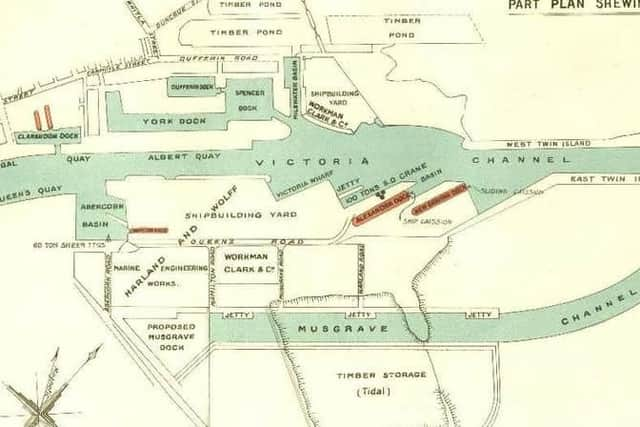
In the early days Workman Clark outsourced making engines to Rowan & Sons of Belfast and other suppliers but after 1891 the ‘wee yard’ made its own engines. The ‘wee yard’ pioneered the development of the Charles Parson turbine engine and the construction of insulated and refrigerated fruit-carrying vessels (for United Fruit and Elder & Fyffes West Indian banana trade). The company specialised in medium-sized cargo boats and combined cargo and passenger vessels.
Harland & Wolff specialised in the construction of high-speed trans-Atlantic liners whereas Workman Clark concentrated on the production of ‘smaller, slower ships for less glamorous trades’. Because Harland & Wolff and Workman Clark had different customer bases and specialisms, the two firms were rarely in direct competition.
Clark was a founder member of the Ulster Unionist Council in 1905 and in 1907 Clark contested the North Belfast by-election, briefly becoming the Unionist MP for North Belfast.
As an industrialist and a shipbuilder, he believed that Home Rule would have a disastrous impact on the Irish economy, the prosperity of Belfast and the shipbuilding industry.
The 1907 contest in the north of the city was the third contest in the constituency in swift succession and Clark was chosen as the candidate most likely to defeat William Walker, the formidable Labour candidate, who in the general election of 1906 had trimmed the Unionist majority in the constituency to under 300. Clark boosted the Unionist majority to a rather more healthy 1,827.
According to Fred Crawford, one of Clark’s most fervent supporters, another one-time apprentice at Harland & Wolff and the principal figure in the Larne gunrunning of April 1914, the contest ‘was fought on the question of the Union, and the Union only. There were no side issues as far as Mr Clark was concerned’.
In January 1910 Clark retired from the House of Commons to devote more attention to his business affairs. However, this did not signal any weakening of his commitment to the Union.
During the third Home Rule crisis George Clark chaired the secret Ulster Unionist Council sub-committee established to acquire the wherewithal to oppose Home Rule by force of arms. As chairman of Duncairn Unionist Association, he invited Sir Edward Carson to contest the newly-created constituency in the general election of 1918. After the establishment of devolution in 1921 Clark became a member of the Northern Ireland Senate.
During the Great War Workman Clark built 35 vessels for the Admiralty and standard merchant ships to replace those lost to German U-boats. The latter ships were built at break-neck speed: ‘During their construction one of the firm’s men established a new world riveting record in the north yard, [John Moir drove 11,209 rivets in a normal working day on June 5 1918] and the south yard replied by making a record in the way of finishing a standard ship, an 8,000-ton vessel being completed in 3¼ days from the time of launch’. It was for his firm’s contribution to the war effort that Clark received the Baronetcy of Dunlambert in 1917.
After the war demand for ships initially remained high: in 1920 Workman Clark had orders for 37 ships and appeared to be in a stronger position than Harland &Wolff but by 1921 orders began to dry up.
By that stage Sir George had resigned from the board of directors in protest at the financial dealings which were to result in the firm’s temporary liquidation in 1927.
The firm was revived in 1928 as Workman Clark (1928) Ltd. The receivers hoped to persuade Sir George to resume control of the new company but he declined on health grounds. With the onset of the world depression in 1929, Sir George made a wise decision.
In 1932 and 1933 Harland & Wolff did not launch a single ship. Workman Clark launched its last ship, an 8,000-ton tanker named Acavus, in 1934.
Sir George died at his home, Dunlambert, Fortwilliam Park, on March 23 1935. He was buried on March 26 in Belfast City Cemetery. Less than a month later, it was announced that the firm was to be sold and closed.
Sir George Clark occupied a prominent position within a network of Scots and Ulster business dynasties. Either directly or by marriage Clark was related to the Ulster business families of Corry (timber and building supplies), Workman (his shipbuilding partner), Smiley (the ropeworks), Dixon (timber and shipping), and Matier (linen) as well as the Clarks and Kerrs of Paisley (thread manufacturers). (Sir George had married Frances Elizabeth, daughter of Henry Matier in 1881.)
Sir George’s grandson, George Anthony Clark (1914-1991), was the third baronet and a senior unionist and Orangeman, being grand master of the Grand Orange Lodge of Ireland (1957-67), chairman of the standing committee of the Ulster Unionist Council (1967-72), president of the Ulster Unionist Council (1980-90) and patron of the Ulster Unionist Council (1990-91).