
Gordon Lucy column: Samuel Sloan, the Lisburn-born railway chief who was ‘an actual ruler of the United States’
Since the 1920s, American historians have referred to the last third or so of the nineteenth century – the period sandwiched between the Reconstruction era and the Progressive era – as “The Gilded Age”, borrowing the title from one of Mark Twain’s lesser-known novels which satirised the corruption and social ills of the era.
It was also a period of unprecedented economic expansion in which railroads played a central role. Railroad track mileage tripled from 1860 to 1880, and then doubled again by 1920.

Railroads created a highly efficient network for carrying freight and passengers across the US. The result was an integrated market practically the same size as Europe but without internal barriers, tariffs, or language barriers to disrupt it, and a common financial and legal system to facilitate it.
The wealthy and powerful industrialists and financiers who were the era’s principal movers and shakers were J P Morgan (finance and industrial consolidation), John D Rockefeller (oil), Andrew Carnegie (steel), Cornelius Vanderbilt (railroads and shipping), Jay Gould (finance and railroads), E H Harriman (finance and railroads), and Henry Clay Frick (steel and finance).
Because of their cut-throat and ruthless business practices - exploiting workers, engaging in monopolistic practices, and wielding improper political influence - they are often referred to as “robber barons”. (Cornelius Vanderbilt was so described by the New York Times as early as 1859.)
Others, taking a more benign interpretation of their activities, choose to regard them as “captains of industry”.
Most of them, like Carnegie and Rockefeller, tried to redeem themselves by their philanthropy which shaped the landscape of education, healthcare, and culture. Whether this mitigated the negative impacts of their ruthless wealth accumulation is another matter altogether.
In 1958, in a celebrated article in Business History Review, Hal Bridges observed that, “‘The most vehement and persistent controversy in business history has been that waged by the critics and defenders of the ‘robber baron’ concept of the American businessman”. Even in 2025 the jury is still out.
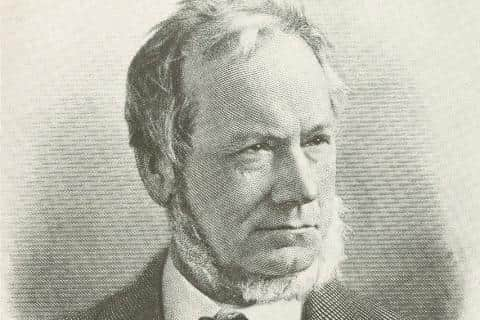
Although Samuel Sloan did not quite possess the profile of J P Morgan and the others, he was a close associate of Morgan and a formidable operator and extremely wealthy man in his own right.
Sloan was born on Christmas Day 1817 in Lisburn. When he was one year old, his parents William and Elizabeth Sloan emigrated to New York via Quebec.
He attended the Columbia College Preparatory school until he was 14 when his father died. He then began work in a New York import house, eventually becoming head of the firm.
In 1857, when he retired from the import business, 40-year-old Sloan already had a successful career behind him but few could have anticipated his second, longer, and significantly more spectacular career – as a railway magnate.
In 1855 he became a director of the Hudson River Railway even before he left the import business
He became a director of the Delaware, Lackawanna and Western Railroad in 1864, and became its president in 1867. Prior to accepting the DL&W presidency, Sloan had declined an offer to become president of the New York and Harlem Railroad. He retained the DL&W presidency for 32 years, and extended its network. The company achieved great success, not least through transporting anthracite mined in the railway's expanded territory but also through carrying commuters from New Jersey, Long Island, Connecticut, and Upstate New York into New York City.
This prompted the New York Times to observe: “No name in the financial and railroad world is more closely identified with building the great railroad systems which serve New York than that of Samuel Sloan."
Gustavus Myers in his classic work, “History of the Great American Fortunes”, described Sloan as one of “the monarchs of the land ... the actual rulers of the United States; the men who had the power in the final say of ordering what should be done".
Industrialists wielded far greater clout than politicians, a very high proportion of whom were mediocrities and corrupt to boot. This explains why Sloan only served two years as a member of New York Senate.
During his lifetime Sloan had been associated with 17 railroad companies and at the time of his death he was director or officer of 33 corporations including Citibank, Farmers Loan and Trust Company, United States Trust Company, Consolidated Gas Company, and Western Union Telegraph Company. Although he resigned the presidency of the DL&W in 1899, he continued as chairman of the board for the remaining eight years of his life.
Sloan’s philanthropic endeavours focused on healthcare (notably Long Island College Hospital and hospitals for the insane), education (especially Rutgers College), and the Dutch Reformed Church (his wife’s denomination) and the Episcopal Church.
Allegedly a lifelong Presbyterian, Sloan put a stop to the running of the railways on Sundays. He said: “I would not work myself on a Sunday, and I do not see why the men under me should be made to work.”
However, if he was a lifelong Presbyterian, it is curious that the Episcopal Church was the recipient of his philanthropy and he was buried at St Philip's Church, Garrison, New York, an Episcopal Church.
Sloan died aged 89 on September 22, 1907.
The three palatial houses he built in the Hudson Valley are testament to his great wealth accumulation.
His home, Lisburne Grange, an archaic spelling of his birthplace, was built in 1864. Originally designed in a Gothic style, it was remodelled by the next generation in the Italianate style. Built on the Hudson River, Lisburne Grange still enjoys sweeping views of West Point Military College.
The other two grand houses were built in 1883 and 1885 as wedding presents for two of his daughters.
Two places in the United States are named in his honour: Sloan, Iowa (because of his involvement with the Sioux City and Pacific Railroad), and the village of Sloan, New York (which is built on land he once owned).
A statue was erected of Sloan in Hoboken, New Jersey, in 1899 – in his own lifetime. The inscription highlights the most significant role of his career:
SAM SLOAN
1817–1907
FOR THIRTY-TWO YEARS PRESIDENT
OF THE DELAWARE, LACKAWANA &
WESTERN RAILROAD COMPANY
1867–1899.