
Gordon Lucy: Francis Fowke, Belfast-born career soldier who designed the Royal Albert Hall, but did not live to see it completed
On November 9 some News Letter readers will have attended the Royal British Legion’s Festival of Remembrance in the Royal Albert Hall. Many others will have viewed the event on television.
Comparatively few, however, at a guess, will be aware that the magnificent structure was designed by a Ballysillan man.

A blend of Victorian grandeur and Italianate influence, its striking domed roof, intricate mosaic friezes, and elaborate terracotta ornamentation make it a visual masterpiece.
The hall was designed by civil engineers Captain Francis Fowke and Major-General Henry Y D Scott of the Royal Engineers.
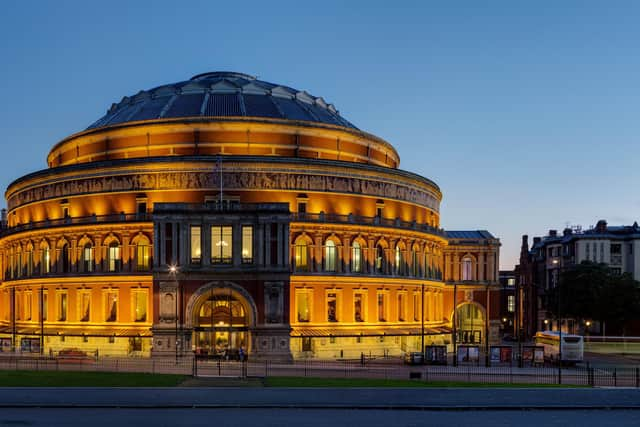
It was opened by Queen Victoria in 1871 and was originally to have been called the Central Hall of Arts and Sciences, but was renamed the Royal Albert Hall of Arts and Sciences by Queen Victoria when she laid the hall's foundation stone in 1867, in memory of her husband, Prince Albert, who had died six years earlier.
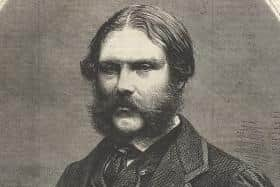
Francis Fowke was born on July 7 1823 in Belfast, the elder of two sons of John Fowke (1794-1851), a lieutenant in the 68th Regiment of Foot, and his first wife, Jane (née Ferguson).
He was educated at the Royal School, Dungannon, and the Royal Military Academy, Woolwich (1839-41). Obtaining his first commission in the Royal Engineers in 1842, he achieved the rank of captain in 1854.
He served in Bermuda, where he distinguished himself as a military architect, returned to England and designed Raglan Barracks at Devonport. In 1854 he was put in charge of the machinery displayed at the Paris Universal Exhibition and was subsequently appointed secretary of the British commission to the exhibition and created chevalier of the Légion d'Honneur.
Fowke specialised in government commissions, combining classical renaissance styles with modern technology to create large iron-framed buildings with glazed open galleries. A favourite of Prince Albert, who was a great admirer of the ingenuity of the Royal Engineers, Fowke was responsible for the buildings in ‘Albertopolis’ – the area in South Kensington bought with the profits from the Great Exhibition of 1851 – including the Victoria and Albert Museum and, of course, the Royal Albert Hall.
In 1858 he was sent to Dublin by Henry Cole, secretary of the Science and Art Department in London, to inspect and report on Charles Lanyon’s excessively costly scheme for the proposed new National Gallery and to discover the reasons for the delay in carrying out the project.
Fowke significantly modified Lanyon’s designs, creating as functional a building as possible within the financial and space constraints of the Leinster Lawn site. He reproduced the exact external dimensions of the nearby Natural History Museum (completed in 1857) to create the appearance of a symmetrical arrangement.
He introduced significant innovations in construction (using possibly for the first time in Ireland an early form of reinforced concrete, the patented Fox & Barrett system), in ventilation and in lighting.
When the gallery was opened in January 1864, the response of the Dublin press was overwhelmingly favourable, the Irish Times describing the Sculpture Hall as ‘elegantly arranged, beautifully proportioned and admirably adapted to its purpose’.
The Irish architectural establishment, however, was scathing, if not vicious. A paper read to the Royal Institute of Architects of Ireland referred to the ‘meanness of the entrance ... the intensely ugly, awkward and dangerous staircase leading to the picture galleries’; it considered the new gallery ‘the work of an amateur ... a bad building ... a national gallery of the fine arts from which architecture is excluded’.
Other buildings for which Fowke was responsible include the Prince Consort’s Library at Aldershot and the Edinburgh Museum of Science and Art.
Prince Albert laid the foundation stone of the latter on October 23 1861 – his last public appearance before his death six weeks later.
Although best known as an architect, Fowke was responsible for an array of ingenious inventions including a military fire-engine, a folding camera, a portable rubber bath, mobile scaffolding and a collapsible military pontoon-bridge. He had a keen interest in cameras, designing in the mid-1850s ‘the most portable as well as the lightest camera in use’ which when collapsed and folded flat, the camera measured only 13 by 10½ by 3½ inches.
Francis Fowke died of overwork, aged only 42, on December 4 1865 at his residence in South Kensington. Thus, he was the posthumous architect of the Albert Hall, the work being supervised by Major-General Scott. Before his death, Fowke had won the competition for the design of the Natural History Museum, although he did not live to see it completed either.
Such was the Irish architectural establishment’s antipathy for his design of the National Gallery, the Dublin Builder published an obituary devoid of charity and common decency, but the Athenaeum was much closer to the mark in observing that ‘the public has lost in this engineer one of the ablest of its servants’.
Henry Cole, the civil servant whose astute management was disproportionately responsible for the success of the Great Exhibition of 1851, provided a gracious and judicious assessment of Fowke’s life and work, expanding on this point:
‘I firmly believe that the arts of construction in this country have sustained a great loss by Captain Fowke’s death. At this period, when Art is so transitional, and Science is making so many discoveries, and men’s minds are seething with inventions; when the use of new materials is being constantly manifested, and the new adaptation of old materials is constantly entered upon, England has lost a man who felt the spirit of his age, and was daring enough to venture beyond the beaten path of conventionalism. Captain Fowke, to my mind, was solving the problem of the decorative use of iron, and, by appreciating the spirit both of the Gothic and the Renaissance architecture, as on the threshold of introducing a novel style of architecture, when, alas! death, at the early age of forty-two years, has cut short his promising career.’
(As a member of the Society for the Encouragement of Arts, Manufactures, and Commerce, Cole energetically campaigned to improve standards in industrial design and is credited with inventing the Christmas card.)