
Gordon Lucy: Ulster-Scot Robert R Livingston was a key player in two of the most crucial events in founding of modern America
Thomas Jefferson crafted his own epitaph, highlighting the achievements for which he wished to be remembered:
‘HERE WAS BURIED THOMAS JEFFERSON, AUTHOR OF THE DECLARATION OF AMERICAN INDEPENDENCE, OF THE STATUTE OF VIRGINIA FOR RELIGIOUS FREEDOM, AND FATHER OF THE UNIVERSITY OF VIRGINIA’

Although he was American Minister in Paris (1785-89), George Washington’s Secretary of State (1789-93), John Adams’ vice-president (1797-1801) and the third president (1801-09), Jefferson omitted mention of these great offices in his epitaph.
Jefferson, a superb wordsmith but a poor public speaker, was the primary author and drafter of the Declaration of Independence rather than the document’s sole author and drafter.
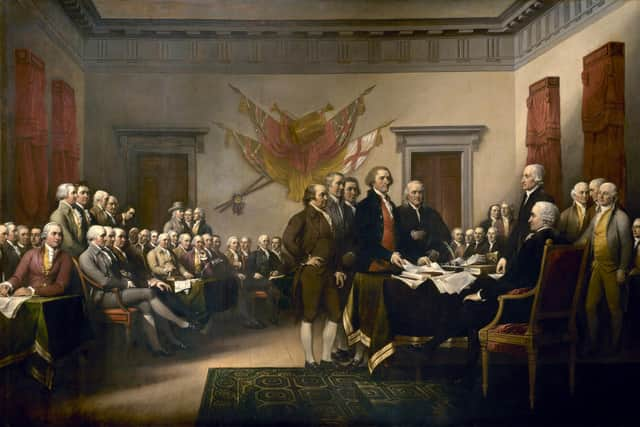
He wrote the initial text, at the suggestion of John Adams, in a Philadelphia boarding house in June 1776 for the Committee of Five.
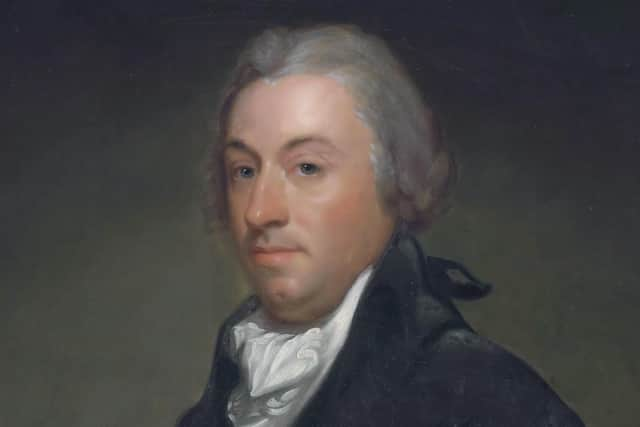
Robert R Livingston, a lawyer and politician from New York and a member of that prominent family whose roots stretch back to Killinchy, was appointed to the Committee of Five by the Second Continental Congress on June 11, 1776, alongside:
• Thomas Jefferson of Virginia;
• John Adams of Massachusetts, a key driving force and advocate for the document;
• Benjamin Franklin of Pennsylvania, who, along with Adams, made revisions to Jefferson's draft;
• Roger Sherman of Connecticut.
As the committee took no minutes, we know comparatively little for certain about the drafting process. Contradictory accounts written many years later by Jefferson and Adams are frequently cited but they cannot be regarded as entirely reliable.
The committee reviewed Jefferson's draft, making changes, perhaps even extensive changes, before presenting Jefferson's revised draft to Congress on June 28, 1776.
Congress too made changes, notably removing Jefferson's strong (and hypocritical) denunciation of the slave trade to maintain unity, and removed nearly a quarter of Jefferson’s text.
Although Jefferson resented the changes, he did not make a fuss.
Livingston was recalled by the New York Provincial Congress to serve in the new state government before the final document was signed on August 2 1776, and thus he did not sign the document. However, he sent his cousin, Philip Livingston, to sign in his place.
From 1781 to 1783 Livingston served as first US secretary of foreign affairs under the Articles of Confederation.
In 1783, he accepted the post of chancellor of the state of New York, the state’s highest judicial officer. He was known as ‘The Chancellor’ for the rest of his life.
On April 30 1789, in that role Livingston administered the oath of office to President George Washington. The Bible Livingston used to administer the oath of office to President Washington is owned by St John's Masonic Lodge No 1. (Livingstone was a freemason and the first grand master of the Grand Lodge of New York.) The Bible has since been used at the inaugurations of Presidents Harding, Eisenhower, Carter, and George H W Bush.
When Thomas Jefferson became president in 1801, he appointed Livingston US minister to France where he served until 1804.
He was instructed to secure trading rights in New Orleans or gain possession of another port on the Mississippi River.
In his negotiations with the French, Livingston recognised opportunity when he saw it and exceeded his instructions by proposing France cede Louisiana, an area roughly defined by the Missouri and Mississippi watersheds, to the United States. In the early months of 1803 Napoleon was planning a full-scale invasion of England and just after Easter Napoleon informed his generals and ministers that he intended paying for the invasion by selling Louisiana.
In ‘the greatest real-estate deal of all time’ the French sold the vast territory for $15 million which worked out at approximately three cents an acre. The Louisiana Purchase doubled the size of the US overnight and accounts for 26% of the US mainland today. The acquisition included all of what are now the states of Arkansas, Iowa, Kansas, Missouri and Nebraska, and parts of North and South Dakota, Montana, Wyoming, Colorado, Minnesota, New Mexico, Texas and today’s Louisiana.
Livingston summed up the significance of his achievement with a prescient observation: ‘We have lived a long time but this is the noblest work of our whole lives … the United States takes rank this day among the first powers of the world.’
President Jefferson sent James Monroe, who had served as US minister to France between 1794 and 1796, to France to assist Livingston in negotiating the Louisiana Purchase but Livingston had already done all the heavy lifting by the time of Monroe’s arrival.
News of the Louisiana Purchase reached Washington at the end of June 1803 and Jefferson was delighted to be able to announce it formally on July 4.
Although Jefferson and Monroe had played only minimal roles, they were feted as national heroes whereas the real credit belonged to Livingston who was denied the recognition his achievement richly deserved during his lifetime and beyond.
This was because Jefferson and Madison, who was secretary of state at the time of the Louisiana Purchase and the future fourth president, had sealed away Livingston’s letters and papers from France and deflected praise, identifying him as a potential rival for the presidency. Jefferson and Madison regarded Monroe, a fellow Virginian, on the other hand, as an ally.
While in France, Livingston collaborated with Robert Fulton in developing the first viable steamboat, the North River Steamboat, whose home port was at the Livingston family home of Clermont Manor.
On her maiden voyage with Livingston travelling as a passenger, she left New York City, stopped briefly at Clermont Manor, and continued to Albany up the Hudson River, completing in under 60 hours a journey that had previously taken nearly a week by a sloop.
Livingston's final years were spent experimenting with new agricultural techniques and raising sheep.
Before his death on February 27 1813, he also founded and became the first president of the American Academy of Fine Arts and became a trustee of the New York Society Library.
In his monumental multi-volume, ‘History of the United States during the administrations of Jefferson and Madison’ (1889-1891), Henry Adams described the Louisiana Purchase as a ‘momentous’ event that ranked in importance alongside the Declaration of Independence.
By virtue of his pivotal role in both crucial events, Robert R Livingston deserves to be remembered as a significant member of ‘The Founding Fathers’.