
Gordon Lucy: Winston Churchill’s gratitude to Scotland – for three important reasons
Winston Churchill was born on St Andrew’s Day (November 30) 1874 in Blenheim Palace, the grandest house in England and England’s only non-royal and non-episcopal palace. As he said, it was there he took two of the most important decisions of his life – to be born and to marry.
And it was within sight of Blenheim Palace, he chose to be buried – in Bladon churchyard alongside his father Lord Randolph Churchill and his mother Jennie Jerome Churchill.

Churchill’s date of birth invites consideration of his relationship with Scotland, not least because many Scots believe he disliked or even hated Scotland and its people. Nothing, as Scottish journalist and historian Andrew Liddle amply demonstrates, could be further from the truth.
Churchill was grateful to Scotland for three of most important things in his life – his wife, his constituency, and his regiment.
HIS WIFE
Churchill first encountered Clementine Hozier, a granddaughter of the 10th Earl of Airlie at a ball in 1904. He was initially bowled over by her beauty. They met again at a dinner party in March 1908.
After five months of meeting each other at social events, as well as frequent correspondence, Winston realised Clementine was a spirited young woman of lively intelligence and character.
He proposed to her during a house party at Blenheim on August 11 1908. They were married less than a month later in St Margaret’s, Westminster.
It was a close and affectionate marriage despite the competing demands of public life. They had five children.
HIS CONSTITUENCY
Between 1908 and 1922 Churchill was MP for Dundee, a double-member constituency, being elected on five occasions. He was very pleased with the constituency and wrote to his mother (rashly in retrospect): ‘It is a life seat and cheap and easy beyond all experience’.
In reaching that conclusion he was influenced by the fact that Dundee had returned Liberal MPs for the previous 50 years. What Churchill had not foreseen was the role which the rise of the Labour movement in its many forms would play in scuppering his ‘seat for life’.
Dundee electors initially were flattered to be represented by a Cabinet minister and seemed prepared to overlook Churchill’s long absences. However, by 1922 things were very different. From the outset of his political career Churchill invariably addressed national rather than local issues. From his point of view, Dundee suffered the inconvenience of being 440 miles from Westminster and only accessible by overnight sleeper train from King’s Cross. The notion of ‘nursing his constituency’ was entirely alien to him, as it was to most of his contemporaries.
By 1922 Churchill’s pre-war reforming zeal lay in the past. Pride in having a high-profile politician and Cabinet minister as their MP was replaced by disillusionment with his record both as a Cabinet minister and as a largely absentee MP.
Churchill’s left-wing radicalism of 1908 had morphed into pronounced conservative tendencies which were to characterise the rest of his career. This was to weigh heavily against him in the general election of 1922. Dundee was – and still is – a very left-leaning city.
Churchill’s defeat in Dundee in 1922 also owed much to his ill-health. An operation to remove his appendix left him barely able to walk, limiting his ability to make public speeches and tour the constituency.
He was defeated for the second seat by Edwin Scrymgeour, who became the first and only prohibitionist to be elected to the House of Commons. Amused contemporaries noted how the drunks stumbled out of the city’s pubs to vote for Scrymgeour – presumably endorsing his left-wing politics rather than his prohibitionism.
Although stunned by his defeat, Churchill generously praised Scrymgeour, who had contested Dundee on five previous occasions, on each occasion increasing his vote.
In a speech in the city’s Liberal Club, shortly after the declaration, he said: ‘All my life I will look back with feelings of the deepest regard for Dundee and for those in it who stood by me faithfully.’
When Churchill declined the Freedom of Dundee in 1943, he did not do so out of pique. He was acting on the advice of Tom Johnston, the secretary of state for Scotland and a Labour member of Churchill’s coalition government, who advised him not to accept because it was not offered unanimously.
HIS REGIMENT
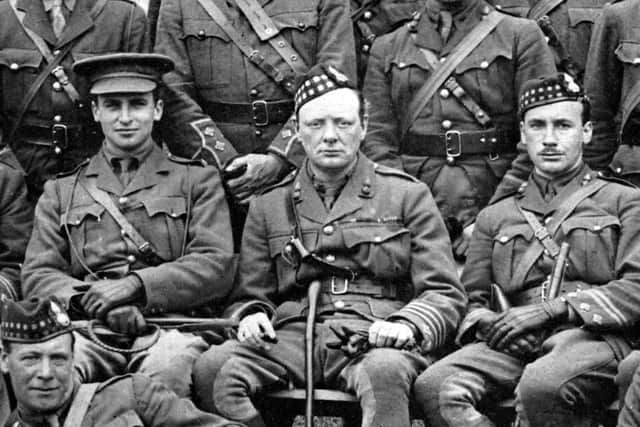
During the Great War, he commanded the 6th Battalion of the Royal Scots Fusiliers at Ploegsteert (between Armentières and Messines) on the Western Front from January to May in 1916.
His two key subordinates were both future Scottish political leaders. Andrew Dewar Gibb, a founding member and subsequent leader of the SNP (1936-1940), was Churchill’s adjutant, and Archibald Sinclair, a future leader of the Liberal Party (1935-45), was his second-in-command. Sinclair served continuously as Churchill's wartime coalition as secretary of state for air.
HIS SUPPORT FOR SCOTTISH HOME RULE
Churchill’s affection for Scotland and her people is evidenced by the fact that Churchill was one of the first senior British politicians to espouse Scottish home rule and advocate UK federalism. In October 1913 he predicted that ‘the day will most certainly come when a federal system will be established in these islands which will give Wales and Scotland control, within proper limits, of their own affairs’.
In May 1950 the Labour government rejected John MacCormick's Covenant, a petition to the UK government to create a home rule Scottish parliament, which secured two million signatures by 1949. Churchill was personally sympathetic.
HIS FIRST BIOGRAPHER WAS A SCOT
Finally, there are over a thousand biographies of Churchill in existence but his first biographer was Alexander MacCallum Scott, a Glasgow Liberal MP, who was for a time Churchill’s private secretary.
In 1905 Scott wrote: ‘The youth of 30 is confidently spoken of by his admirers as a future prime minister.’ He also described Churchill as belonging to ‘a race of giants’. Although these observations might have been reasonably dismissed as hyperbole or even hagiography 119 years ago, as Andrew Roberts noted in his biography in 2018, they could now be regarded as ‘prescient’.