
Great American novelist John Steinbeck was fascinated by his Ulster roots
John Steinbeck is best known for his novella ‘Of Mice and Men’, and his novel ‘The Grapes of Wrath’ that won him a Pulitzer Prize in 1940. In the course of his life, he wrote 27 books, including 16 novels, six non-fiction books and two collections of short stories.
He was born John Ernst Steinbeck Jr on February 27 1902 in Salinas, California, to John Ernst Steinbeck, Monterey County treasurer, and Olive Hamilton, a school teacher.
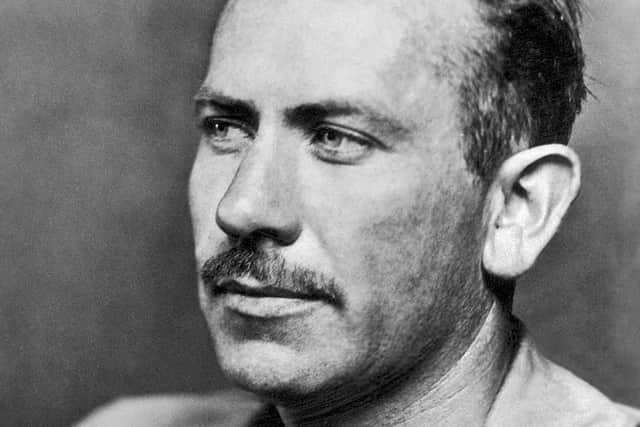

His father was of German stock, his mother was of Ulster-Scots heritage. Samuel Hamilton of Mulkeeragh, Ballykelly, Co Londonderry was his maternal grandfather. As Alister McReynold points out in his book ‘Kith and Kin’, Steinbeck was only two when his grandfather died. Yet he had a life-long fascination with the man and his Ulster roots. He twice visited Ballykelly to explore his Ulster origins but with only limited success.
He recalled driving through Ballykelly ‘without knowing it was there’, but at Limavady the locals turned him back. He recalled: ‘I guess I had thought of Ballykelly as a town; it isn’t – it’s what they call in Texas a wide place in the road.’
However he described Ballykelly as ‘the seat of my culture and the origin of my being and the soil of my background’. He took little or no interest in his father’s Germanic roots.
In the second chapter of ‘East of Eden’ (1952), Steinbeck wrote: ‘Young Samuel Hamilton came from the north of Ireland and so did his wife. He was the son of small farmers, neither rich nor poor, who had lived on one landhold and in one stone house for many hundreds of years. The Hamiltons managed to be remarkably well educated and well read; and, as is so often true in that green country, they were connected and related to very great people and very small people, so that one cousin might be a baronet and another cousin a beggar’.
He also delineated the character of Samuel’s wife: ‘She had a dour Presbyterian mind and a code of morals that pinned down and beat the brains out of nearly everything that was pleasant to do.’
She also possessed ‘... a finely developed sense of sin. Idleness was a sin, and card playing, which was a kind of idleness to her. She was suspicious of fun whether it involved dancing or singing or even laughter.’ Steinbeck’s mother was a profound influence on her son. Olive Hamilton was involved in a wide range of charitable and social organisations in which she played a leading role and undertook most of the work. During the Great War no one sold more war bonds in Salinas than Olive. She imbued her son with a strong sense of right and wrong, moral outrage at social injustice and a love of language and books. He studied English Literature at Stanford but left without completing his degree. His experience working as an agricultural labourer and semi-skilled technician, enabled him to write with realism and understanding about the lives of those worked on the land. This is evident in ‘Tortilla Flat’ (1935), his first novel to attract serious attention.
‘Of Mice and Men’ derives its title from the Robert Burns poem ‘To a Mouse’: ‘The best laid schemes o’ mice an’ men/Gang aft agley’ (or ‘go often awry’). It is the story of George and Lennie, two itinerant farm labourers, the latter of huge strength and weak mind, exploited but at the same time protected by the former. The title ‘The Grapes of Wrath’ was taken from ‘The Battle Hymn of the Republic’ (‘Mine eyes have seen the glory of the coming of the Lord/He is trampling out the vintage where the grapes of wrath are stored’) written by abolitionist Julia Ward Howe in 1861. Steinbeck’s third wife Carol suggested the title. As Steinbeck explained to his literary agent: ‘I like the song because it is a kind of march and this book is a kind of march.’
The novel owed much to Steinbeck’s research for a series of newspaper articles entitled ‘The Harvest Gypsies’ which appeared in the San Francisco News (illustrated with the haunting photographs by Dorothea Lange) from October 5 to 12 1936. Written at break-neck speed (2,000 words a day for 100 days), the book chronicles the story of the Joads, an Oklahoma family (Okies), who, after losing their farm during the Depression, embark on an exodus (along Route 66) to what they believe is the promised land (California) in search of a better life. Their journey to California and their reception when they arrive are both grim and almost soul-destroying. The book is widely viewed as a powerful plea for consideration of human values and common justice but not everyone saw the book in this positive light.
It was burned in Salinas. In Bakersfield, Buffalo and San Jose it was banned. The Associated Farmers of California dismissed the novel as a ‘pack of lies’ and ‘communist propaganda’. It was even briefly banned in the USSR because Stalin found the revelation that even the most destitute Americans could afford motorised transport embarrassing.
In the United States Ruth Comfort Mitchell in a book entitled ‘Of Human Kindness’ attempted to refute the novel by defending California’s treatment of its immigrant workers. Eleanor Roosevelt, the president’s wife, weighed in on Steinbeck’s side and rejected allegations that Steinbeck was guilty of exaggeration. Even the US Senate took Steinbeck’s side.
‘The Grapes of Wrath’ was the best-selling book of 1939, selling almost half a million copies in the first year of publication alone. The following year John Ford turned the book into a film of the same name, starring Henry Fonda. Thus, ‘the Great American Novel’ became one of the few enduring ‘Great American Motion Pictures’. Since then the book has been widely studied as a set-text in English literature courses in both schools and universities.
However, by the time he was awarded the Nobel Prize for Literature in 1962, his reputation in the United States was in free fall with academics and literary critics.
Although the Nobel Committee praised his ‘realistic and imaginative writing’ and his ability to combine ‘sympathetic humour and keen social perception’, the New York Times queried why the Nobel committee gave the award to an author whose ‘limited talent is, in his best books, watered down by tenth-rate philosophising’.
The opening in 2012 of the Nobel Prize archives revealed that Steinbeck was a ‘compromise choice’. Also in the frame for the award were Robert Graves, Lawrence Durrell, Jean Anouilh and Karen Blixen but the committee thought there was no obvious candidate and concluded that Steinbeck was the strongest candidate in a weak field, scarcely a fair conclusion.
As the American academic Burton Feldman has observed in study entitled ‘The Nobel Prize: A History of Genius, Controversy, and Prestige’ (2000), the prize has ‘become widely seen as a political one – a peace prize in literary disguise’ – with judges prejudiced against authors with different political preferences to their own.
In his acceptance speech in Stockholm in 1962, Steinbeck said: ‘… the writer is delegated to declare and to celebrate man's proven capacity for greatness of heart and spirit – for gallantry in defeat, for courage, compassion and love. In the endless war against weakness and despair, these are the bright rally flags of hope and of emulation. I hold that a writer who does not believe in the perfectibility of man has no dedication nor any membership in literature.’
In September 1964, President Johnson awarded Steinbeck the Presidential Medal of Freedom.
Steinbeck died on December 20 1968.
Down the years ‘The Grapes of Wrath’ features on many ‘100 best’ lists. Informal estimates suggest that it has sold about 15 million copies between 1939 and 2014. ‘The Da Vinci Code’ may have sold 80 million copies and ‘Fifty Shades of Grey’ 60 million but this does not mean that they are better books.