
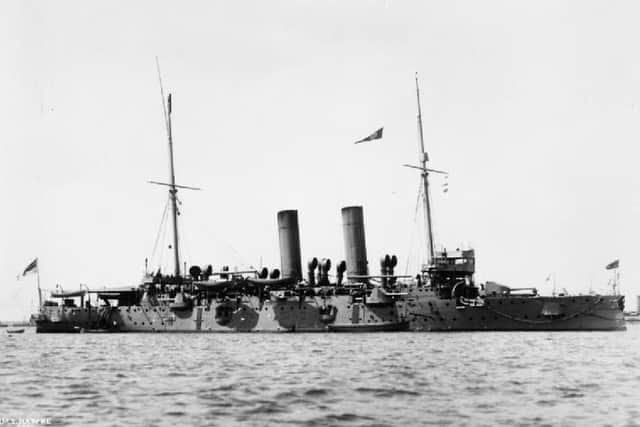
HMS Hawke was sunk by a German U-boat on October 15 1914, and 49 of the Ulster sailors on board died
Between August 9 and 22 1914 the British Expeditionary Force was safely transported across the English Channel at the start of World War One. This truly impressive achievement is obscured by a series of setbacks sustained by the Royal Navy in the early months of the war in the North Sea.
Initially, the Admiralty did not take the threat posed by submarines very seriously and, to be fair, the Germans did not yet fully appreciate their potential either. (By 1916, although submarines played only a minimal role in the Battle of Jutland, fear of them figured prominently in Admiral Jellicoe’s calculations.)

On September 5 1914 the U-21 sank the cruiser HMS Pathfinder. There were, as far as can be ascertained, 268 personnel on board plus two civilian canteen assistants. There were just 20 known survivors, one of whom was staff surgeon Thomas Aubrey Smyth of Bedeque House, Dromore, Co Down.
On September 22 the U-9 sank three armoured cruisers – the Aboukir, Hogue and Cressey – in a single action. From all three ships 837 men were rescued and 62 officers and 1,397 ratings lost.
The U-9 sank the cruiser HMS Hawke on October 15 and on the last day of 1914 U-24 sank the pre-Dreadnought battleship Formidable.
Hawke was an Edgar-class armoured cruiser operating as part of the 10th Cruiser Squadron assigned to the Northern Patrol. Launched at Chatham in 1891, she was one of the oldest ships still in service.
Having been used as a training ship, she had a significant number of boy sailors on board. She had been recommissioned in February 1913.
On October 15 she was in ‘the northern waters’ of the North Sea with her sister ship, HMS Theseus, when they were attacked. The two ships were vulnerable because they were operating without a destroyer screen and were slower than the U-9, which was tracking them. Their position was some 60 miles off Aberdeen.
At the time, Hawke had just turned to intercept a neutral Norwegian collier. The U-boat missed the Theseus with its first torpedo but unfortunately hit Hawke amidships near a magazine. The detonation was followed by a second huge explosion, in which many of the crew were killed. The ship sank within five minutes.
A survivor recalled: ‘We were struck right amid ships between the two funnels, quite close to one of the magazines. All hands were on deck, and it was a terrible explosion.
‘The vessel immediately took a heavy list to starboard. I have never been on a ship so well equipped with life-saving apparatus, but the way the vessel heeled over made it almost impossible to get the boats out.
‘The boat in which I was saved had a narrow escape from being taken down with the suction. We were struck about 11 o’clock in the forenoon, and just as we got away from the Hawke, we distinctly saw the periscope of the enemy’s submarine come to the surface. We thought he was going to ram us, but apparently he was on the lookout for any other rescuing vessels.
‘Prior to the accident the Hawke was cruising about zigzag fashion, and we never saw the submarine until we felt her. It was beginning to get hazy when we were almost run down by the Norwegian steamer which picked us up. This boat, after affecting the rescue, cruised about in search of the rafts, but nothing was seen.’
The Norwegian steamer rescued 49 survivors while the destroyer HMS Swift rescued a further 22 men on a raft.
Had there been sufficient time to launch other lifeboats undoubtedly more men would have been saved by the Norwegians.
In all 524 men drowned, including the ship’s Captain, Hugh P E T Williams.
Another high-ranking casualty was Lieutenant-Commander Ruric Waring from Waringstown.
Eighty-six boy sailors were lost. Only seven survived.
Theseus was under strict Admiralty orders not to attempt to pick up survivors because the Hogue and Cressey were attacked while trying to rescue the crew of the Aboukir on September 22 1914.
The sinking of the Hawke is of interest because this year marks the 110th anniversary of the loss of the Hawke.
Secondly, after years of painstaking research, in August what is almost certainly the wreck of the Hawke was located 70 miles east of Fraserburgh by divers from Lost in Waters Deep, an organisation dedicated to uncovering wartime shipwrecks in Scottish waters.
Although the ship has deteriorated after more than a century on the seabed, it is still ‘virtually intact’. The guns are in ‘amazing condition’. A lot of the teak decking is still in place. ‘There's lots of Royal Navy crockery. She was clearly taken completely by surprise because lots of the portholes are still open. Some interior features like a clock and wall-mounted barometer are also all still visible’.
Thirdly, the loss of Hawke resulted in the deaths of 49 Ulster sailors. One reminder of this is a fascinating display in Barrington Gardens in Belfast which highlights the fact that Able Seaman Hugh Crawford, Able Seaman John Thomas Gibson Dawson, Stoker 1st Class John Mills, Chief Petty Officer Charles Molloy and Additional Stoker 1st Class Archer Thompson hailed from the Donegall Road or south Belfast.
Only six Ulster sailors serving on the Hawke survived: Charles Trainer from Londonderry, Thomas Hoy from Larne and Belfast men J A Allen, Thomas H Doyle, John Aitken and James O’Neill.
While the loss of the Hawke and other ships was a blow to the prestige of the Royal Navy, especially in the eyes of the British public, such encounters were tragic and embarrassing rather than strategically disastrous.
The only major wartime confrontation between the Royal Navy and the German High Seas Fleet took place at Jutland in May and June 1916. The Royal Navy lost three battlecruisers, three cruisers, eight destroyers and suffered 6,100 casualties; the Germans lost one battleship, one battlecruiser, four cruisers and five destroyers, with 2,550 casualties.
While the Royal Navy was shaken by this balance sheet, Jutland ought to be viewed as a strategic British victory because the German High Seas Fleet never again challenged the Royal Navy in the North Sea. Britannia continued to rule the waves.