
Horace Greeley, an eccentric with Northern Ireland roots, was seen as the 'conscience of America' in the 1800s
Horace Greeley’s maternal ancestors came from Garvagh in Co Londonderry and settled in New England in the early years of the 18th century.
He was very conscious of his Scottish and Scotch-Irish ancestry. In his autobiography he described his ancestors as people ‘whose store of Scottish and Scotch-Irish traditions, songs and anecdotes, shreds of history &c, can rarely have been equalled’.
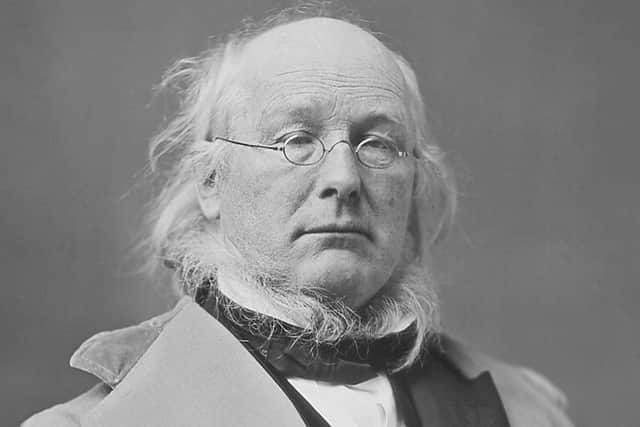

Greeley was born near Amherst in New Hampshire in 1811.
It is alleged that he could not breathe for the first 20 minutes of his life. Some biographers, such as Mitchell Snay, maintain he may have developed Asperger’s syndrome as a result and this may account for his eccentric behaviour in later life.
The eldest of five sons of a poor farmer, he received only a rudimentary education. His introduction to journalism came through his apprenticeship to a Vermont printer. In 1831 he moved to New York where he worked as a job printer, published a literary magazine and a Whig Party campaign paper.
In 1841, after experimenting with publishing some short-lived papers, he founded the New York Tribune, a daily which from 500 subscribers at the beginning rose to 11,000 only seven weeks later. By the 1850s it had a circulation of over 250,000, making Greeley an extremely influential opinion former.
The Tribune was trenchant in its opposition to slavery and promoted the ideas of Charles Fourier, the French utopian socialist.
He was an enthusiast for causes as diverse as vegetarianism, brown bread, free-thinking and spiritualism and was receptive to a wide variety of ‘progressive’ ideas emanating from Europe ranging from women’s rights to temperance. He recruited Margaret Fuller, one of America’s earliest feminists, as a regular contributor to the paper.
His interest in events in Europe is neatly illustrated by the election of Giovanni Maria Mastai-Ferretti as Pope Pius IX in 1846. At the time of his election Pius IX was viewed as a liberal and in the vanguard of the Italian national movement. Thus, on November 29 1847, ‘to the accompaniment of thunderous applause’, Greeley read before an assembly of more than 6,000 persons an address of congratulations to Pius IX. Then, in a remarkable volte-face, Pio Nono swiftly withdrew from the national movement and became an out-and-out reactionary. Greeley and the Tribune were not slow to condemn him.
Like many Ulster-Scots, Greeley was an avowed opponent of slavery. He vigorously denounced the Fugitive Slave Act of 1850 (which authorised the arrest of runaway slaves), the Kansas-Nebraska Act of 1854 (which allowed the inhabitants to determine whether or not slavery would be permissible or excluded from the two territories) and the Dred Scott decision of 1857 (in which the US Supreme Court ruled that the US Constitution was not intended to extend US citizenship to people of African descent, irrespective of whether they were enslaved or free).
One of the founders of the Republican Party, he unsuccessfully urged Abraham Lincoln to make emancipation a central aim of the Civil War because at the outset of the conflict Lincoln’s overriding aim was the preservation of the Union. Lincoln only felt able to issue the Emancipation Proclamation on January 1 1863 after the Union’s strategic victory at the Battle of Antietam.
By the 1860s Greeley’s influence was diminishing because of his increasingly idiosyncratic views and his unsuccessful bids for political office. His dress sense was eccentric too. He wore an old linen coat that made him look like a farmer who had just arrived in town for supplies.
The Tribune continued to wield significant influence but it was much less under the day-to-day control of Greeley as he increasingly became absorbed in politics as a Liberal Republican. He was vehemently opposed both to the ‘Reconstruction’ policies of the Radical Republicans and the perceived corruption of the administration of his fellow Ulster-Scot President Ulysses S Grant. (Grant was a man of integrity but many of his acolytes subscribed to very lax standards.)
In 1872 Liberal Republicans nominated Greeley as their presidential candidate against Grant. Greeley was also nominated by the Democrats in the hope that their combined vote would defeat the incumbent. The contest was rapidly billed as one between ‘a man of no ideas’ (Grant) and ‘the man of too many ideas’ (Greeley).
Although Grant did not actively campaign, Greeley travelled extensively through New Jersey, Pennsylvania, Ohio, Kentucky, and Indiana, delivering up to 22 speeches per day. During the campaign, he may have delivered as many as 150 speeches.
Grant won an easy victory carrying 31 states to Greeley’s six and winning 286 votes out of 349 in the Electoral College.
For an Ulster-Scot, Greeley was surprisingly ill-equipped for the rough and tumble of electoral politics. Being very thin skinned, he took criticism very personally. Devastated by his defeat and even more so by the death of his wife Mary Youngs Cheney (to whom he was utterly devoted) five days before election day, Greeley was a broken man. He died within a month, before the Electoral College met, on November 29.
Horace Greeley is often referred to as ‘the conscience of America’, an evaluation widely shared then and now. An alternative view would be that he adopted positions which were inconsistent, that he was a sucker for almost any -ism which he came across and that his ideas were intellectually incoherent – ‘all over the shop’ as we might say.
Perhaps Iver Bernstein, a historian of mid-19th century America, makes the same point more generously and sympathetically: ‘Greeley was an eclectic and unsystematic thinker, a one-man switch-board for the international cause of “Reform”.
‘He committed himself, all at once, to utopian and artisan socialism, to land, sexual, and dietary reform, and, of course, to anti-slavery. Indeed Greeley's great significance in the culture and politics of Civil War-era America stemmed from his attempt to accommodate intellectually the contradictions inherent in the many diverse reform movements of the time.’