
John Luke: Shy, modest and unassuming, the Belfast man defied the stereotype of an artist
The Committee for the Encouragement of Music and the Arts, the precursor of the Arts Council, commissioned John Luke to paint a mural in Belfast City Hall to commemorate the Festival of Britain in 1951.
Luke made Sir Arthur Chichester, the founder of modern Belfast, reading King James I and VI’s Charter of 1613, which could be regarded as the birth certificate of the city, the focus of his work.
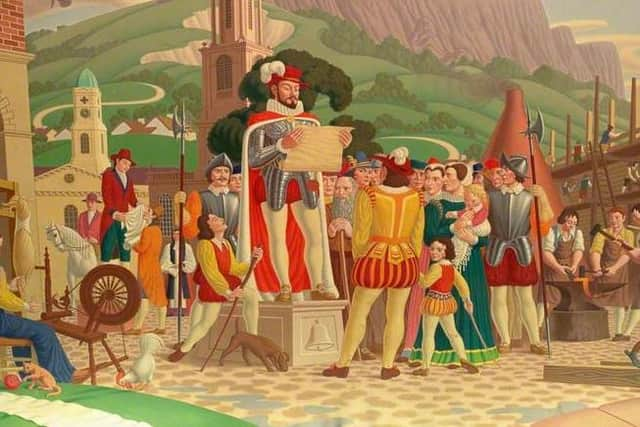

The mural also celebrates the industries which would form the basis of Belfast’s future prosperity – shipbuilding, rope making, engineering and linen. As 19th-century Belfast was known as ‘Linenopolis’ because of its reputation as a world leader in linen manufacturing, Luke perhaps chose to emphasise this by depicting a bleaching green, flax growing, spinning and weaving.
Luke worked on the commission for 16 months. In August 1951 the News Letter reported: ‘From 11 o’clock in the morning until 11 at night the painter is hard at it. He brings his meals with him’. His painting technique was painstakingly slow, his manner precise. 'I'm afraid I'm very much a one job man,' he once explained to his friend John Hewitt, the poet and critic. 'My strength lies in making the most of one job at a time, in sustained thought and effort, to bring it to the highest level of organisation and completeness I desire …’
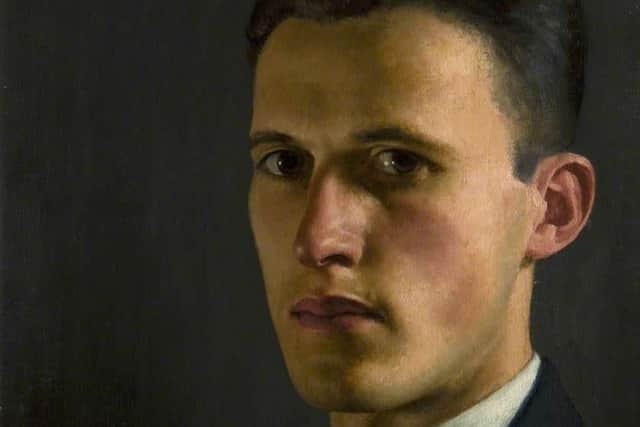
The precision of his work was replicated in the artist’s appearance and personal manner. Dark haired, in stature he was erect and spare of build. Always tidy, his clothes brushed, his hair short, he was, in John Hewitt's words, 'not at all close to the romantic stereotype of the artist'.
The success of the city hall mural brought him to the attention of a wider audience and prompted another mural commission to decorate the new Provincial Masonic Hall in Rosemary Street in Belfast in 1956. The theme on this occasion was ‘King Solomon building The Temple’. When the Masonic sold the hall some years ago, the consensus was that although the hall was an impressive structure the mural was worth more than the building.
In 1961 Luke began work on yet another mural in the Millfield extension of the Belfast College of Technology, the theme this time being ‘Building and Engineering’. This mural was never quite finished because Luke had great difficulty standing as his legs were swollen. When this building was demolished in 2022 the unfinished mural was retained by the demolition contractor.
Although John Luke was born January 16 1906 in Belfast, both his parents came from the Ulster-Scots heartland of mid-Antrim.
James Luke, his father, was a boilerman from Ahoghill. Sarah Luke, his mother, was the daughter of a weaver from near Ballymena.
John was educated at Hillman Street National School and at the Sunday School of Duncairn Gardens Methodist Church. On leaving school he worked in the mill of the York Road Flax Spinning Co and later as a riveter's boy in the Workman & Clark shipyard.
As Luke’s father had a keen appreciation of the value of education, he encouraged John to take drawing lessons at the Belfast Technical College. His talent and diligence secured him a scholarship for the 1924-25 session.
By the time he graduated with distinction in 1927 he was teaching part-time at the college.
In 1928 he was awarded the prestigious Dunville scholarship, which allowed him to study in London at the Slade School of Art. There he shared a studio and flat with the Banbridge-born sculptor F E McWilliam.
He graduated in 1930 with a diploma in fine art, and went on to study life-drawing and wood-engraving for a short time in the autumn of that year at the Westminster School of Art. Shortly afterwards he spent six weeks in Paris before returning to Belfast at the end of 1931.
Luke was fascinated by the craftsmanship of renaissance masters such as Piero della Francesca and Botticelli. Paul Cézanne and Georges Seurat were also significant influences.
Pre-war work included ‘MacArt’s Fort’, ‘Connswater Bridge’ and ‘The Lustre Jug’. When Dr Alexander Irvine visited Belfast in 1938 he painted his portrait. ‘Shaw’s Bridge’ dates from 1939.
At the outbreak of war he stopped painting and in spring 1941 he moved with his widowed mother to Killylea, Co Armagh, to escape the Belfast Blitz. He taught part-time at Manor House girls' school, Milford, during this period.
He resumed painting in 1943, producing ‘Pax’ and ‘The road to the west’ for Hewitt the following year. He affixed a note to the back of the panel detailing the meticulous process by which it was painted.
Although Hewitt and James White greatly admired his virtuosity, they also warned against it stifling his creative impulses.
Disregarding their advice, he continued to work in this manner, of which ‘The three dancers’ (1945), and ‘The rehearsal’ (1950) are fine examples. However, he ceased panel painting in the early 1950s. Painstaking as ever, his pace became even slower and his output diminished.
Painting the mural in the city hall consumed much of his time, as did presumably ‘King Solomon building The Temple’.
He also executed for Hillsborough Castle two commemorative plaques of the coats of arms of two successive governors of Northern Ireland, Lord Wakehurst and Lord Erskine of Rerrick.
From 1954 he taught at the Belfast School of Art, where his kindly and gentle manner was recalled by students with affection.
A shy, modest, unassuming and even taciturn man, Luke possessed a wit much admired by his small circle of friends.
Luke spent his last years living a very spartan existence in his flat at 240 Duncairn Gardens. He died in the Mater Hospital in on February 4 1975, having been in declining health for some years.
The Arts Councils of Ireland mounted exhibitions of his work the following year in the Ulster Museum and the Douglas Hyde Gallery in Dublin. John Hewitt produced a short monograph on Luke’s career and work in 1978.
In 2012 Joseph McBrinn of the then University of Ulster, curated the most comprehensive retrospective and critical assessment of John Luke's work ever mounted. McBrinn also wrote ‘Northern Rhythm: The Art of John Luke (1906-1975)’.