
John Newton, the author of 'Amazing Grace', was a slave trader who 'loved sin'
John Newton wrote ‘Amazing Grace’ in late 1772 to illustrate a new year's sermon about God's grace, inspired by his own dramatic conversion after surviving a fierce storm at sea in 1748.
The hymn is a personal reflection on his life, from his past as a slave trader to his redemption and spiritual journey, emphasising themes of a lost soul found and saved. He wrote it to help his illiterate congregation understand the message of the sermon.
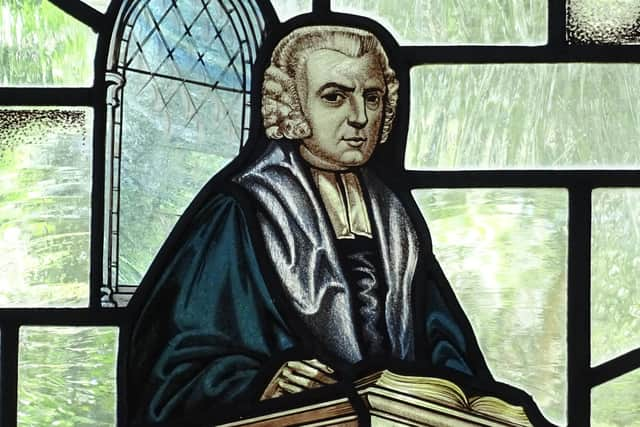

The following epitaph once hung in St. Mary Woolnoth in London and serves as a very useful introduction to the man.
JOHN NEWTON, Clerk
Once an infidel and libertine
A servant of slaves in Africa,
Was, by the rich mercy of our Lord and Saviour
JESUS CHRIST,
Restored, pardoned, and appointed to preach
The Gospel which he had long laboured to destroy.
He ministered,
Near sixteen years in Olney in Bucks,
And twenty-eight years in this Church.
John Newton was born in 1725. His father was a stern and aloof sea captain but his mother was kindly and Godly woman who taught her son the importance of the Scriptures. Unfortunately, she died two weeks before John’s seventh birthday.
Nevertheless, she left her son an abiding legacy. Newton ‘often saw the necessity of religion, as a means of escaping hell’ but conceded that he ‘loved sin’ and was ‘unwilling to forsake it’.
He went to sea as a lad, was flogged by the Royal Navy for desertion and lived as a white slave in Africa. Escaping, he worked for six years as the master of a slave ship.
As noted above, he came to faith in 1748. Returning to England aboard the slave trading ship Greyhound, the ship and crew encountered a severe storm, which threatened to overwhelm them. Newton awoke in the middle of the night and, as the vessel filled with water, prayed for God’s mercy and said the Lord’s Prayer.
The ship eventually found shelter in Lough Swilly but Newton does not record the name of the village where Greyhound found safe harbour but it was in easy reach of Londonderry where John Newton stayed. The village carpenters worked for five weeks to repair and refit the ship.
Newton had another miraculous escape during this period which gave him further food for thought. Having been invited to join a shooting party by the mayor of Londonderry, he was climbing a bank when the fowling piece he was carrying discharged near his face destroying a corner of his hat.
These experiences marked the beginning of his conversion to evangelical Christianity. Thereafter he avoided profanity, gambling, and drinking but he continued to participate in the slave trade for several more years.
He would later say, however, that his true heart conversion did not happen until sometime later: ‘I cannot consider myself to have been a believer (in the full sense of the word) till a considerable time afterwards.’
Following his retirement from the sea, Newton became Surveyor of the Tides in Liverpool, during which time he studied Greek, Hebrew and Theology. He took Holy Orders in the Church of England in 1764. That same year he published ‘An Authentic Narrative’, a record of his experiences and adventures.
He accepted the curacy of Olney, where he lived until 1780 when he became rector of St Mary Woolnoth in London. The church, designed by Nicholas Hawksmoor, is located on the corner of Lombard Street and King William Street and is close to both the Bank of England and the Royal Exchange. Newton’s preaching there attracted huge crowds, and he exercised great influence.
‘Amazing Grace’ was not immediately popular or well known. It was in America that it became established. The Americans did two things for the hymn which contributed enormously to its popularity. First, they set it to the tune of an old plantation melody entitled ‘Loving Lambs’, the tune which we now know as ‘Amazing Grace’. Secondly, they replaced Newton’s final verse with another verse beginning ‘When we’ve been there ten thousand years’. This was the final verse of the anonymous hymn ‘O Jerusalem, my happy home’ which appeared in ‘A Collection of Sacred Ballads’ (1790), compiled by Richard and Andrew Broaddus.
Newton has been criticised for continuing to participate in the slave trade while, at the same time, espousing Christian convictions. For example, in his book, ‘The Isles’ (Oxford, 1999), the historian Norman Davies accuses Newton of ‘horrendous hypocrisy’.
In 1779, Newton began to feel the pangs of conscience, or at least write about them in his diary for the first time. Nine years later, during his time as the rector at St Mary’s in Woolnoth, he acknowledged the evils of slavery and his own sin in promoting the trade.
After what he felt was his true conversion to Christianity, Newton came to regret deeply and repent of his personal involvement in the slave trade.
He joined William Wilberforce in the campaign for abolition. Indeed, he played a significant role in persuading Wilberforce not to abandon his career in the House of Commons.
When Wilberforce wondered whether it was possible to serve God and one's nation in parliament and whether the two might be mutually exclusive, he consulted Newton. Newton advised Wilberforce: ‘God has raised you up for the good of the church and the good of the nation, maintain your friendship with Pitt [the Prime Minister and a friend since their days at Cambridge together], continue in Parliament, who knows that but for such a time as this God has brought you into public life and has a purpose for you’.
In 1787 Newton wrote a tract supporting the campaign, ‘Thoughts Upon the African Slave Trade’. He lived to see the abolition of the slave trade in the British Empire. Only weeks before he died on December 21 1807 John Newton said: ‘My memory is nearly gone, but I remember two things: I am a great sinner and that Christ is a great Saviour’.