
Jonny McCambridge: The maths problems and the problem with maths - stumped by algebra
Are you sitting comfortably? Then let's start with an easy one – 3xy+6x.
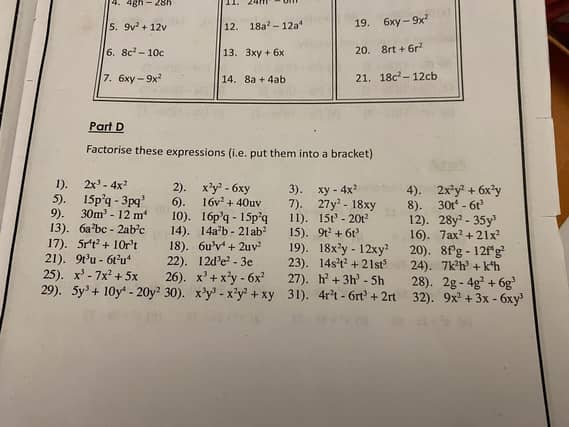

OK, so you need a little bit of additional information? The instruction is to factorise the expression (ie, put them into a bracket).
Still no good? Let's try something different.
8(x+6)=-2(3x+4).
On this occasion, find the value of x.
It's alright if you need a bit of time.
Feel free to use pen and paper.
There's no rush, I've got all day…..
Do you give up? That makes two of us.
While these mathematical conundrums may seem impenetrable, I have to assume they are quite basic. I know this because I have not borrowed them from some advanced academic textbook, but instead from my son's homework.
I said I was starting with an easy one and I meant it (relatively speaking). I had wanted to reproduce a more complicated example here but the vast majority of the mathematical problems in his schoolbooks include numbers or letters which are squared, cubed or greater, and I have no idea how to reproduce the tiny little 2, 3, or 4s that signals these operations on a keyboard. Have a look at some of the more advanced questions on the photograph above for an example.
It is getting late on Wednesday and the maths homework has to be in by Thursday. Yes, you can advance the argument (and I have) that we should not leave these things to the last minute, but we are where we are.
There are no less than 49 mathematical 'expressions' to be completed. We've been at the first one for around 20 minutes and I'm not any closer to finding a solution. It's not so much that I don’t know the answer (though clearly I don't), more that I don’t know how to begin searching for it.
I look at my son. He shrugs his shoulders. He looks at me. I shrug my shoulders. I chew the top of a pen as I scan the long list of unsolved problems. They become more complicated further down the page and we're hopelessly stuck on the first one. I try my old trusty method of Googling the answer, but the little phone responds with a series of lines of indecipherable numbers and equations, before an advert asking me to buy a pair of high heel shoes fills the screen.
I sigh deeply. It is going to be a long night.
I was around the age that my son is now when I think I first worked out that maths was not going to be my calling. While I had perfectly adequate mental arithmetic skills and could work out percentages, factors and decimals, once we got into equations which involved symbols rather than numbers, I tended to get mixed up. Geometry was all Greek to me, I had a poor relationship with trigonometry and the best that could be said about probability was that I quickly grasped it was probable I would never be very good at it.
I look at it as one of the first points of significance in the journey from adolescence to adulthood, when I turned my face away from mathematics and science and set my course in the direction of the arts. This is not to suggest that I was very good at English or history, merely that those studies did not make me feel hopelessly lost.
I have never been the type of person who argues that maths has no use in everyday life. I know that I employ maths hundreds of times every day. The simple task of writing this column is controlled and determined by the word count which is needed to fill the page. When I cook dinner, there are timings and calculations required to bring all the different elements to the table at the one time. The constant struggle to balance how much I extravagantly spend each month with the meagre amount that I earn is all maths.
I suppose where I struggle is understanding the relevant practical applications of more advanced mathematics. I know that algebra was vital in ways I could never hope to understand in the construction of the ancient pyramids or in landing a man on the moon, but how does it assist me in getting through the day?
I am intrigued by this question so I Google 'How is algebra used in everyday life?' The AI inspired answer responds immediately.
'Algebra is used in real life for personal finance, like creating budgets and calculating loan payments, as well as for everyday tasks like cooking and measuring.'
Now, I cook every day. I am quite familiar with processes such as chopping, kneading, roasting, basting or spreading. If there is algebra present in my kitchen I have not yet discovered it at the back of the cupboard.
I look at my son who is still struggling with the homework. I see the strain of concentration on his face and it breaks my heart a little. The truth is that, like his daddy, maths will just never be his thing. It is a few years away but I am already conscious of the challenge of getting him through a maths GCSE, just so he can then forget all about it afterwards and concentrate on studying things he is actually good at.
I look again at the first problem. I write a few numbers down and think hard until I come up with a possible solution. The problem is, I have no idea if it is right.
We move onto the second one. I use the same method, there seems to be some logic to it. I show it to my son and soon he is motoring down the list of sums on the page. Some time later in the evening we finish the homework.
It is, I suppose, possible that we've found the correct answers to all 49 problems. It is just as likely that they are all wrong. We'll see.