
L S Lowry, the deeply private painter who chronicled England’s industrial north
In 1922 the art critic of the Westminster Gazette described William Conor as ‘the delineator of Ulster industrialism’.
L S Lowry fulfilled the same function for the environs of Salford and Pendlebury in Greater Manchester. His ambition was ‘to put the industrial scene on the map because nobody had seriously done it before’.
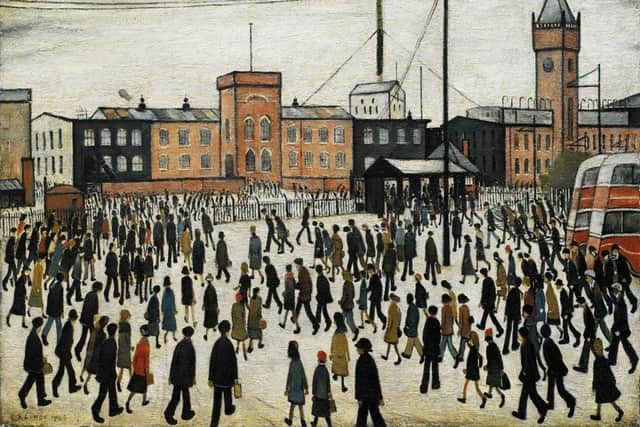

Through his bleak urban industrial landscapes peopled with ‘matchstick’ men, women and children Lowry captured the poverty and drudgery that characterised life in the industrial north of England.
When Angela Barratt, a young journalist and admirer of his work who conducted as many as 15 extensive interviews with him in the early 1970s, paid tribute to him for putting the ‘industrial scene on the map [with] these wonderful paintings’, Lowry replied modestly: ‘That’s very nice of you. Thank you for that.’

Laurence Stephen Lowry was born on November 1 1887 in Stretford.
Lowry's grandfather Frederick Lowry had moved as a boy from Ulster in 1826 and finally settled in Manchester where he built up a career as an estate agent.
His father Robert, a quiet man who was at his most comfortable fading into the background as an unobtrusive presence, worked as a clerk for the Jacob Earnshaw and Son Property Company. Such affection as the young Laurence Stephen Lowry received came from his father.
He had a complex relationship with his cultured and talented but sickly mother, Elizabeth. She was a frustrated concert pianist who was both a dominant influence and a source of emotional strain. She had exacting high standards and was intolerant of failure.
After his father’s death in 1932, Lowry became her primary caregiver until her death in 1939, a role that left him feeling isolated and unfulfilled. He always regarded himself as a failure because his mother told him so.
Downward social mobility had forced the family to move in 1909 from leafy Victoria Park in Manchester to industrial and working-class Pendlebury which was to prove to be the source of much of his artistic inspiration.
Although he initially disliked Pendlebury: ‘Here the landscape comprised textile mills and factory chimneys rather than trees. At first, I detested it and after years I got pretty interested in it, then obsessed by it.’
Lowry’s appreciation was transformed by pure chance when he witnessed the changing of shifts at Acme Mill: ‘One day I missed a train from Pendlebury – [a place] I had ignored for seven years – and as I left the station I saw the Acme Spinning Company's mill… The huge black framework of rows of yellow-lit windows standing up against the sad, damp charged afternoon sky. The mill was turning out… I watched this scene – which I'd looked at many times without seeing – with rapture…’
After he left school he became a rent collector at the Pall Mall Company, a position which required him to walk the industrial streets of Manchester and Salford daily. He used his free time, in the evening or a spare hour at lunch, to take lessons in freehand drawing to hone his craft. By 1905 he had secured a place at the Manchester School of Art.
He was fortunate enough to study under French Impressionist Pierre Adolph Valette. Lowry later admitted: ‘I cannot overestimate his effect on me’. Valette enabled him to see the world through new eyes with artistic ideals from Paris.
In 1915 his studies took him to Salford to the Royal Technical Institute where he would develop as an artist for a further 10 years. During this time, his focus on industrial urban landscapes allowed him to amass his own portfolio which gained a distinctive style and artistic approach.
As we have demonstrated, Lowry was not a self-taught artist. His painting was not confined to ‘matchstick’ people and bleak mills and factories. He was an accomplished portraiture and landscape (seascape) artist. Self-Portrait (1925) is regarded as the definitive early self-portrait and is often reproduced as a print.
Lowry frequently depicted solitary, enigmatic young women, Portrait of Ann (1957) being a notable example.
He had a life-long fascination with the sea and painted his seascapes while holidaying in Lytham St Annes, Rhyl, Sunderland and Berwick-upon-Tweed.
His response to those who called him ‘a Sunday painter’, was simple: ‘I'm a Sunday painter who paints every day of the week.’
During his life Lowry produced about 1,000 paintings and over 8,000 drawings.
Lowry's work is held in many public and private collections. The largest collection is held by Salford City Council and displayed at The Lowry. Its collection has about 400 works.
The Tate Gallery in London owns 23 works.
He was not a political painter or, if he was, it was entirely in spite of himself. He denied being a communist or a socialist or even a social reformer. He shocked Angela Barratt by telling her that he was ‘an out and out conservative’ but when Barrett admitted that she was a socialist, he replied, ‘Well, I'll forgive yer.’
It is difficult to believe that he did not have respect and affection for the people whose lives he depicted on canvas. His identification with the North of England was total. He told Barrett, ‘I don't like the South of England. No guts in it. Horrible place’.
Lowry was convinced his paintings would be worthless after his death.
Although he had enjoyed some success in his final years, surely he could never have imagined he would become one of the best-loved British artists of the 20th century or that his paintings would sell for millions of pounds.
Going to the Match, his 1953 painting of crowds of spectators streaming into Burnden Park, the then home of Bolton Wanderers, sold for £7.8m in 2022. (Although a Manchester City fan, he always had a soft spot for Bolton Wanderers.)
A few months after Lowry’s death on February 23, 1976, the Royal Academy held a massive retrospective of his work. It broke attendance records for a 20th-century artist at the time, attracting perhaps as many as 350,000 visitors and prompting queues down the street.
Lowry turned down a knighthood in 1968, along with four other honours between 1955 and 1976, because he was a deeply private person who despised social distinction and did not want his status or lifestyle changed. He told Labour Prime Minister Harold Wilson, ‘All my life I have felt most strongly against social distinction of any kind’.