
Lasting legacy of King James VI and I was his Authorised Version of Bible
This year marks the 400th anniversary of the death of King James VI and I. The greatest legacy of his reign was the Authorised Version of the Bible or the King James Bible as it is still known on the other side of the Atlantic.
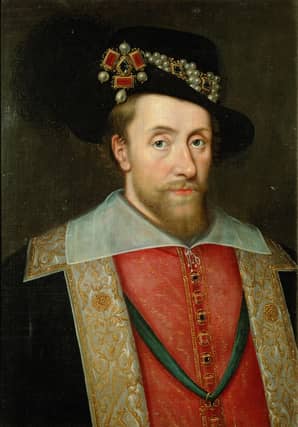

In March 1603 the English monarchy passed smoothly from the Tudors to the Stuarts. On April 5 James VI and I left Edinburgh for Westminster. His progress south was greeted with great enthusiasm which he always fondly remembered.
On James’s way south, one thousand Puritan ministers – in the so-called ‘Millenary Petition’ – petitioned their new monarch to reform the Church of England. They wished for freedom not to wear surplices, to dispense with the sign of the cross in the baptism service, and for steps be taken to ensure an effective and resident clergy.
The petitioners hailed James as ‘our physician to heal these diseases’. In response, James, who enjoyed theological debate, agreed to summon a conference of leading Puritans and selected bishops at Hampton Court Palace.
The conference convened there in January 1604. Assuming that James had Presbyterian sympathies, having been raised in that tradition, the bishops were nervous. Unaware of James’ deep-seated antipathy to Presbyterianism, the Puritans, on the other hand, viewed the future with optimism.
James’ distaste for Presbyterianism was the product of being surrounded by Presbyterians who did not share his exalted concept of kingship. George Buchanan, a Scottish intellectual of European stature and James’ own tutor, regarded the deposition of wicked kings perfectly legitimate.
In 1596 Andrew Melville did not mince his words with James when he told his monarch: ‘I mon tell yow, thair is twa Kings and twa Kingdomes in Scotland. Thair is Chryst Jesus the King and his Kingdome the Kirk, whase subject King James the Saxt is, and of whase kingdome nocht a king nor a lord nor a heid, bot a member.’
In the light of this experience, James was resolute in his opposition to any change in the episcopal form of church government. James told Dr John Reynolds, a leading Puritan and the president of Corpus Christi College, Oxford: ‘If you aim at a Scots Presbytery, it agreeth as well with monarchie as God and the devil!’
While James rejected most of the demands of the Puritans, he gave the Puritans a much more sympathetic hearing than is commonly appreciated and he was on occasion critical of the bishops.
When Dr Reynolds proposed that there should be a new translation of the Bible, although a majority of those present were not favourably disposed to the idea, James agreed.
Admittedly, James and Reynolds had differing motives. Reynolds wished to displace the Bishops’ Bible of 1568 while James was anxious to displace the widely used and Puritan Geneva Bible of 1560. James had a special antipathy for the Geneva Bible’s marginal notes which he regarded as subversive and less than respectful of monarchy.
The Geneva Bible came interleaved with numerous explanatory notes, many of them explicitly anti-royalist. For example: the word ‘tyrant’ which is not to be found in the Authorised Version, occurs over 400 times in the Geneva version.
James took umbrage at the marginal notes to two passages in the Geneva translation. He objected to the note to Exodus 1:17 commending the civil disobedience displayed by the Hebrew midwives and the note to II Chronicles:15:16 criticising King Asa for not having executed Queen Maachah, his idolatorous grandmother.
James’ sensitivity on the latter subject is more readily appreciated if one recalls that James’s mother was Mary, Queen of Scots, who could be viewed as an idolator and was executed by Queen Elizabeth I in 1587.
The Conference passed a resolution to produce a new translation from the original Hebrew and Greek, without marginal notes, for the use of all the churches in England. This decision was undoubtedly by far the most important result of the Hampton Court Conference.
By June 30 1604, King James, who was keenly interested in the project, had approved a list – drawn up by Archbishop Bancroft of Canterbury – of 54 of the best Hebrew and Greek scholars to undertake the work, although only 47 actually participated in the project.
The scholars were organised into six companies, two each working separately at Westminster, Oxford, and Cambridge, on sections of the Bible assigned to them. The Old Testament was allocated to three companies, the New Testament to two companies and the Apocrypha to one.
The work commenced in 1607. The scholars received no remuneration for their work and completed their task in two years.
When each group completed its task, its work was submitted to 12 men, two from each company, to curb individual preferences and to ensure its scholarly and non-partisan character. This review and revision took a further nine months.
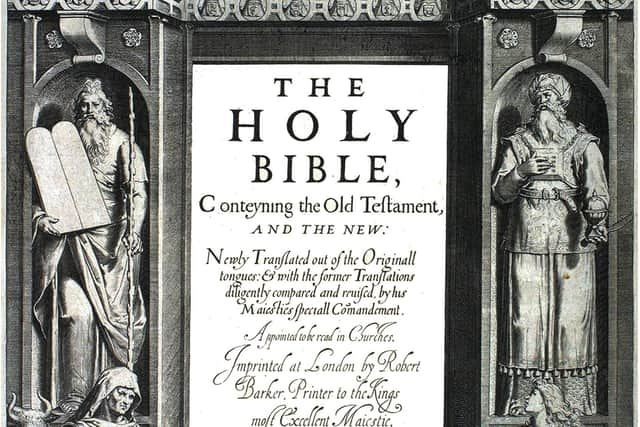
The Authorised Version was finally published in 1611. The title page of the Authorised Version described it as ‘newly translated out of the original tongues’ and as ‘appointed to be read in churches’. Neither assertion was strictly true. With respect to the first claim, while paying close attention to the Hebrew and Greek, the new Bible was essentially a revision of existing English translations, notably the Bishops’ Bible and the Geneva Bible. With respect to the second claim, the King, Parliament or the Church never officially sanctioned it.
The Authorised Version did not secure immediate or universal acceptance. It took almost 50 years to displace the Geneva Bible in popular favour. However, thereafter, the Authorised Version held unchallenged sway for 250 years. Few would quibble with Lord Macaulay’s assessment of the literary quality of the translation: ‘The English Bible, a book which, if everything else in our language should perish, would alone suffice to show the whole extent of its beauty and power.’
Winston Churchill, a master practitioner of English prose, observed: ‘The scholars who produced this masterpiece are mostly unknown and unremembered. But they forged an enduring link, literary and religious, between the English-speaking people of the world.’
In 1968 Geddes MacGregor, the Glasgow-born scholar and theologian, described it as ‘the most influential version of the most influential book in the world, in what is now its most influential language’.
Since then, it has been increasingly displaced by modern versions, principally the New International Version (1973), the New Revised Standard Version (1989), and the English Standard Version (2001).