
Letitia Dunbar-Harrison, the Protestant librarian unwittingly mired in 1930s controversy over her religion
Some people strive to leave their mark on history. Others wish only to live quiet, peaceable and useful lives without drawing attention to themselves. Letitia Dunbar-Harrison had no desire to even be a footnote to history, let alone to be mired in controversy.
Letitia Elizabeth Eileen Dunbar was born on February 4 1906 into a Church of Ireland family in Dundrum, Co Dublin.
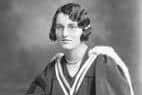

Shortly after her birth her parents and siblings emigrated to America. Letitia stayed in Dublin and was raised by her childless maternal aunt, Edith Elizabeth Harrison, and her husband. As a child she was known as Harrison but around 1930 she hyphenated her foster-parents’ name with her own.
An extremely able student, she won a constant stream of prizes and distinctions at both Alexandra College and Trinity College, Dublin, and graduated with honours in modern literatures (French and Spanish).
She then took a six-month library course at Dublin County Library, followed by nine months in charge of the children's library at Rathmines and attended a further course in library studies at UCD.
Despite not possessing requisite command of the Irish language, in 1930 the Local Appointments Commission appointed her county librarian of Mayo ahead of more than 100 other applicants. The relevant legislation allowed her three years to meet the language requirement. Given her linguistic prowess, she almost certainly could have acquired the necessary level of proficiency within that timescale.
The appointment provoked stiff resistance in Mayo. The County Council's library committee refused to accept the appointment. A special meeting of the County Council in December 1930 also decided by a vote of 21-6 not to accept the appointment. On January 1 1931 the council was dissolved and replaced by a commissioner who promptly confirmed Dunbar-Harrison's appointment.
Although opposition initially focused on Dunbar-Harrison’s lack of proficiency in Irish, this was essentially a fig leaf. The crux of the matter was that – in the words of J J Lee in ‘Ireland, 1912-1985: Politics and Society’ – she ‘suffered from the dual stigma of being a Protestant and a graduate of Trinity College, Dublin’.
Monsignor D’Alton, the Roman Catholic dean of Tuam, and others said so explicitly.
D’Alton, a member of the library committee, stated: The only outstanding qualification she has is that she is a Protestant and was educated in Trinity College. Are these not peculiar qualifications for a [Roman] Catholic county like Mayo? Ninety-nine per cent of the people of Mayo are [Roman] Catholic’.
J T Morahan claimed: ‘Trinity culture is not the culture of the Gael; rather it is poison gas to the kindly Celtic people.’
Father Timothy Corcoran SJ, a leading Roman Catholic and nationalist polemicist and fanatical Irish language enthusiast (who knew no Irish), claimed that the episode was proof that W T Cosgrave’s government were stooges of Freemason job-hunters, 'fished out of the Elizabethan cess-pool' (by which he meant TCD) whom they were appeasing in order to stay in power with Protestant votes. He also believed that Protestants should be excluded from public positions that might endanger the faith of Roman Catholics.
Éamon de Valera, the Fianna Fáil leader and leader of the opposition, in a debate in the Dáil endorsed that view: ‘I say that if I had a vote on a local body, and if there were two qualified people who had to deal with a Catholic community, and if one was a Catholic and the other a Protestant, I would unhesitatingly vote for the Catholic.
‘Let us be clear and let us know where we are ... If this librarian were simply a sort of clerk, who attended to somebody who came in and handed out a book which that person asked for, then I would not have any hesitation in saying that it was not an educational position, and that there was no reason whatever for introducing religion in that case ... the people of Mayo, in a county where, I think – I forget the figures – over 98 per cent of the population is Catholic, are justified in insisting upon a Catholic librarian.’
This stance was tantamount to excluding Protestants from other positions too, such as dispensary doctors.
While Miss Dunbar-Harrison found the inhabitants of Castlebar friendly and courteous and that they made it clear that they had nothing against her personally, they insisted that she was unsuitable for the role of county librarian. Some even acknowledged that she was 'a refined and cultivated young lady'.
Almost all the local libraries in the county boycotted the new librarian and an impasse between central and local government ensued.
To defuse a situation which was spiralling out of control, a face-saving accommodation was reached between the Roman Catholic bishop of Tuam and W T Cosgrave whereby Letitia Dunbar-Harrison was transferred to the Department of Defence library in Dublin in January 1932.
In June 1932 she married Robert Crawford, a Methodist minister whom she had met in Castlebar. On her marriage she resigned from the public service (as then required by law) and was subsequently known as Aileen Crawford.
As Methodist ministers moved from place to place after six-year terms, the Crawfords lived and served in Waterford, Dundalk, Adare, and Roscrea before moving to Whitehead where Robert died in April 1954.
As a widow, Aileen Crawford stayed in Northern Ireland and settled in Belfast where, after qualifying as an accredited local preacher, she became the first woman to apply for ordination in the Methodist Church.
After she failed one of the required examinations, the Methodist Church decided in 1955 that while there were no theological reasons for excluding women from the ministry, they could not be ordained for practical reasons. (The Methodist Church began to ordain women in 1978.)
Aileen Crawford was extremely active in and loyal to Irish Methodism. She was secretary, and subsequently president, of the Irish Methodist Women's Association between 1945 and 1962 and played a leading role in 'meals on wheels' and the social services provided by University Road Methodist Church, Belfast.
She died in Belfast on October 12 1994. She did not choose to write about her unfortunate experiences in Mayo. In a RTE documentary in 2009 a niece described her aunt as ‘a woman ahead of her time’.