
Margaret Thatcher’s march into history books started 50 years ago when she became leader of the Conservative Party
This year marks two significant anniversaries in the life of Margaret Thatcher. She was born on October 13 1925 and on February 11 1975 she became the first woman to lead the Conservative and Unionist Party or any major British party.
Edward Heath, her predecessor, had led the party in four general elections, loosing three of them. While he might have been forgiven for losing in 1966 on the grounds that he had only become party leader eight months earlier and had insufficient time to establish himself, he certainly was not forgiven for defeat in February 1974 – when he called a wholly unnecessary election in response to the miners’ strike and lost his majority in the House of Commons – and the rerun in October 1974 in which he failed to overturn the February result. Conservatives hate being in opposition and believe there is something seriously wrong with a leader who cannot deliver electoral success.
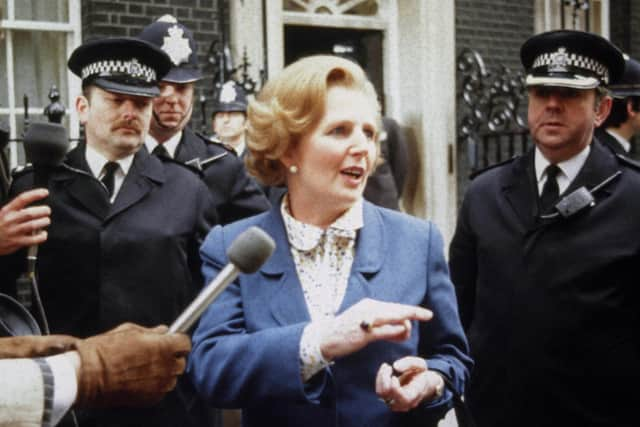

Heath’s vulnerability was compounded by his aloofness and lack of social skills. He had a poor rapport with his MPs who then constituted the electoral college in any leadership contest. Skilfully organised by Airey Neave, Mrs Thatcher’s astute campaign manager, the peasants revolted and deposed Heath.
To the astonishment of the media, in the first ballot on February 4 Mrs Thatcher polled 130 votes and Heath 119. Heath withdrew and William Whitelaw, Jim Prior, Geoffrey Howe and John Peyton entered the fray but in the second ballot Mrs Thatcher polled 146 votes. She won by a greater margin than the rules required and with more votes than even Neave had anticipated.
Conservative grandees thought ‘the party had taken leave of its senses’ and that ‘she wouldn’t survive to Christmas’. In this they were mistaken because she was to lead the party for almost 15 years, 11 of them as prime minister and win three successive general elections – a feat unrivalled since Lord Liverpool’s premiership in the early 19th century.
When she ceased to be prime minister in 1990 only Salisbury and Gladstone in modern British politics had spent longer in 10 Downing Street but they required three and four separate premierships respectively to do so.
What had Conservative MPs voted for? They had voted for change and a repudiation of Heath. Beyond that it is difficult to say because her political ideas were far from fully developed. Her political thinking was substantially shaped and refined between 1975 and 1979.
Alfred Sherman, a former Marxist intellectual and convert to Conservatism who was an extremely influential figure behind the scenes, thought, ‘She wasn’t a woman of ideas, she was a woman of beliefs, and beliefs are better than ideas’.
She proceeded cautiously and surrounded herself with like-minded advisors and consulted various think-tanks, notably the Centre for Policy Studies which she, Sir Keith Joseph and Sherman had co-founded in 1974.
In an essay in ‘Conservative Century’, published in 1994, Anthony Seldon explained: ‘The Thatcher experiment was motivated at least as much by hunger for office as by ideology: scholarly attention has focused too much on the intellectual roots of “Thatcherism” and too little on its pragmatism and adaption to the rightward and anti-statist movement of public opinion.’
The Conservative manifesto in 1979 was entitled ‘Time for a change’. In a foreword, Mrs Thatcher claimed that the election was perhaps ‘the last chance’ to restore the proper balance between the state and the individual.
Conservative electoral strategists recognised that it was not only the highest taxpayers who favoured lower taxation and that a large proportion of the electorate was increasingly happy to opt out of parts of the welfare state. They also recognised the appeal of selling off council houses at half price to large swathes of the electorate but beyond that there was little or nothing in the Conservative manifesto about privatisation or the widespread deregulation of industry.
In October 1978, it looked as if Jim Callaghan was going to call an early election, one which he had a decent chance of winning because the economy was in better shape than it had been and the Labour government had recovered some of its popularity.
With the benefit of hindsight, Callaghan unwisely decided against calling an election because he expected another round of pay policy to demonstrate the success of his economic strategy but his government was derailed by ‘the Winter of Discontent’.
Callaghan had hoped to keep public sector pay settlements below 5% but tanker drivers secured a 14% pay rise, driving a horse and cart through the policy.
By the end of January 1979, water and sewerage workers, ambulance drivers and dustmen were all engaged in highly visible and disruptive industrial action. The trades unions were busily undermining a Labour government, just as the National Union of Miners had brought down Heath’s government in February 1974.
On March 28 the Callaghan government lost a vote of confidence, the first time this had happened since 1924. Parliament was dissolved on April 7 and the election took place on May 3.
Mrs Thatcher blamed Callaghan for ‘the Winter of Discontent’, reminding the electorate how close the country ‘came to being governed by picket’ since 1974.
Furthermore, she revelled in being labelled ‘the Iron Lady’ by the Soviet Union after a strongly anti-Communist speech in 1977.
From the outset, a Conservative victory seemed a foregone conclusion because the party was running 10 points ahead of Labour in the opinion polls. The fly in the ointment, from a Conservative perspective, was their leader’s personal unpopularity compared to the avuncular Callaghan.
Mrs Thatcher proved to be an energetic campaigner, undertaking a punishing schedule of walkabouts, factory visits, radio phone-ins, house meetings and speeches.
Virtually running her campaign team into the ground, she gave it everything she had because she was convinced that she would get only one chance, the Conservative Party being, as we have already noted, unforgiving of failure.
In the event she secured a majority of 44. Labour’s share of the vote slumped to 36.9%. The Tories took a 43.9% share with a swing of 5.2%, the largest since 1945.