
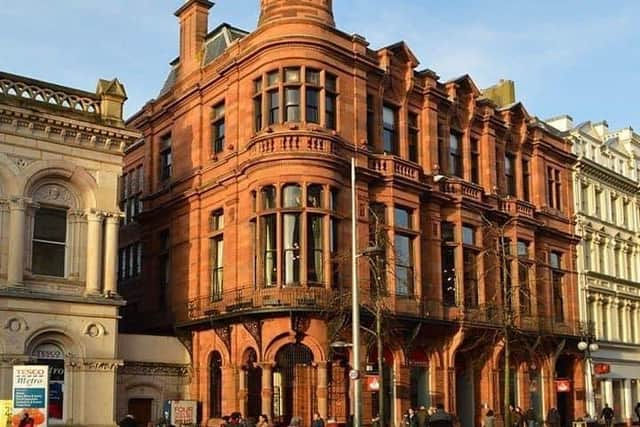
Opening of Reform Club in Belfast in 1885 was a high point for Ulster Liberal politics
The period between 1868 and 1885 witnessed a gradual erosion of the Conservative Party’s hegemony in Ulster politics and the steady advance of the Liberal Party.
In the general election of 1865 the Conservatives won 27 of the 29 parliamentary seats in Ulster, the Liberals won two. In the general election of 1868 the Liberals doubled their representation and won one of the Belfast seats for the first time since 1837, reducing the Conservative tally to 25.

In 1874 the Liberals lost their two seats in Co Cavan to the Home Rule Party but won six elsewhere. The Conservatives won 21 seats.
The 1880 general election proved to be the high-water mark of the Liberal advance. The Ulster Liberals raised their tally of MPs to nine, reducing the Tories to only 18.
The Liberal advance was based on the party’s platform of support for tenant right and greater parliamentary democracy which appealed to an alliance of Presbyterian and Roman Catholic tenant farmers and voters. In this era the Conservative Party was viewed as the party of the Church of Ireland and landlordism.
In May 1880 cock-a-hoop prominent Ulster Liberals met in Lombard Street to consider ways of improving party organisation in Ulster. The meeting was addressed by B L Green, secretary of the Manchester Reform Club, which had been established in 1867 as a gentlemen’s club for Liberal politicians and supporters in the Manchester area. In 1871 it moved into elegant purpose-built premises on King Street, designed by the architect Edward Salomons.
Ulster Liberals believed that their cause would be advanced by the formation of a similar club which ‘would bring together men of position and influence in the province’.
A committee of 11 drew up a plan to form a limited liability company to construct a building for the club which would have 300 members, based on an entry fee of 10 guineas and an annual subscription of five guineas for Belfast members and three for country members.
An alternative (and possibly politically more astute) scheme to have a larger membership and a cheaper subscription fell on deaf ears.
A suitable site on Royal Avenue was acquired and Maxwell & Tuke of Manchester won the competition to design the building. The building contract was awarded to James Henry of Crumlin Road, Belfast. Work was well advanced by early 1884 and a membership list was opened.
On June 12 287 members attended a general meeting. Prominent businessmen (such as W J Pirrie, Edward Hughes and Adam Duffin) were well represented as were professional men (like Alexander Caruth and C H Brett) but there were very few tenant farmers (like Samuel Black from Randalstown). The club’s social exclusivity impaired its effectiveness as a meaningful central and electoral organisation.
Although plans for a formal opening were postponed because of problems in obtaining a suitably prominent Liberal to perform the ceremony, the club opened its doors for business on January 1 1885.
On November 4 the Marquess of Hartington formally opened the club, the occasion being marked by a lavish banquet. Hartington was the heir to the 7th Duke of Devonshire, succeeding to the title in 1891, and probably has the unique distinction of being the only politician to decline to become prime minister on three occasions. He owed his position in the party and the country to his obvious integrity rather than his brilliance. (While he was not the model for the Duke of Omnium, the father of Plantagenet Palliser, in Trollope’s Palliser novels, he would have been perfect for the role.)
In his after-dinner speech Hartington expressed his opposition to ‘any project of Home Rule’.
Within weeks, on December 17, in an interview Herbert Gladstone stunned the political world with the revelation that his father W E Gladstone had become a convert to Home Rule for Ireland. Whether Herbert Gladstone had made a premature disclosure or was flying a kite – the so-called ‘Hawarden kite’ – for his father still remains unclear.
Despite their attachment to the Union, Presbyterian Liberals were slow to abandon Gladstone because of their gratitude for his disestablishment of the Church of Ireland and his two land acts of 1870 and 1881. They were reluctant to accept Lord Randolph Churchill’s characterisation of their highly esteemed leader as ‘an old man in a hurry’, not least because Lord Randolph was so obviously a young man in a hurry.
However, when Gladstone’s embrace of home rule was placed beyond all reasonable doubt with the introduction of his first Home Rule bill in the House of Commons on April 8 1886, Thomas Sinclair, who was to emerge as the leading exponent of Liberal Unionism, that same month forcefully enunciated the liberal unionist viewpoint:
‘We shall show the world that come what may Ulster will never consent to yield up her citizenship, or be expelled from the Imperial Parliament to be degraded to a junior partnership in a subordinate colony.'
On April 13 Ulster Conservatives and very unhappy Liberals met in the Ulster Hall to pass resolutions against Home Rule and on June 4 an Ulster Liberal Unionist Committee was established.
Writing about the revolutions of 1848 in ‘The Course of German History’ (1945), A J P Taylor memorably observed: ‘German history reached its turning-point and failed to turn’.
Sometimes history seems to be moving inexorably one direction and suddenly takes off in a completely different one. Perhaps this is why wise historians stick to interpreting the past and leave predicting the future to astrologers.
Perhaps in 1885 and 1886 Ulster had reached a turning point but likewise failed to turn. A potential future Liberal Ulster was derailed by Gladstone’s conversion to Home Rule and the decision of the Home Rule Party to contest a broad swathe of Ulster constituencies for the first time.
The latter resulted in the defection of Roman Catholic voters from the Liberal Party (a development which had occurred in the rest of Ireland in 1874) and the split in Liberalism between Gladstonian Liberals (who supported Home Rule) and Liberal Unionists (who opposed Home Rule) seriously weakened the Presbyterian component of the Ulster Liberal Party.