
Poor, orphaned, and with little education, but Ernest Bevin was a political titan of the first half of the 20th century
In 2020 Lord Adonis subtitled his biography of Ernest Bevin ‘Labour’s Churchill’. Although Churchill and Bevin came from totally different backgrounds, had different interests and were on opposite sides during the General Strike, their admiration was mutual and genuine. Churchill even described Bevin as ’the most distinguished man that the Labour Party has thrown up in my time’.
Plain-spoken, pragmatic, and often blunt, Bevin’s innate intelligence, tremendous work ethic, and strong leadership skills made him one of the most influential political figures of the first half of the 20th century.
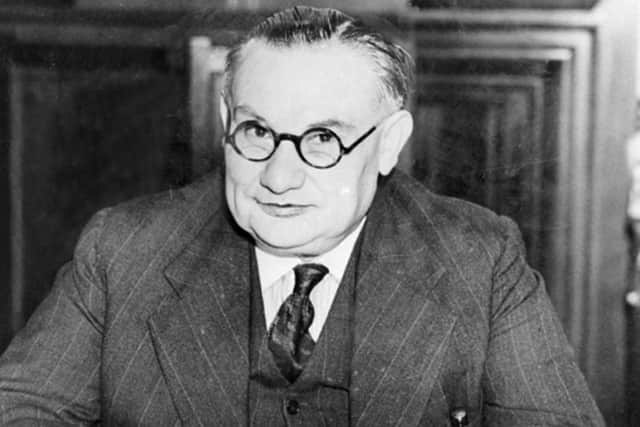

Born on March 9 1881 in Somerset, Bevin grew up in rural poverty, received little formal education and was orphaned at the age of eight.
He began work at 11 in the Bristol docks but soon exhibited a remarkable gift for organisation. He became involved in the Dockers' Union and was instrumental in the creation of the Transport and General Workers Union, of which he became general secretary in 1922.
This was an incredible achievement, given that it required bringing together and organising men and women from an enormous range of different jobs into a single, integrated union.
Initially Bevin had limited faith in parliamentary politics but had been a member of the Labour Party since its formation, and had unsuccessfully contested Bristol Central in the 1918 general election.
Although not an MP in the inter-war years, Bevin was a key figure in shaping the Labour Party’s strategy and ideology and was responsible for ensuring that the claims of organised labour were central to the ethos and policies of the party.
As a trade unionist, Bevin believed in obtaining material benefits for his members through direct negotiations and viewed strike action as a last resort. Accurately gauging its prospects of success, he had no enthusiasm for the General Strike.
Bevin’s strong antipathy to communists and communism was a legacy of this period. He regarded communists as ‘workshy intellectuals’ whose attempts to infiltrate trade unions had to be strenuously resisted.
His powerful speech at the 1935 party conference ousted veteran pacifist George Lansbury from the leadership of the party and secured his replacement with Clement Attlee. Unlike many Labour activists in the 1930s, he was a vigorous advocate of rearmament and opposition to fascism.
In 1940 Bevin was appointed minister of labour and national service by Winston Churchill in the wartime coalition government, and he shortly afterwards became MP for Central Wandsworth. This proved to be one of Churchill's most inspired appointments. Bevin succeeded in transforming the UK into a total war economy, mobilising a higher proportion of its population than totalitarian Germany.
In 1945, Bevin became foreign secretary in Attlee's Labour government. Attlee was originally minded to appoint Bevin chancellor of the exchequer and Hugh Dalton foreign secretary but he changed his mind – partially through the influence of King George VI who disliked Dalton – and swapped them round.
Attlee and Bevin worked together on the decision to create a British atomic bomb despite opposition from pro-Soviet elements of the Labour Party, people who Bevin despised.
Bevin had no illusions about the nature of the Stalinism and correctly regarded Molotov, the Russian foreign minister, as a mass criminal.
He carved out a clear and unambiguous role for the UK as a staunch ally of the USA in the Cold War against the USSR and was a major influence in nudging the United States into a leadership role through the Truman Doctrine, the Marshall Plan and Nato.
Although Bevin was ‘scarcely capable of wielding a pen or completing a grammatical sentence’ and he ‘would intervene in Cabinet at length with the minimum of grammatical precision but the maximum of impact’, he was loved and admired by his Foreign Office officials for ‘his directness, reliability and integrity’.
Alexander Cadogan, the permanent secretary at the FO, wrote, ‘He knows a great deal, is prepared to read any amount, seems to take in what he does read, and is capable of making up his own mind and sticking up for his (and our) point of view against anyone’.
Surprisingly, his foreign policy attracted comparatively little criticism because by 1948/49 the Prague coup, the Berlin airlift and the Tito-Stalin split had revealed the true nature of Soviet communism and had removed the scales from the eyes of all but his most dim left-wing critics. (The British left admired Tito’s experimentation with ‘workers’ democracy’.) Fellow-travellers and pacifists like S O Davies and Emrys Hughes, the MPs for Merthyr Tydfil and South Ayrshire respectively, could simply be disregarded.
For much of the time between 1945 and 1951 Bevin was in poor health. In 1943 a doctor had declared that ‘Bevin had not one sound organ in his body apart from his feet’. After the war Bevin suffered a series of minor heart attacks but astonishingly bounced back every time.
By March 1951 seriously failing health forced Bevin to relinquish the Foreign Office to become Lord Privy Seal, observing, ‘I am neither a Lord, nor a Privy, nor a Seal.’ A month later, Bevin died from a heart attack on April 14 1951, holding the key to his ministerial red box.
Never seduced by ‘the Establishment’, during his lifetime Bevin was offered many honours but declined them all. However, he was accorded the honour of having his ashes buried in Westminster Abbey on June 8 1951.
When Stafford Cripps died in 1952, Attlee (by this time leader of the opposition) was invited to broadcast a tribute by the BBC. After the broadcast, Frank Phillips, a BBC announcer, took Attlee to the hospitality room where the following revealing exchange took place:
‘I suppose you will miss Sir Stafford, sir.’
Attlee fixed him with his eye: ‘Did you know Ernie Bevin?’
‘I have met him, sir,’ Phillips replied.
‘There's the man I miss.’
Alan Bullock, author of the monumental three-volume biography of Bevin, took the view that Bevin ‘stands as the last of the line of foreign secretaries in the tradition created by Castlereagh, Canning and Palmerston in the first half of the 19th century’. There is no reason to quibble with that assessment.