
Pope Francis has died, senior Vatican official announces
Pope Francis had died at the age of 88, a senior Vatican official has announced.
History’s first Latin American pontiff charmed the world with his humble style and concern for the poor but alienated conservatives with critiques of capitalism and climate change.
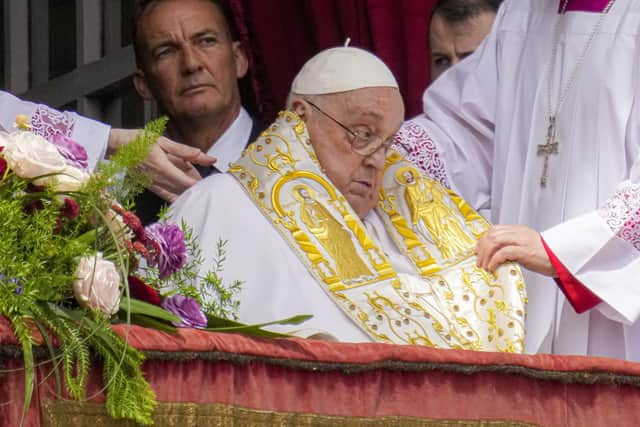

Bells tolled in church towers across Rome after the announcement, which was read out by Cardinal Kevin Farrell, the Vatican camerlengo, from the chapel of the Domus Santa Marta, where Francis lived.
“At 7.35 this morning, the Bishop of Rome, Francis, returned to the home of the Father. His entire life was dedicated to the service of the Lord and of his Church,″ he said.
“He taught us to live the values of the Gospel with faithfulness, courage, and universal love, especially for the poorest and most marginalised.
“With immense gratitude for his example as a true disciple of the Lord Jesus, we commend the soul of Pope Francis to the infinite, merciful love of God, One and Tribune.″
Francis, who suffered from chronic lung disease and had part of one lung removed as a young man, was admitted to Gemelli hospital on February 14 for a respiratory crisis that developed into double pneumonia.
He spent 38 days there, the longest hospital stay of his 12-year papacy.
However, he emerged on Easter Sunday – a day before his death – to bless thousands of people in St Peter’s Square and treat them to a surprise Popemobile tour of the piazza, drawing wild cheers and applause.
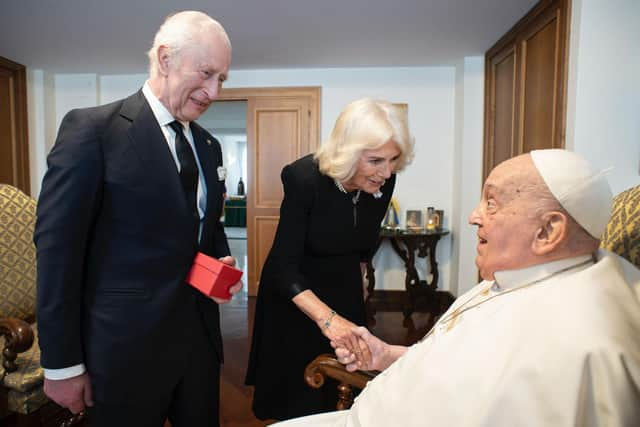
The King and Queen met with the then convalescing pope during their state visit to Italy earlier this month.
Charles and Camilla completed a four-day tour of Rome and Ravenna, which included brief time that the King and Queen spent with a recuperating Pope Francis. It was described as a personal highlight for couple who felt it was a “very significant and special moment”.
The couple were said to have had a wonderful conversation with the pontiff, who was recovering from double pneumonia, during their private meeting that lasted 20 minutes at the Vatican. The first two state visits of the King’s reign were to Germany and France, and it was “no accident” Charles was asked to travel to Italy to foster a “relationship that really, really matters”, said the palace official.
Pope Francis was asked by the leader of the Catholic Church in Ireland to visit Northern Ireland as part of his historic 2018 trip to Ireland.
The Archbishop of Armagh, Eamon Martin, said he travelled to Rome to ask if Francis would travel north of the border “to affirm the peace process”.
But he said it became clear that it would be a 36-hour visit to Dublin, apart from a quick trip to Co Mayo.
The primate of Ireland also said that the pope’s words of repentance for clerical abuse scandals during the 2018 visit “were worth so much” and that his promotion of empathy towards migrants will be one of his strongest legacies.
The pontiff visited Ireland for two days in August 2018, which included a visit to Knock, a meeting with victims of clerical abuse, and a visit to a homeless centre run by the Capuchin Fathers.
The visit culminated in an open-air Sunday Mass in Dublin’s Phoenix Park, where pilgrims’ attendance was a fraction of the million people who greeted Pope John Paul II at the same spot in 1979.
The legacy of church abuse cast a long shadow over the pope’s Irish visit, during which he addressed a number of crimes by its institutions and members.
Speaking to the PA news agency, Archbishop Martin said that his address to the victims of clerical abuse and mistreatment during the Phoenix Park event were worth a lot.
“I think the actual words that the pope spoke, particularly whenever he expressed those very, very, sincere apologies and repentance to victims and survivors of abuse, I think, really, they were worth so much.”
Much was made of the attendance numbers during that visit as it was observed that they were significantly down on Pope John Paul II’s visit.
“Most of us expected that this would be something much smaller, not least because the world has changed,” the archbishop said.
“People use mobile phones now, they tune into things online, they tend not to go to big, big, massive gatherings.
“A lot of people watched it on TV, they tuned in on their radios or on their mobile phones, and only a much smaller crowd arrived in the Phoenix Park that afternoon.
“So I will say I was probably thinking, ‘Oh this is going to be disappointing’, however, we’re told that it was actually one of the biggest gatherings of people in Europe that year, and so it was still a big gathering of people.”
The archbishop said that as soon as it was announced that the pope would attend the World Meeting of Families in Dublin, a religious event held every three years in a different location, “there was a lot of excitement”.
“We wanted to plan for it, and everybody wanted the pope to visit them.
“I remember at the time asking if Pope Francis could come to Northern Ireland, just to affirm the peace process and also because when Pope John Paul II came to Ireland back in 1979 he intended to come north and to come here to Armagh, but unfortunately, he couldn’t because of the violence, so he held that meeting instead south of the border in Drogheda.
“So I actually went over to Rome to try to petition Pope Francis to come to the north, but by then it was clear he was only coming to the World Meeting of Families.
“It was going to be a very short visit of 36 hours, roughly, to Ireland and the only thing he was going to do different was he was going to go over to Knock for a short period of prayer and come straight back to Dublin.”
He said that the Argentinian-born Jesuit spent a sabbatical in Dublin in 1980 to learn English and asked him regularly about the peace process.
“Whenever I would meet him, he would always ask me about Ireland, ‘the green country’ he would say, and then he would like to know how things were going, particularly in terms of the peace process.
“He had clearly a big interest in peace and also in the progress of our peace.”
He said one of Francis’ strongest legacies during his papacy would be his call for empathy towards migrants and refugees.
“We have to remember Pope Francis himself was a descendant of migrants from Italy to Argentina, and it’s clear, even in his own autobiography which he produced called Hope, it’s clear that he was so motivated by that story of his grandparents and how they came over from Italy.
“It’s interesting that one of the very first things he did as pope is he went to the island of Lampedusa, a small island which had been overwhelmed by a huge number of people trying to find solace, trying to find asylum, and trying to make their way to a better world.
“He exposed for the entire world the reality and indeed the scandal of the displacement of people in the world, in many cases due to war, and how these people were not finding a welcome, how so many of them were dying, how so many of them were victims of the exploitation of human trafficking.
“The plight of migrants he would have seen as the modern day marginalised, those on the peripheries who people didn’t want, they didn’t want to welcome them.
“Some of his strongest statements have been very challenging for all of us – about the need to promote help for these people, the need to integrate people who are migrants, and I think that that has been troubling for a lot of us, because people tend to say, ‘well that’s fine, but we need we have services that will look after ourselves’.
“That has been a big issue in Ireland, both north and south.”