
Portstewart-born Sir George Stuart White’s distinguished military career was sealed by Victoria Cross
Sir George Stuart White was born at Low Rock Castle, Portstewart, Co Londonderry, on July 6 1835.
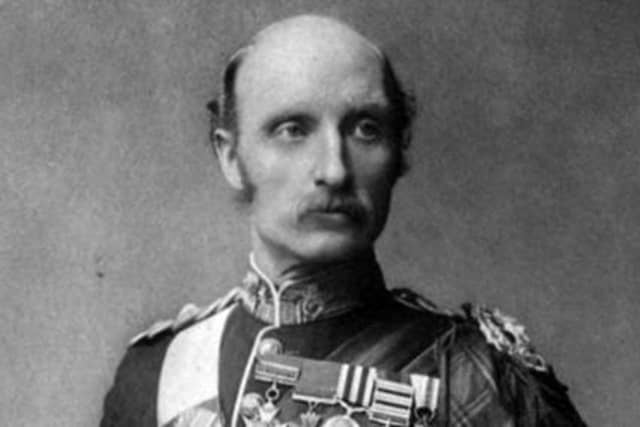

Although the Whites were a family of English descent, they frequently took Ulster-Scots brides, including McCollums, Hamiltons, Drummonds and Stuarts. Some of these families claimed kinship with the Abercorns, the Royal House of Stewart/Stuart and the Bruces.
George was the second son of James White of Whitehall, Co Antrim, and his wife Frances Ann, daughter of George Stewart, surgeon-general to the army in Ireland, and his wife Frances, daughter of Colonel William Stewart MP, of Killymoon Castle, Co Tyrone.
George was educated at Bromsgrove School, Worcestershire, and later at King William’s College on the Isle of Man. He excelled at cricket and swimming but spelling and punctuation were not his strong points.
In 1850 he entered the Royal Military Academy at Sandhurst. After graduating, White was commissioned into the 27th (Inniskilling) Regiment of Foot in 1853, transferred to India in 1854 and saw service as a lieutenant in Peshawar during the 1857 Indian Mutiny.
He was promoted to captain in 1863 and transferred to the 92nd (Gordon Highlanders) Regiment of Foot.
He returned to England before being further promoted to major on December 24 1863. After five years in England he returned to India with his regiment in 1868.
In 1874, he married Amelia, daughter of Joseph Baly, the archdeacon of Calcutta, with whom he had one son and four daughters.
During the 2nd Afghan War (1878-1880), White, with 200 of his regiment, outflanked a superior force of Afghans in the Saug-i-nawishta gorge on October 6 1879, leaving the route from Charasia to Kabul free for the remainder of the British and Indian troops. For his bravery during this incident White was awarded the Victoria Cross.
The citation reads: ‘For conspicuous bravery during the engagement at Charasiah on 6 October 1879, when, finding that the artillery and rifle fire failed to dislodge the enemy from a fortified hill which it was necessary to capture, Major White led an attack upon it in person.
‘Advancing with two companies of his regiment; and climbing from one steep ledge to another, he came upon a body of the enemy, strongly posted, and outnumbering his force by about eight to one. His men being much exhausted, and immediate action being necessary, Major White took a rifle, and, going on by himself, shot the leader of the enemy. This act so intimidated the rest that they fled round the side of the hill, and the position was won.
‘Again, on 1 September 1880, at the battle of Candahar, Major White, in leading, the final charge, under a heavy fire from the enemy, who held a strong position and were supported by two guns, rode straight up to within a few yards of them, and seeing the guns, dashed forward and secured one, immediately after which the enemy retired.’
His VC is on display at the Gordon Highlanders Museum in Aberdeen.
India’s North-West Frontier was the focus of much of White's military career, but he was assistant-quartermaster-general in Egypt during 1884-1885. He was commander-in-chief India from 1893 until 1897 when he was appointed quartermaster-general at the War Office.
In September 1899 at the outset of the Second Boer War, White was sent to command the Natal Forces in South Africa. After the battle of Elandslaagte, fearing a Boer attack on Ladysmith, White ordered his forces to fall back to the town.
He took command of the garrison during its subsequent siege by the Boers. When his position there became almost untenable due to lack of supplies, White was instructed by General Sir Redvers Buller (the commander-in-chief of British forces in South Africa in the early stages of the conflict) to destroy the guns and surrender the garrison on the best terms he could but White responded, ‘I hold Ladysmith for the Queen’. (His response may been inspired by the memory of an ancestor, the Rev Fulke White, the first Presbyterian minister of Broughshane, who features in W R Young’s ‘Defenders of Derry’. While it is unclear whether he was in the city during the siege, he was one of the ministers who presented an address to William III at Carrickfergus.) He held out for another 118 days under extremely difficult conditions before the town was relieved on February 28 1900.
The first British troops to arrive in Ladysmith were commanded by Major Hubert Gough (a key figure in the ‘Curragh incident’ in 1914 and commander of the Fifth Army in the Great War) where he met his brother Johnnie who had been besieged inside the town.
White greeted Gough by observing, ‘Thank God we kept the flag flying’. The meeting between White and Gough is the subject of a famous painting by John Henry Frederick Bacon.
As White's health had deteriorated during the siege, when he returned to the UK in May 1900, he was appointed governor of Gibraltar and in that role was promoted to full general.
He was elevated to field marshal in 1903 and made a member of the Order of Merit in 1905. (Admission to the Order of Merit, established by Edward VII in 1902, was a very signal honour as it was in the personal gift of the Sovereign and restricted to 24 living recipients.)
He was governor of the Royal Hospital Chelsea from June 1905 until his death there on June 24 1912, a few weeks shy of his 77th birthday.
Although the White were Anglicans by this stage, Sir George is buried, like his ancestors, in the Presbyterian graveyard in Broughshane.
In September 1944 a large party of Gibraltarian evacuees, resident in and around Ballymena, visited the grave to place a wreath and pay tribute to the former governor of their homeland who had ‘brought them happiness and improved their welfare’.
A bronze equestrian statue of the hero of Ladysmith stands in Portland Place, London.
He also continues to be memorialised by the Sir George White Memorial Flute Band in Broughshane.