
PSNI 25th anniversary: Agreeing a new emblem was first big test, says Pauline McCabe
It was widely accepted that agreeing a new emblem for the PSNI would be the Policing Board’s first big test and that it would be judged by how it did.
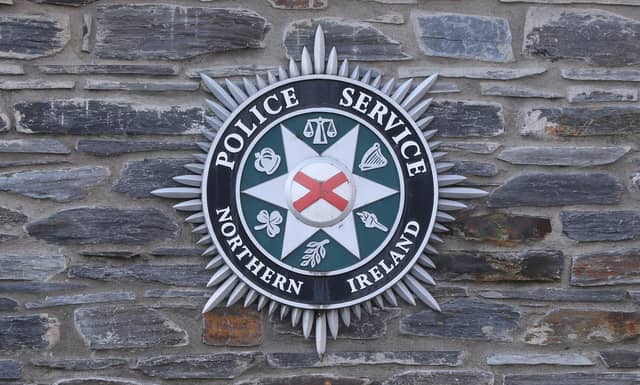

A new police service had just come into being, and the old badge that had meant so much to so many, and so little that was good to so many others, was to be replaced.
In November 2001, Jane Kennedy wrote to the Board Chairman explaining that it was the Government’s intention to have the new police service emblem ready by February 2002, for the first intake of new recruits.
The Board was given until mid-January to agree an emblem and told that, if it failed, the decision would be made by the secretary of state.
An NIO press release followed, publishing seven alternative emblems, described by Ian Paisley Junior as “the complete ruination of everything British”. The Belfast Telegraph also ran a public competition inviting designs.
And so, it somehow came to pass that I found myself at a Policing Board workshop on 20 November 2001 at the Slieve Donard Hotel in Newcastle being asked to chair a sub-group tasked with agreeing a new emblem.
In the moment, the irony of the fact that, only a few years earlier, I didn’t know my DUPs from my SDLP’s, was not lost on me.
The other members of the Desmond Rea appointed sub-group were Alan Brookeborough, Fred Cobain, Tom Kelly, Eddie McGrady and Sammy Wilson.
I welcomed the tight timescale and welcomed also the Secretary of State default position; particularly as the DUP would not want this because it would result in a very neutral selection.
To kick things off, I asked everyone to set their alarms for a pre-breakfast meeting at around 7.30am on 21 November. I was fairly sure that a highly structured and tightly executed process was our best chance of success and that a consultative approach to methodology might not get us very far. The unionists needed the crown, the nationalists needed no crown
and that, simply put, was that.
The night before that first meeting, I prepared two flip charts, Option A and Option B. At the start of the meeting, I talked the group through the options and then asked each of them to choose A or B. I think it is fair to say that this was not what they were expecting but everyone was very cooperative and constructive.
I think that the fear of running out of time for the Slieve Donard excellent Ulster fry did no harm.
Option A required all members, as the next step, to attend a workshop at which we would explore the answers to a series of questions that might inform the emblem design. Three design companies would then be asked to join the meeting, be briefed on the discussion outcomes, and produce designs. A date for ten days later was agreed.
Procurement arrangements at that time were less protracted than today but the Board senior staff supporting the work of the group looked aghast and bemused in equal measures that I could possibly believe that all the paper could be shuffled, and boxes ticked to magic three design companies into a room in ten days.
I stood firm and was grateful to my independent colleague Tom Kelly who worked in marketing and spoke up promising to help make it happen. In the event the Board staff, lead by the absolutely brilliant Lorraine Calvert
and Sinead Simpson, did a first-class job in moving every mountain we put before them during the following weeks.
The workshop took place on 30 November. Sitting outside before it began, I was approached by the head of the Board communications company. He advised me that the adopted methodology was never going to work and urged me to reconsider saying “Pauline, Pauline, this is not how you agree an emblem”.
The workshop considered a series of pre-set questions, and everyone was asked to share their thoughts, taking the broadest view possible. Areas covered included: what messages we thought the emblem needed to communicate; what images might best communicate those messages; and what would be helpful and not helpful for individual members when
communicating with different interests and constituents.
Sheets of flip paper were stuck all over the walls with the questions on the top and Sinead and Lorraine ran around scribbling as thoughts were shared.
The atmosphere was incredibly measured, thoughtful, considered, and everyone listened to one another intently. I found it fascinating and thought it was greatly to the credit of all of those participating and to the selections made by Desmond Rea.
At the end of the discussion, the three design companies were invited to join the meeting and the content on the flip chart sheets was shared with them without any further attempt to elaborate.
I was concerned that allowing the work of the group to extend to the Christmas period would be counter-productive and this being the case, the design companies were given just days to submit their designs.
Before the penultimate meeting of the group, members were each given copies of the design company images, the entries to the Belfast Telegraph public competition and the government issued designs to consider.
I had been through all but the design company ideas over and over and I was very sure that we had zero contenders, so it was with some trepidation that I sat at my kitchen table and one by one, turned over the new images. The results were generally disappointing. How, I wondered, could the words on those flip charts possibly deliver an emblem that was a great big British crown?
There was, however, one Belfast design company, Positive Design, which
had brought a thoughtful, creative approach to their interpretation of the task.
Two young designers, Gillian Caves and Alan Davison informed by the thoughts, ideas and hopes captured on our flip charts, had used a simple, stylistic representation of a variety of symbols, including an olive branch, a torch, a harp, the scales of justice, a shamrock leaf and a crown, to represent our diversity, our aspirations and our desire to respect and protect difference through policing. Crucially all were of equal prominence. At the centre was a sunburst to represent the new beginning with the Cross of St. Patrick placing the symbols in the context of Northern Ireland.
The simplicity and neutrality of the design was full of possibilities.
The meeting to consider the designs took place at Stormont at the end of a working day.
Prior to this meeting, I had spoken in confidence with independent group colleagues Alan Brookeborough and Tom Kelly about the possibilities of the Positive Design emblem.
As Sinn Fein had not taken their seats on the Policing Board, I had also sounded out Denis Bradley.
At the meeting, we once again adopted a process. We gathered around a table, and as I held up each design, each member had to choose between the “remotely possible” and “could never agree” piles to my left and right. The results were predictable, with the more divisive designs evicted.
When it came to the turn of the Positive Design proposal Sammy Wilson, to my utter dismay, shook his head. I asked Sammy to re-consider and, as I did so, someone, I think it was Fred Cobain, leant forward and tapped the crown on the image. “Sammy, it has a crown.” Sammy looked again and this time nodded the image into the possible pile.
A number of neutral designs made the possible pile only out of everyone’s desire to try and appear open minded and comply with the task as set, but everyone understood that completely neutral would not be a good outcome for the unionist members of our group.
In the discussion that followed, it was recognised that the Positive Design emblem offered a possibility that the others did not. It gave no one everything they would have liked, but it gave everyone just enough.
A suggestion WAS made, starting with the words, “I don’t suppose..., that the crown might replace the Scales of Justice at the top of the emblem, but the “nice try” raised eyebrows and half smiles that were the response were accepted graciously.
At a final meeting, Positive Design shared giant mock-ups of their images offering the choice of a silver or gold border to the green emblem.
The first person to gently bow and shake his head when the green and gold version was held up, was that gentleman of all gentlemen, Eddie McGrady.
In this room full of political opponents, he settled the question of colour with a gesture so slight and so gracious that no one else needed to speak.
That day, the group agreed in principle the Positive Design emblem and went back to talk with their various political colleagues on and off the Board, and other stakeholders. The group made a pact that, if their recommendation was accepted by the full board, the emblem would be issued with an agreed statement, and no member of the group would try
to further explain or give meaning to any of the stylistic images on the emblem.
On xxx the nineteen Board members unanimously agreed the new emblem.
A few days later, I received a lovely email from Sinead Simpson explaining what the agreement on the emblem meant to the Board staff. She said that, in the face of great challenges, the emblem agreement had made them feel full of hope for the future and had allayed their fears that this divided Board might never be able to its job.
I think that Sinead’s hope was well placed. Whatever has happened since, what was achieved in those first five years was, in all the circumstances, quite extraordinary.
• Pauline McCabe OBE is an independent member of the NI Policing Board