
Roamer: Childhood memories of war as VE Day 80 draws nearer
Thursday is the 80th anniversary of the end of WWII in Europe - VE Day 80 - a day which the Imperial War Museum (IWM) affirms “has remained in the memory of all those who witnessed it”.

Just a very few of those memories were on this page in recent weeks, including some harrowing wartime accounts, and more follow as the commemorative events continue.
The IWM defines VE Day in 1945 as the end to nearly six years of war that “cost millions of lives, destroyed homes, families and cities and brought huge suffering and privations to the populations of entire countries.”
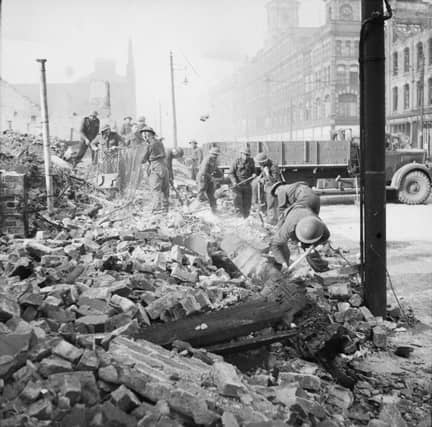
Around 38,000 Ulster people enlisted, of whom just over 10 per cent died, and tomorrow is the anniversary of a tragic attack at home - the Fire Raid - the third of four Luftwaffe bombing raids predominantly on Belfast in 1941 that collectively cost the lives of around 1,000 people.
First was Belfast’s Dockside Raid (7-8 April), then the Easter Monday Raid (15-16 April), the Final Raid (5-6 May) and tomorrow night’s Fire Raid, also a Sunday, when over 200 German bombers unleashed death and devastation on east Belfast, the docks area and the city centre. Over 190 citizens were killed.
Powerfully illustrating contrasting scenes of war, the late, local historian Noel Kirkpatrick’s book ‘In the Shadow of the Gantries’ describes people watching a land-mine dropping from an enemy plane. The device slowly and silently descended by parachute onto east Belfast “where it blew a 20-foot crater across the whole width of roadway.”
With a deafening roar, the road-surface became airborne and tram lines were hurled high over adjacent, disintegrating houses “landing bent and twisted several streets away.”
The heavy iron tram-way points remained attached to their tramlines, impaled in smouldering piles of debris, rubble and dislocated lamp posts. The terrible explosion revealed a curious geological secret!
Local children who clambered into the crater the next day encountered a curious natural phenomenon - “a shimmering, powdery waterfall” recalled Noel Kirkpatrick, who was one of the youngsters in the crater.
He remembered “their footprints were soon smoothed over by the continuous pouring of fine silver sand similar to that found inside an hourglass or egg timer.”
Workmen soon arrived to repair the road, and the sand was covered up again. If you’re at the junction between Albertbridge and Mountpottinger today, there’s a silvery, sandy, subterranean playground underneath, which Hitler’s mighty Luftwaffe couldn’t erase. Christopher Wilson has already recounted being a six-year-old in Greenisland during WWII.
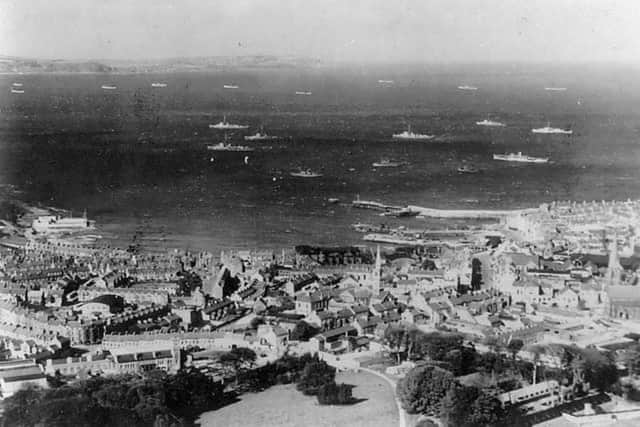
Along with the joys of VE Day in 1941 which Christopher described here several weeks ago, he clearly recalls his first memory of a battle - “the D-Day invasion of Normandy on June 6, 1944. For a week before the invasion Allied naval vessels gathered in Belfast Lough. One morning they were gone, sailing to join many other ships to bombard the German fortifications on the Normandy cliffs. On the morning of June 6 my mother and I were in Belfast city centre. The newspapers had one headline ‘D-day Has Come.’”
Bushmills artist, author, broadcaster and regular Roamer contributor Brian Willis was brought up in Wimborne, a small Dorset town, and attended primary school throughout WWII.
“One day, I came out of school,” Brian remembers, “to be met by a tearful mum. ‘Daddy has been called up and is to go into the army,’ she explained, crestfallen. And my reaction? ‘Oh good - he can get me some badges!’ It was traditional for soldiers to send regimental badges home to their children. A four-year-old’s view of life is different to that of an adult. How lucky they are!”
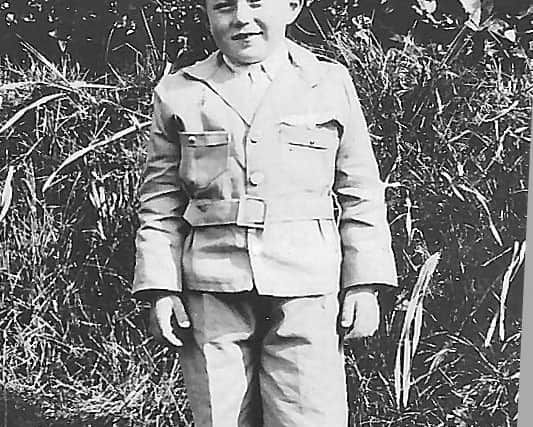
Brian has a framed oil painting in his lounge, of his father Patrick in his uniform, painted by a fellow soldier in 1943. He also has a photograph of himself as a five-year-old, in an RAF uniform!
“Despite clothes rationing,” Brian explains, “my mother bought the uniform in a shop. Children were encouraged to empathise with the armed services during the war, with so many fathers away fighting.”
VE Day wasn’t the end of WWII - that came on August 15, 1945, VJ Day, when Japan surrendered. The official government programme of commemorations covers both anniversaries, at ve-vjday80.gov.uk
Local and national VE Day events are also on www.ve80.com and abundant NI commemorations are on the web and social media!