
Roamer: Local sailing ship was wartime hero and sea-going film star
For the last couple of Saturdays, Carrickfergus’s First World War Q-Ship called Result dominated this page. Today it’s her equally heroic sister’s turn - the Carrickfergus-built Q-Ship called Mary B Mitchell.
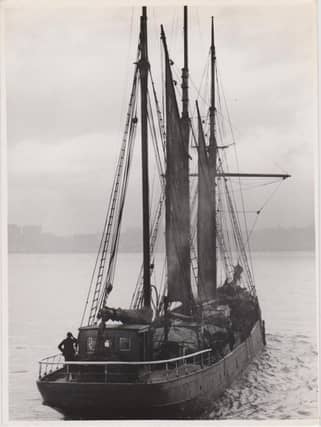

Winston Churchill, First Lord of the Admiralty in 1914, is credited with devising the Q-Ship. “A small cargo vessel”, Churchill mused, “fitted very secretly with two concealed 12-pounder guns, with seamen and two gun operators who should all be disguised. If a submarine stops…they should endeavour to sink it by gunfire!”
Admiral of the Fleet Lord Jellicoe said that few people realised the wonderful work ‘mystery ships’ (they were also called Special Service Ships) did in WWI, displaying “a spirit of endurance, discipline, and courage, the like of which the world has never before seen.”
Described as “one of the most famous of all the Q-Ships” by Lieutenant Commander E K Chatterton in 1922, the Mary B Mitchell - or ‘Mary B’ as she became affectionately known - was “the first Q-Ship to stalk U-Boats in the western end of the English Channel.”
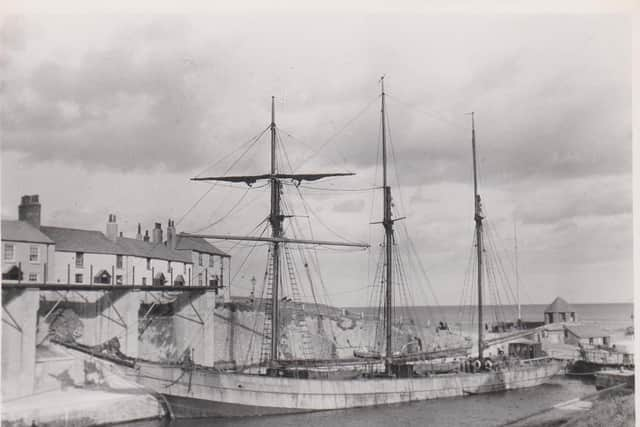
And her versatility knew no bounds!
She was a coastal trader, a luxurious private yacht, an undercover agent with multiple aliases, a star of two movies and finally and tragically, an unsalvageable shipwreck.
The 129-ft-long, 227-ton, three-masted topsail schooner was built in 1892 at the Paul Rodgers shipyard in Carrickfergus for a Welsh industrialist.
She initially carried Welsh slate, and later, cement.
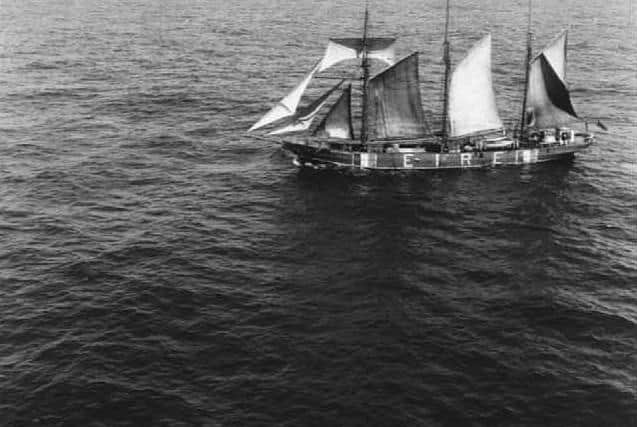
Lord Penrhyn, acclaimed British soldier and politician, adopted Mary B as his plush Mediterranean yacht for several sultry summers but in 1916 she was requisitioned by the Admiralty and fitted out as a Q-Ship, codenamed Q9.
She sailed on 26 June armed with two six-pounder guns hidden under her cargo hatches, a 12-pounder in a collapsable dummy deck-house on her rear (poop) deck, two heavy machine guns and various small arms.
She had a radio mast concealed in her rigging, the Spanish alias ‘Mary Y of Vigo’ painted on her detachable nameplate and a veritable library of replacement nameplates ready for a hasty rechristening!
Sometimes she was the French coaster ‘Jeannette’, sometimes the ‘Brine of St. Malo’ and occasionally the Russian ‘Neptun of Riga’. She interchanged the Red Ensign (Merchant Navy) with the White Ensign (Royal Navy) and even flew one on her stern with the other on her bow!
On 2 December 1916, in the English Channel, commanded by Lieutenant M Armstrong, a U-Boat was spotted about 1,500 yards starboard. It fired on the Q-Ship three times with no hits, giving Armstrong’s bogus ‘panic party’ time to pretend they were abandoning ship while the rest of the crew prepared the guns!
They fired on the U-Boat, hit its conning tower and while it crash-dived another U-Boat surfaced and fired a torpedo which missed the Mary B’s rudder by about 15 feet.
Around three weeks later in January 1917 she lost two masts in a fierce gale and mountainous seas and while being repaired, an engine was fitted.
Her next encounter with U-Boats was in June - three on the same day - presumably she’d encountered a dreaded ‘pack’. Mary B fired up to 100 shells, and though several hit their targets, all the U-Boats dived and departed. Fortunately, Mary B and her crew was intact.
Not so on 3 August, off the Cornish coast, when a U-Boat fired over 70 shells. As Mary B’s decoy ‘panic party’ abandoned ship she received several direct hits, two crew were injured and she had to return to Falmouth for extensive repairs.
Demobbed early in 1919 Mary B returned to the less glamorous role of carrying pit-props, coal, burnt ore and China clay, but her hectic logbook was far from closed!
She featured in two movies, The Mystery of the Mary Celeste in 1935, and McClusky the Sea Rover in 1936, and during WWII, flying the Irish flag of neutrality, she survived hair-raisingly close encounters with both the Royal Navy and several more German U-boats!
Her career finally ended in a fierce gale on 15th December 1943. Loaded with ore Mary B grounded at the mouth of Kirkcudbright Bay in Scotland.
Her crew of eight were taken off by Kirkcudbright lifeboat but salvage was impractical.
A year later she was smashed to pieces in another violent storm.
*Thanks to Graham Walton of Old Carrickfergus Postcards and Christopher Kenny of the Carrickfergus Tall Ship Project for their Mary B images and information.