
Roamer: The railway children who escaped to Ulster from the Nazis
The forthcoming annual Holocaust Memorial Day (HMD) commemorates six million Jews murdered by the Nazis and their collaborators, who also massacred millions from other religious groups, nationalities and organisations.

HMD is on Monday 27 January, the 80th anniversary of the liberation of Auschwitz-Birkenau, Hitler’s biggest concentration camp of over 40,000 concentration camps, labour camps and ghetto-prisons throughout 22 different countries.
The Nazis also perpetrated countless outdoor mass killings in fields and forests - in just two days in September 1941 over 33,000 Jews were shot dead in Babi Yar, a Kyiv ravine. And many other places had tragic roles in the Holocaust.
Vienna’s Aspang railway station was generally a regional connection, quiet and unfrequented - “probably the reason it was made the point of departure for deportation transports under the Nazi regime”, explains a plaque where the station once stood.
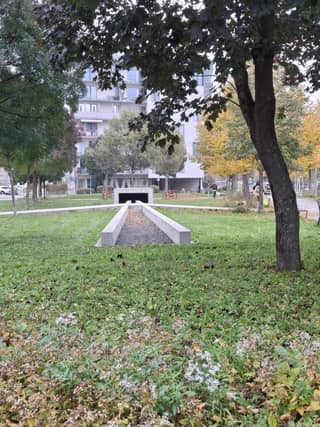
It wasn’t a busy junction, so the Nazis could go about their deadly business without attracting too much attention. Overlooked today by the same apartments whose occupants must have wondered at the unusual influx of wartime ‘commuters’, there’s a beautiful tree-planted park and a poignant memorial sculpture set on a neat lawn.
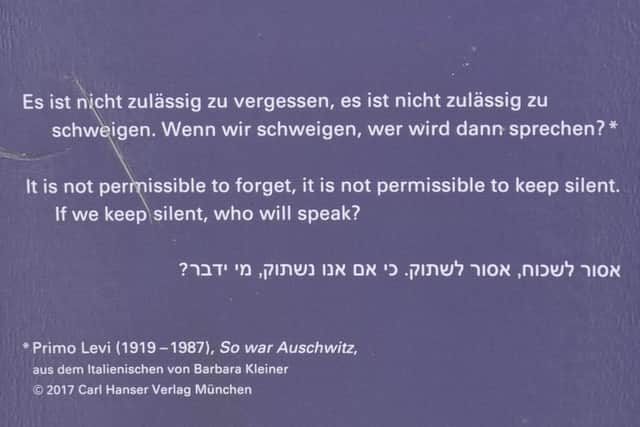
“It is not permissible to forget. It is not permissible to keep silent. If we keep silent who will speak?” - the words of Jewish-Italian Holocaust survivor and partisan Primo Levi are etched on a memorial plaque on the lawn. The commemorative sculpture is two 100ft-long, converging concrete rails leading into a large, dark, hollow, concrete block - representing Aspang Station’s railway tracks leading to death and oblivion.
NI war historian and author Mark Scott introduced me to Aspang several months ago, after we’d visited a nearby school repurposed by the Nazis as a holding centre for the deportation trains’ ‘passengers’. A total of 47 scheduled Aspang departures terminated in extermination camps and ghetto-prisons in Poland, Czechoslovakia, Latvia, Lithuania and Belarus.
“For many of Austria’s 66,000 Holocaust victims” a plaque explains grimly “their journey to death began here.” There was no room in the sealed carriages to sit or lie down; no heating or ventilation; no food or water and no sanitary facilities apart from a bucket.
Many died on the journey, starved or crushed by overcrowding, and adding insult to slaughter, the Nazis forced Vienna’s Jewish Council to pay the full ticket price for every ‘passenger’. The fourth of the 47 trains left on 5 March 1941 with 999 Austrians on board, mostly Jews, on a four-day journey to the Modliborzyce ghetto-prison in Poland.
Modliborzyce boasted horrendous conditions, extreme overcrowding and a notoriously high mortality rate. Its able-bodied men were herded to forced labour in the nearby Lysakow and Jenisow camps. All 999 deportees’ names were listed by the Nazis, with numbers.
Leopold Kessler was number 129, and his wife Ernestine Kessler, nee Schrekinger, was number 130. (The Nazis also added the designation ‘Israel’ to Jewish men’s names, and women were designated ‘Sara’). Paul Messinger was number 880, his wife Erna was 881, Helene König was 870 and Rebekka Nussbaum was number 321. The aforementioned seven deportees had links with Northern Ireland, and with Roamer’s page.
Prior to their deportation to Modliborzyce, Leopold and Ernestine Kessler’s daughter Gertrude (Gerti) and her younger brother Fritz fled Vienna on a Quaker-sponsored Kindertransport train. They came to London, then Northern Ireland, and finally to the Methodist Church’s Childhaven Orphanage at Millisle, County Down.
Rebekka Nussbaum’s daughter Anna also escaped on Kindertransport, also to Childhaven. After the war Gerti married a Belfast doctor and had two sons - one is The Roamer! Two of Gerti’s uncles, gruesomely executed for plotting against the Nazis, are commemorated in Vienna.
Ernestine Kessler escaped from Modliborzyce with Helene König and walked back to Vienna where she hid from the Nazis till war ended. Leopold Kessler was moved from Modliborzyce in October 1942 and died in a Belzec concentration camp gas chamber during the first week of November 1942. Paul Messinger assisted Ernestine Kessler after her escape and like Oskar Schindler, saved hundreds of Jews from certain death by employing them in a Nazi-approved factory.
Tragically, Paul couldn’t save his wife Erna who died in Auschwitz-Birkenau. Only 14 of 999 on Aspang’s fourth deportation train lived to return to Vienna. Of a total of 47,035 Jews deported from the station between February 1941 and October 1942 - only 1,073 (2%) survived.
l Mark Scott’s book about Vienna’s Holocaust will be published later this year.