
SAS hero Blair Mayne, the ‘bravest man never to win a Victoria Cross’, died in car crash 70 years ago this month
Lord Ashcroft, the international businessman and philanthropist, has amassed the world’s largest collection of Victoria Crosses.
Although Blair Mayne was never awarded the VC, he was awarded the DSO on four occasions.
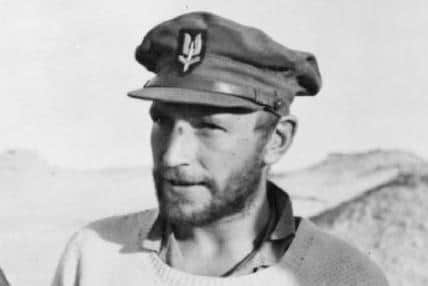

Ashcroft’s admiration for the man knows no bounds, being especially impressed by his ‘cold courage’ – he knew the dangers yet repeatedly confronted them.
The gallery in the Imperial War Museum displaying Ashcroft’s collection of VCs and GCs identifies seven qualities possessed by recipients of the VC – leadership, sacrifice, aggression, skill, initiative, endurance, and boldness. Blair Mayne surely possessed them all.
Thus, he has his niche in history as ‘the bravest man never be awarded the Victoria Cross’ and in this Ashcroft was echoing the assessment of Peter Forbes, a maths teacher from Newtownards and a local expert on Blair Mayne’s life.
Robert Blair Mayne was born into a prosperous middle-class Protestant family in Newtownards on January 11 1915. Blair (as he was known) was the second youngest of seven children – four boys and three girls.
As a youngster, he enjoyed the outdoor life and sport. An exceptional athlete at both Regent House and Queen’s University, he excelled at rugby, cricket, riding, fly-fishing, hunting and shooting.
As a Queen’s law student, he won the heavyweight title for Irish universities and became a finalist in the British universities’ championship. His rugby talents (as a second-row forward) were recognised and won him six caps for Ireland. In 1938 he toured South Africa with the British Lions, taking part in 20 of the 24 Test and provincial matches.
In 1939, Mayne graduated and qualified as a solicitor. His final game for Ireland came on March 11 1939, five days after he had joined the Territorial Army in anticipation of the outbreak of the Second World War.
In late 1939, Mayne and two friends joined a Royal Artillery territorial unit, but the following April he transferred to the Royal Ulster Rifles. He then applied to join the Commandos and was mentioned in dispatches for his role in the Litani River raid in Syria against Vichy French forces in June 1941.
He was subsequently recruited into the SAS in September 1941, just two months after it was formed, and led a mission in November 1941 that was to be its first major success: an attack on Tamet airfield in Libya in which dozens of enemy aircraft were destroyed.
For the next year, Mayne participated in many night raids deep behind enemy lines in the deserts of Egypt and Libya, pioneering the use of military jeeps to conduct surprise raids. It is estimated that he personally destroyed up to 100 aircraft on the ground.
In January 1943 Mayne took command of the SAS and went on to lead his men in Sicily, Italy, France and Germany.
As it is impossible to do justice to Mayne’s exploits in a brief article, let us look more closely at episode for which he was recommended for the VC.
On April 9, while advancing in north-west Germany, ‘B’ Squadron of the SAS came under heavy fire from farm buildings and a major was killed. When Mayne arrived on the scene, he quickly went into the open and, firing from the shoulder, launched a ferocious onslaught on a farm building until all enemy soldiers in it were dead or wounded.
Next, he drove a jeep in full view of the enemy and with all guns blazing, to rescue two wounded comrades. For this act of bravery, Mayne was recommended for the VC, and his actions were supported by witness statements.
His actions fulfilled the criteria for a VC but the recommendation was crossed out and replaced with ‘3 Bar DSO’. No compelling reason has ever been advanced to explain why the medal was denied. Even George VI expressed surprise that the VC had ‘so strangely eluded him’.
The principal culprit in denying Mayne the VC was probably David Stirling who is celebrated as the founder of the SAS. Contrary to his own myth-making, Stirling was neither a military innovator nor an outstanding soldier. As Gavin Mortimer’s biography of Stirling in 2022, entitled ‘The Phoney Major’, makes abundantly clear, Stirling was immature, incompetent and reckless.
When Stirling was captured through his own bungling incompetence in 1943, the SAS flourished in his absence under Mayne’s inspirational leadership.
Mayne had immediately recognised that Stirling had neither the skills nor the aptitude to wage a successful guerrilla campaign. He recognised that the only sense in which Stirling was his superior was in terms of social class. Stirling was an aristocrat and politically well-connected whereas Mayne was middle class and grammar school educated.
Stirling was intimidated by and envious of Mayne because he was a constant reminder of his personal shortcomings. Stirling appropriated Mayne’s virtues and qualities for himself and shamelessly dumped his manifold flaws and failings onto Mayne.
Stirling sought to undermine Mayne’s reputation at every turn and embellish his own. It is likely that he used his undeniable charm, capacity for manipulation and social connections with Churchill and the Royal Family to badmouth and deny Mayne the recognition he richly deserved.
After the war, Mayne, working as a solicitor and becoming secretary to the Law Society of Northern Ireland, had difficulty adjusting to civilian life. He may have been suffering from post-traumatic stress disorder.
On December 14 1955, he attended a Masonic dinner and afterwards continued drinking with some fellow Freemasons in Bangor. He then headed home and drove at speed in his red open-top Riley sports car, swerved to miss an unlit stationary lorry and crashed into an electricity pole. He was found dead in his car at 4am, having fractured his skull, less than a mile from home.
As a local newspaper observed, ‘It may seem a strange fate that Col Blair Mayne should have survived so many hazards as a soldier and at 40 lose his life in a motor accident’.
His funeral on December 16 was the largest ever witnessed in Newtownards and was attended by senior military figures and other dignitaries. At the graveside, the Rev Fraser McCluskey MC, a former SAS padre, said: ‘The gift of leadership and the ability to inspire complete devotion and loyalty were his to an exceptional degree.’
He was laid to rest in the family plot at Movilla.