
SAS veteran: 'If Americans were dealing with IRA there would have been thousands of bodies - we were absolutely restrained''
An SAS veteran has said that UK forces were “absolutely restrained” in Northern Ireland, and that soldiers knew “there was far too much at stake” to break the law.
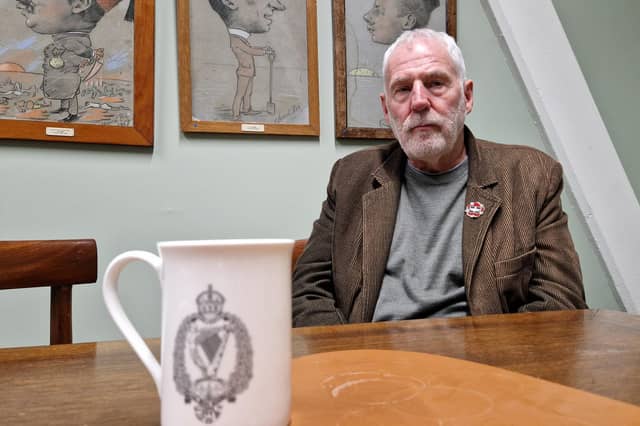

George Simm, 72 and from Northumberland in the far north of England, told the News Letter that if any other comparable army had taken on the IRA (such as the Americans) then “there would have been thousands of bodies”.
He was giving interviews this week in the run up to Remembrance Sunday because he feels he has a “duty” to warn that the government’s approach to the Troubles risks harming the military’s capacity to fight more generally.
Mr Simm, who spoke to the News Letter at the Royal Ulster Rifles Regimental Museum in Belfast, had signed up to the junior wing of the Coldstream Guards in 1969 aged 15-and-a-half.
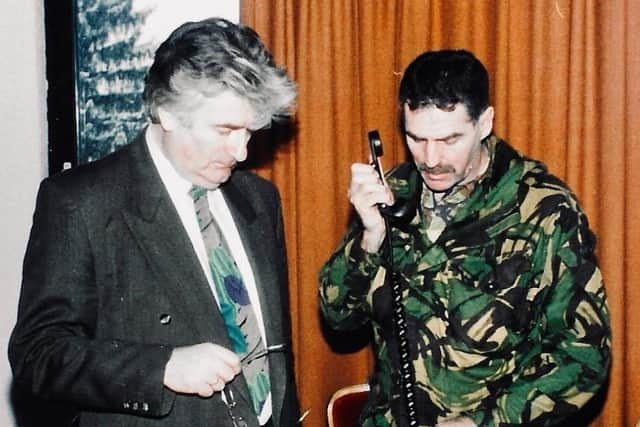
Two years later he moved into the full regiment before joining The Guards Parachute Company and then applying for the SAS in 1975 at the age of 21.
Out of about 200 applicants, perhaps only 10 or 12 got through a selection process that involved things like a 45-mile march over the mountains of the Brecon Beacons.
"But it’s not really about that – it’s a mental exercise,” he said.
“They’ll take you to the point of exhaustion and then give you something really challenging to do.
"And what they’re interested in is not whether you achieve it: it’s whether you’re going to do it.
"It’s psychological.”
He rose to regimental sergeant major, and remained in the regiment until 1999.
"I was obsessed with joining the Army,” he said, adding he has “never regretted a single minute”.
"It’s been incredibly fulfilling. And if anybody understands what it’s like to save a life, it’s better than sex.
"It’s just an extraordinary feeling, and it can be addictive.
"I’ve had the great good fortune to be in that position on numerous occasions."
How many lives has he saved?
“Indirectly, you’re talking tens of thousands because of the work we did, especially in Bosnia,” he said.
He also cited the lives saved through combatting Pablo Escobar’s Medellin cartel in Colombia where Mr Simm and his comrades had been sent to train the country’s anti-narcotics police.
What about directly?
"Probably between six and 10 I would say, because you can never tell,” replied Mr Simm.
‘I UNDERSTAND THE CRITICISM – WE KILL PEOPLE’
For example, he had been part of an SAS operation at Drumnakilly in Co Tyrone in 1988, when three IRA men were shot dead while attacking what they believed was an off-duty UDR man (it was really Mr Simm in civilian clothes).
Ten days earlier, members of the same East Tyrone brigade had killed eight soldiers in the Ballygawley bus bombing – something which had been “just another day in the office for these guys”, said Mr Simm.
Gerry Harte, one of the dead trio at Drumnakilly, had been trying to kill an average of about one person per week, Mr Simm said.
“I understand the criticism” which the regiment faces, he said, “because we kill people… but if you understand the context and clarity, then it all makes sense”.
During his career he was also dispatched to Belize, which the UK had pledged to protect from Guatemalan attempts to annex its territory, as well as to Oman and the Persian Gulf.
But Northern Ireland was “the spine” of his work.
UK MORE ‘SUBTLE’ THAN OTHER FORCES:
“Northern Ireland was peculiar because it’s our own people,” he said.
"When you’re fighting elsewhere, you’re fighting against another culture.
"When you’re fighting here you’re fighting against your own culture and your own people under British law.
"Talk about a complicated operating environment. That’s extraordinary.
"If there had been any other army comparably – the French, Americans, possibly the Poles now – had been employed on an operation like this, there would have been thousands of bodies.
"That’s because of the way the British Army conducts its business…
"I think we’re different.
"I think we’re more subtle.
"I can tell you for a fact that if for example Americans had been employed here, there would have been bodies all over the place.”
Is he saying British forces were very restrained in Northern Ireland?
"Absolutely restrained,” he said.
Does he think they were they too restrained?
"No. I think on balance it was about right.”
According to the Ulster University-run Conflict Archive on the Internet (CAIN) the British Army killed 300 people during the Troubles, of which 139 were members of paramilitary groups (151 were civilians).
The RUC’s Special Branch and the SAS “were the two things that beat [the IRA] into a cocked hat” he said.
He turned to the subject of the SAS’ series of “ambushes” against the IRA, such as Drumnakilly, which have often been the subject of court action in recent years.
He stressed that he and his comrades had been intercepting people who were on a mission to kill – “an organised crime group with pretty good guns”.
“We didn’t invite them in,” said Mr Simm.
"We’d have much preferred they’d stayed away, frankly.
"But they would turn up, and everything that happened past that point was down to them…
"We arrested far more than we killed.”
SOLDIERS FACE ‘KAFKAESQUE’ LEGAL PROCESS:
As to soldiers breaking the law, he said “there was far too much at stake for that sort of behaviour”.
"We fully expect to be answerable for every shot we fire,” he said.
If this is so, why would investigations into SAS activity in Northern Ireland concern him?
"None of us are frightened by it,” he said.
"It’s a waste of time.
"Produce your evidence, and make a charge, and we’ll go on to a court.
"But they don’t do that.
"What they do is abuse the civil process through inquests and inquiries and judicial reviews, blah blah blah, to continually keep the wheels turning, which has an inference of guilt but without any evidence.
"What that does is wears people down.”
He said former soldiers are “lost” in a “Kafkaesque civil process” designed to “keep the Troubles front and centre in society”.
He said “there has to be a line in the account” drawn for soldiers, akin to the de facto amnesty for paramilitaries that was ushered in by the Good Friday Agreement.
Instead the Labour government “have boxed themselves in to a pretty poor agreement with the Republic” which will restart things like the inquest into the SAS slaying of eight IRA men at Loughgall as part of “endless, circuitous, evidence-free investigations” of soldiers.
He referred to politicians as “gifted conmen” who want to turn soldiers into essentially "armed social workers”.
"The reason I’m doing this [speaking out] is we’ve completely lost any form of trust in the people who are constitutionally, professionally, legally bound to protect us,” he said.
"That’s all gone now, and we’ve suddenly realised we’re exposed.
"That doesn’t mean that we feel threatened.
"If we are damaged, if our brand is damaged, if our capability is diminished, that affects national security.
"But the clowns who are making all this happen don’t really understand that.
"Where we are currently as a country, in the threat environment nationally and internationally, there is only us, and a rather small army which is diminishing by the day…
"I have a duty to do what I’m doing.
"I don’t do it with any glee – I should be at home with my dogs and my grandchildren.
"I’m getting pulled all over the place to do all this stuff.
"But it’s neccessary.”
He was asked what he would do about the legacy of the Troubles, if it were up to him.
"The way these civil confilcts end is in a truth-and-reconciliation process,” he said.
"So you have the Legacy Commission: empower that properly, which seems to be the case with Declan Morgan.
"Put all the investigations into there – everything.
"But they don’t.
"They keep some inquests out… it’s politics.
"It’s the agreement with the Free State.
"It’s the agreement with the Shinners.
"That’s what it’s all about.”
With days to go until Remembrance Sunday, Mr Simm concluded: "It always makes me sad.
"All my friends are dead.
"All of them.
"They all died in service.
"It’s the only day of the year when I get slightly emotional.”
THE GOVERNMENT RESPONDS:
George Simm’s criticisms of government policy on the legacy of the Troubles were put to the Northern Ireland Office.
It responded with a statement, as follows: "The Troubles Bill is about enabling families to seek information and accountability about the deaths of their loved ones, including through information sharing by the Irish authorities.
"The government has strengthened the Troubles Bill to ensure that it includes effective safeguards for any veteran who is asked to provide information to the Legacy Commission or to a coroner.
"The bill guards against repeat investigations.
"It makes clear that there was no equivalence between lawful conduct by soldiers and the actions of terrorists.
"And in cases relating to the Army the operational context and orders by senior officers must be taken into account.
"The Legacy Act, which offered immunity to terrorists, was opposed across Northern Ireland.
"This bill replaces it in a fair and balanced way."