
Sergeant David Nelson - a hero, awarded with honour in recognition of war bravery
One of the earliest Victoria Crosses of the Great War was won by Sergeant David Nelson of ‘L’ Battery, Royal Horse Artillery – at Néry, a small village in the département of Oise, near Compiègne. (The first VC of the war was won by Lieutenant Maurice Dease from Co Westmeath at Mons.) Nelson was the first soldier of Ulster birth to win the award in the great conflict.


He was born April 3 1886 (or possibly 1887), the youngest son of George and Mary Anne Nelson (nee Black), Darraghlen, Stranooden, Monaghan. He had two brothers (George and Thomas) and a sister (Annie). In the 1901 census the family name is recorded as Neilson rather than Nelson.
David attended Urcher National School and Monaghan Model School. Before becoming a regular soldier, he was employed as a shop assistant.
Nelson enlisted in the Royal Field Artillery on December 27 1904 and subsequently transferred to the Royal Horse Artillery. He was promoted to bombardier with ‘L’ Battery on April 3 1910 and to sergeant on August 5 1914 (the day after the British declaration of war on Germany), having obtained a first-class gunnery certificate from the School of Gunnery at Shoeburyness.
During the retreat from Mons, part of the 1st Cavalry Brigade – including ‘L’ Battery – was bivouacked in Néry. At approximately five o’clock on the morning of September 1 1914 the battery, with horse teams hooked to the guns, was waiting to move off in the early morning mist when they were surprised by German troops on the nearby hills who poured heavy fire into their bivouac area.
Members of ‘L’ Battery immediately unhooked their guns and brought them into action. For two hours they maintained a rapid fire against the German positions, losing guns and troops throughout the action, until only one gun remained, served by two wounded men, one of whom was David Nelson.
At 7.15 reinforcements from the Middlesex Regiment and the Cameronians arrived and were able to eject the Germans from their commanding position.
During the course of the action 'L' Battery suffered 25 fatalities, with about another 30 or so wounded out of a strength of 170.
According to the Commonwealth War Graves Commission website, the battery sustained 74 fatalities during the course of the war which means a third of the battery’s total deaths for the entire war occurred on a single day. Few units surely would have sustained such a high proportion of its fatalities in one action.
Hospitalised after the action at Néry, Nelson was taken prisoner when Germans overran the field hospital in which he was being treated two days later. After a few days in captivity, astonishingly Nelson managed to escape.
From a French hospital he wrote: ‘My battery suffered a heavy loss on Tuesday morning … but I escaped with two wounds – one slight on the thigh, the other severe on the right side. We were taken prisoner by the Germans on Wednesday night. However, I escaped on Saturday and found my way to French troops.’
Nelson recovered slowly from the more serious of his two injuries. On his return to Monaghan he was feted as a hero and was presented with a ceremonial sword in recognition of his bravery and the distinction which he brought to his local community.
Three members of ‘L’ Battery were awarded the VC for the action at Néry: Captain E K Bradbury, Sergeant-Major G T Dorrell, and Sergeant Nelson. Bradbury’s VC was awarded posthumously.
The award of Sergeant Nelson’s VC was gazetted on November 16 1914. The citation read: ‘For helping to bring the guns into action under heavy fire at Néry, on 1st September, 1914, and while severely wounded remaining with them until all the ammunition was expended, although he had been ordered to retire to cover.’
He was presented with it by King George V at Buckingham Palace on January 13 1915. The day before his VC was gazetted, Nelson was commissioned as a second lieutenant. Between March 1915 and December 1917 he was a captain-instructor at the School of Gunnery. (It was during this period he became a Freemason, joining Priory Lodge 1000 in Essex.)
By March 1918 Nelson was an acting major, serving in France.
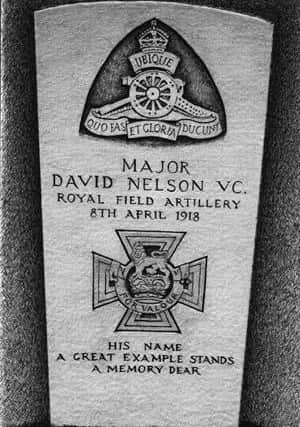
While commanding ‘D’ Battery, 59th Brigade, Royal Field Artillery, he was seriously wounded on April 7 1918. He died of his wounds the following day and is buried in Lillers Communal Cemetery. Lillers, a small town in Pas de Calais, is about 15 kilometres west-north-west of Bethune and the Communal Cemetery and Extension lie to the north of the town.
Sergeant Nelson’s VC is in the Imperial War Museum in London. ‘D’ Battery carries Néry as its honour title and annually commemorates the unit’s heroic action.
Although Néry was not a major battle and in the great scheme of things a very minor engagement compared to the great battles of the Somme or Passchendaele, Néry is still significant in that it was the first time the British had forced the Germans to retreat.
Furthermore, like Le Cateau, the engagement created a breathing space for the hard-pressed BEF from the relentless pursuit by the Germans – despite being outnumbered and outgunned.
On September 1 2014 the Ulster History Circle and the Ulster-Scots Agency unveiled the plaque at his family's former church, Cahans Presbyterian Church, in Monaghan.
In addition to David Nelson, an impressive war memorial inside the church commemorates four other members of the congregation who gave their lives for King and Country: George David McCullagh, David Black (who was probably a relation of Nelson’s mother, possibly a nephew, because they both came from the same townland), William J Fleming and David Turbitt. McCullagh, Fleming and Turbitt all died on July 1 1916, serving with the Ulster Division at the Somme.