
Somme battlefield memorial marks extraordinary WWI sacrifice of Newfoundland
Surely no trip to the Ulster Tower or the Thiepval Memorial to the Missing is complete without visiting the Newfoundland Memorial at nearby Beaumont-Hamel.
It is the largest battalion memorial on the Western front and the largest area of the Somme battlefield that has been preserved. Along with preserved trench lines, there are various memorials and cemeteries contained within the site.

In Canada July 1 is Canada Day but in Newfoundland the day takes on an additional significance. It is Memorial Day, the day on which Newfoundlanders recall the sacrifice of the Newfoundland Regiment at Beaumont-Hamel on July 1 1916, the opening day of the Somme offensive.
Of the 801 Newfoundlanders who went into battle that morning, only 68 were able to answer the roll call the next day, with 255 dead, 386 wounded and 91 missing. Every officer became a casualty. The dead included 14 sets of brothers, including four lieutenants from the Ayers family of St John’s.

In 1914 Newfoundland was distinct from Canada and one of the least densely populated parts of the British Empire. Newfoundland had a strong and vibrant Orange tradition. With the outbreak of war the governor organised a committee to recruit a force of 500 men to serve with the British Army. A thousand men, many of them Orangemen drawn from the island’s fishing villages and the lumber towns, responded to the call, sufficient to raise a complete battalion: the Newfoundland Regiment.
The Newfoundland Regiment acquired the nickname the ‘Blue Puttees’ because of a shortage of fabric which resulted in the regiment wearing blue puttees rather than the standard olive drab puttees. The regiment served at Gallipoli, in Egypt and on the Western Front.
The regiment joined 88th Brigade of the 29th Division at Suvla in 1918 and served with that brigade until April 1918. Apart from the tiny Bermuda Volunteer Rifle Corps (attached to 1st Lincolns), the Newfoundland Regiment was the only unit from outside the United Kingdom to participate in the opening day of the Somme offensive.
At 9.15am on July 1 1916, the Newfoundlanders – forming part of the 29th Division – attacked from a support trench nicknamed St John’s Road. They attacked from this support trench because the British front-line trenches were so tightly packed with dead and dying soldiers from the leading waves, who had been stopped by formidable barbed wire obstacles and German machine-gun fire.
By attacking from a support trench the Newfoundlanders were obliged to cover more than 200 yards in full view of the enemy, without support or anything to distract enemy fire, before they even reached the British front-line. Once they reached no man’s land, they were then expected to negotiate the tangles of shattered barbed wire to reach the enemy trenches more than 500 yards down the slope.
As the Newfoundlanders advanced toward the enemy, there was a tree halfway down the slope that marked the spot where German fire seemed to become particularly intense. This gnarled tree – it is still there – was nicknamed the ‘danger tree’ by the Newfoundland troops and it marked the spot where many of them would fall that morning. As they walked into the hail of machine gun and artillery fire, it was said that many of them tucked their chins in, almost like they were walking into the teeth of a blizzard back home. But it was not snow which was flying all around them but German bullets. Only a handful of Newfoundlanders reached the German front-line. There they were shot. In less than three-quarters of an hour the battalion was practically wiped out.
The Newfoundland Regiment’s sacrifice did not go unremarked. Of their action, Lieutenant Colonel Arthur Lovell Hadow, the battalion’s English commanding officer, observed: ‘It was a magnificent display of trained and disciplined valour, and its assault only failed of success because dead men can advance no further.’
Against the odds, the Newfoundland Regiment was painstakingly recreated and in 1917 distinguished itself in the Third Battle of Ypres and the Battle of Cambrai. After Cambrai King George V honoured the Newfoundland Regiment with the prefix ‘Royal’, the only regiment so honoured during the Great War.
By the end of the war, more than 6,200 Newfoundlanders had served in its ranks, with one-quarter of the regiment’s overseas force losing their lives and almost three-quarters of those who served in battle becoming casualties. The loss of so many young lives, compounded by the number of wounded, disabled and sick who returned to Newfoundland after the war, would have a significant impact on the colony for many years afterward.
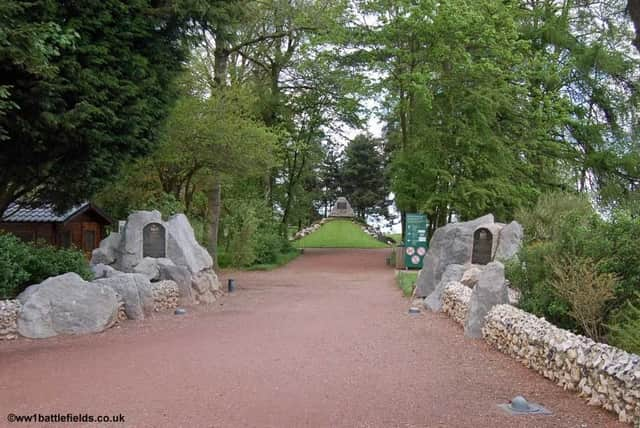
Today, the ground over which the Newfoundland Regiment fought on July 1 1916 is a Memorial Park which commemorates all the Newfoundlanders who fought in the Great War, particularly those who have no known grave. The site was officially opened by Field Marshal Earl Haig on June 7 1925.
On a mound, surrounded by rock and shrubs native to Newfoundland, there stands a great bronze caribou, the emblem of the Newfoundland Regiment. Situated close to the headquarters dugout of the 88th Brigade, of which the Newfoundland Regiment was a part, the caribou nobly faces in the direction of the former foe, overlooking the trenches and ground across which the battalion endeavoured to advance that grim July day.
At the base of the mound, three bronze tablets carry the names of 820 members of the Royal Newfoundland Regiment, the Newfoundland Royal Naval Reserve, and the Mercantile Marines who gave their lives in the First World War and have no known grave.
Back home, a practical memorial to Newfoundland’s fallen was opened in September 1925: the Memorial University of Newfoundland, the largest university in Atlantic Canada.
Peter Hart, the Canadian historian and one of its alumni, deserves mention for two impressive books: ‘The IRA and Its Enemies, Violence and Community in Cork, 1916–1923’ (1998) and ‘The IRA at War 1916–1923' (2003).
Hart focused renewed attention to the Dunmanway killings in west Cork between April 27–29 1922 when 13 Protestant men and boys were shot by the IRA. He suggested that such sectarian attacks and intimidation played a direct role in the decline of the Protestant population in the 26 counties.