
Somme commander Oliver Nugent had a testy relationship with Unionist politicians, but commanded the respect of his troops
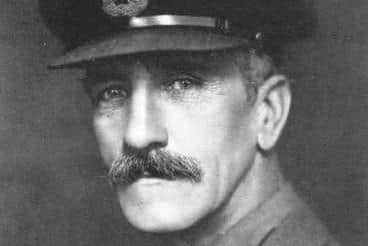
Oliver Nugent was born on November 9 1860 at Aldershot. He was the son of Major-General St George Mervyn Nugent and Emily, daughter of Rt Hon Edward Litton, the MP for Coleraine between 1837 and 1843.
The Nugents, whose home was Farren Connell, Mount Nugent, at the very southern extremity of Co Cavan (these days it has a Meath postal address), were a family long-established in Ireland.

The first Nugent to settle in Ireland was Hugh de Nugent – who died in 1213 – who came here with Hugh de Lacy, the first earl of Ulster. Socially and politically the Nugents were Anglo-Irish but ethnically they were Anglo-Norman.
Oliver was educated at Harrow, and entered the Royal Munster Fusiliers in 1882, transferring to the King's Royal Rifle Corps in the following year.
His early Army service was spent on the North-West Frontier of India. In 1897-8 Nugent attended staff college where one of his fellow students was Douglas Haig.
Promotion was slow in this era: he was a captain in 1890 and in 1899 he became a major. It was also in 1899 Nugent married Catherine Percy, daughter of T Evans Lees and Mrs Lees, of Wimborne, Dorset.
Our detailed knowledge of his military career is due to his invaluable correspondence with his wife from 1899 onwards. His marriage coincided with the outbreak of the Boer War. They discussed, as far as censorship allowed, the progress of the campaign, and his severe wounding and convalescence in a prisoner-of-war camp in Pretoria. (Doctors were unable to remove a bullet lodged close to his spine which caused him pain for the rest of his life.)
Their correspondence continued after the end of hostilities, and follows Nugent’s career in England, Ireland and India until the outbreak of the First World War.
Placed on the half-pay list on February 14 1914, he returned to Ireland and helped train the UVF in his ancestral county. Nugent’s papers include material relating to the Co Cavan regiment of the UVF, between March and June 1914. They include a copy of the Cavan Volunteer Force Defence Scheme, camp orders, diary of work, expenditure and list of quotations for supplies related to a Camp of Instruction held in March 1914, a memorandum on training and an order regarding the holding of day parades.
At the outbreak of the Great War Nugent was given command of a brigade in France with the temporary rank of brigadier-general. As the Ulster Division completed its training, Nugent took over command from Major-General Powell.
Despite his Ulster Protestant background, Nugent’s relationship with Ulster Unionist politicians was fraught because his perspective was essentially that of an Irish Unionist rather than that of an Ulster Unionist. Furthermore, he irked those politicians by refusing to subordinate military professionalism to political considerations.
Nugent wrote 600 letters home which cover the period between May 1915 and April 1918 when he commanded the Ulster Division. They provide a daily record of life on the Western Front.. Thirty cover the period of the Somme offensive.
On the eve of the Somme offensive Nugent wrote to Sir George Richardson, the commander of the UVF back home: ‘We could hardly have a date better calculated to inspire national traditions amongst our men of the North.’
Nugent was alluding to the fact that the postponement of the offensive for two days resulted in the Ulster Division’s first major engagement falling on the same date as the Battle of the Boyne 226 years earlier.
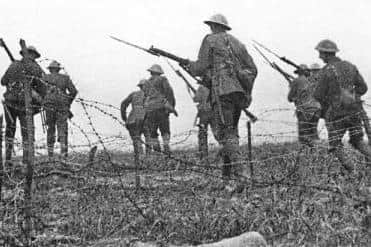
Nugent’s plan – unlike that of most divisional commanders – was to send men out in to no-man’s-land before zero hour where they would wait, protected by the curtain of shell-fire on the German lines, so that they were much closer to their objective when the whistle blew.
Initially, Nugent addressed his men after the opening of the Battle of the Somme with the words, ‘Men, you've done very well but you might have done better’. ‘There was a lot of murmuring in the ranks, and some thought he was anything but a gentleman’. However by July 5 he had revised his opinion sufficiently to confess that he had commanded ‘the best troops in the world’.
He redeemed himself by issuing the following Special Order of the Day: ‘The General Officer Commanding desires that the Division should know that in his opinion nothing finer has been done in the war than the attack by the Ulster Division on 1st July … There is nothing in the operations carried out by the Ulster Division that will not be a source of pride to all Ulstermen.’
The Special Order spoke further of ‘the standard of gallantry and devotion that may be equalled, but is never likely to be surpassed’.
The Special Order concluded ‘Ulster has every reason to be proud of the service of our country. Though many of our best men have gone, the spirit which animated them remains in the Division, and will remain never die’.
Nicholas Perry, Nugent’s biographer, contends that Nugent’s key contributions to the division’s initial success were his comprehensive pre-battle training and his decision to push his leading waves into no-man’s land before zero hour, so enabling then to overrun the forward German positions before they could be manned.
Nugent’s correspondence covers the Battle of Messines in June 1917, Langemarck in August 1917 and Cambrai in November 1917 and the great German offensive of March 1918. Messines was a stunning success. Of Langemarck, Nugent wrote to his wife, ‘It has been a truly terrible day. Worse than 1 July I am afraid’.
During the ‘Kaiserschlacht’ of March 1918, the Ulster Division only narrowly escaped annihilation. Nugent skilfully held it together through nine days of ferocious combat and a series of fighting withdrawals, at a cost of over 6,000 casualties.
Nugent was to remain with the division until May 6 1918. However, before leaving the division Nugent executed a Trust Deed establishing a trust for the benefit of officers and men of the division, their wives, widows, orphans or dependants.
On May 7 Nugent returned to England, preparatory to taking up his final command in India, where he commanded the Meerut Division in the Afghan War of 1919.
In 1920 he retired from the Army. Relations with Douglas Haig were never harmonious and it was widely believed that Haig played a significant role in delaying Nugent’s knighthood which only materialised in 1921 through the efforts of Field Marshal Sir Henry Wilson who had greatly admired Nugent’s professionalism.
Nugent died from pneumonia on May 31 1926. A memorial service was held in St Anne’s Cathedral which was attended by hundreds of Ulster Division veterans, deeply conscious of his genuine concern for their welfare, but Unionist politicians largely chose to absent themselves.