
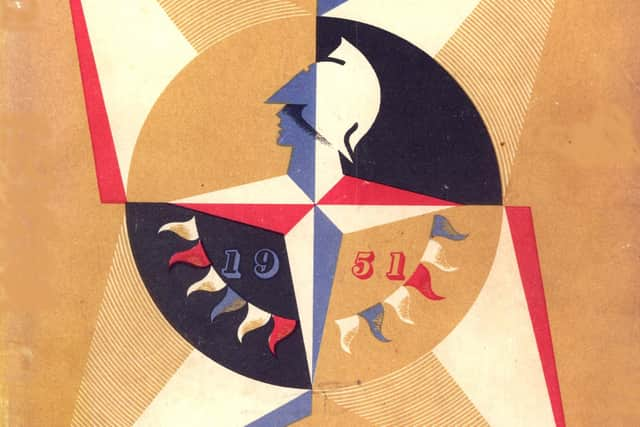
The Festival of Britain in 1951 held out the promise of a brighter and more colourful future
The Great Exhibition of 1851 – the ‘Great Exhibition of the Industries of All Nations’ – proved a stunning popular and financial success. So much so that in the middle of the Second World War the Royal Society of Arts, the same organisation which organised the Great Exhibition, boldly suggested marking the centenary with a similar event.
In 1947 Herbert Morrison, the deputy prime minister in the post-war Labour government, took up the idea with the intention of boosting national morale, celebrating British achievements in science, technology, and the arts, and providing, in the words of Gerald Barry, a prominent left-leaning newspaper editor and the project’s director-general, a ‘tonic for the nation’ to counter post-war austerity.

Post-war Britain was a grey and drab place. There was a severe housing crisis courtesy of the Blitz and the Luftwaffe and a need to build 750,000 new dwellings to address the crisis.
Wartime rationing had to be continued due to shortages of food and raw materials and in some ways was stricter after 1945, with bread rationing introduced in 1946 and potato rationing in 1947.
When Queen Elizabeth II came to the throne in 1952 sugar, butter, cheese, margarine, cooking fat, bacon, meat, and tea were all subject to rationing. (Rationing only ended in 1954.)
There were serious political objections to the festival from both Labour and Conservative MPs. Labour critics viewed it as a waste of time and a diversion of scarce resources at a time when there was an urgent need for new homes and job creation. Conservatives, including Churchill, viewed the project as ‘three-dimensional socialist propaganda’ (which up to a point it was).
Clem Attlee, the prime minister, wrote to Morrison expressing the hope that an election in autumn 1951 would enable the Labour Party to benefit from the popularity of the festival.
Unlike the Great Exhibition, the festival was not another world fair because international themes were absent, as was the Commonwealth. The focus was entirely on the UK and its achievements.
The Festival of Britain was opened by a conspicuously frail King George VI and Queen Elizabeth in a ceremony at St Paul's Cathedral on May 3 1951 and opened to the public on May 4.
Lambeth-born Morrison was a proud Londoner, so it ought to come as no great surprise that the main focus of the festival was a 27-acre site on the south bank of the Thames at Lambeth. (Morrison took the title Baron Morrison of Lambeth when raised to the peerage in 1959.)
Festival pavilions told the story of the British contribution to world civilisation, from the past to the present and the future. The various structures housed 20,000 exhibits. The theme of the upstream site was the Land of Britain, and the downstream was the People of Britain.
The famous Dome, built of prefabricated steel and aluminium, was the central and dominating structure of the festival.
At 365 feet in diameter and 93 feet in height, it was four times larger than the Albert Hall. Its galleries accommodated exhibitions with the overall theme of discovery. There were eight sections that included land, sea, sky, and outer space.
Another feature of the festival site was the 296-feet tall Skylon. A futuristic-looking, slender, vertical, cigar-shaped structure of steel and aluminium supported almost invisibly by cables that towered above the site, it looked like a space rocket poised for take-off. Contemporaries joked that, like the British economy of 1951, ‘It had no visible means of support’.
The second largest structure after the Dome was the Festival Hall. Planned and built by the London County Council as a permanent concert venue, it was incorporated into the exhibition.
Developing the South Bank site was a massive undertaking, planned and completed during a period of industrial disputes and skilled labour shortages. The value of sterling was continually falling, making many of the imported construction materials ever more expensive or less available. Astonishingly, the festival opened on time and within budget.
As the festival was largely centred on London, plans were considered for tours of the exhibition around the country but these were scaled back because they would have been too expensive to implement in full.
Although no comprehensive list exists, events were organised all over the UK. Many of these would have taken place anyway but in the summer of 1951 they were badged as part of the festival.
In Northern Ireland the major event was the Ulster Farm and Factory Exhibition in Belfast, where linen technology and agriculture were celebrated and two farms were built: an 1851 farmhouse and a Farm of the Future.
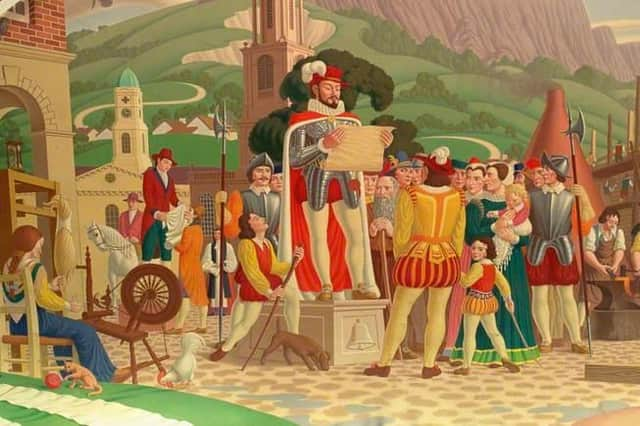
The Committee for the Encouragement of Music and the Arts, the precursor of the Arts Council, commissioned John Luke to paint a mural in Belfast City Hall to commemorate the festival.
Luke made Sir Arthur Chichester, the founder of modern Belfast, reading King James I and VI’s Charter of 1613, which could be regarded as the birth certificate of the city, the focus of his work.
The mural celebrates the industries which would form the basis of Belfast’s future prosperity – shipbuilding, rope making, engineering and linen.
As 19th-century Belfast was known as ‘Linenopolis’ because of its reputation as a world leader in linen manufacturing, Luke perhaps chose to emphasise this by depicting a bleaching green, flax growing, spinning and weaving.
Although the festival was both a popular and critical success attracting 8.5 million visitors, it figures less prominently in popular memory than one might expect. This may be because of the festival infrastructure was churlishly dismantled by the Conservative government elected in October 1951. The only significant edifice to survive is the Festival Hall. If the festival had been a high point in post-war national life, it was quickly eclipsed by the excitement and preparations for the Coronation in June 1953.
Yet there was a legacy because the festival held out the promise of a brighter and more colourful future, acted as a catalyst for a new design aesthetic and launched the careers of noted British architects, artists and designers (Terence Conran’s name springs to mind) whose work would flourish in the 1950s and even more so the 1960s.
The Festival of Britain might even be considered as a dress rehearsal for the 1960s.