
The Great Exhibition of 1851 marked the pinnacle of Great Britain’s industrial dominance
In a speech delivered at the Mansion House in March 1850 to promote the upcoming Great Exhibition of 1851, Prince Albert, the consort of Queen Victoria, expressed his fervent belief as a liberal free trader that technology and industry were bridging the gaps between nations.
A trifle optimistically (or even naively), he described the era as ‘a period of most wonderful transition, which tends rapidly to accomplish that great end, to which all history points – the realisation of the unity of mankind’.

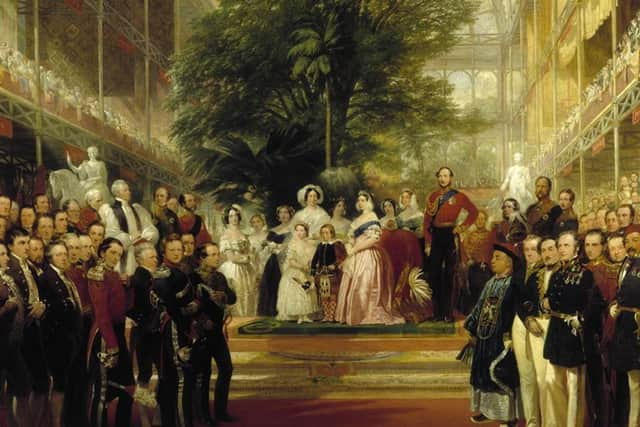
Queen Victoria opened ‘the Great Exhibition of the Industries of All Nations’ on May 1 1851. Taking her cue from her husband, Victoria hailed the event as a ‘great peace festival’. A real enthusiast for the venture, Victoria visited the exhibition three times with her family, and, according to some accounts, perhaps as many as 34 times on her own.
The Great Exhibition primarily had its origins in the annual exhibitions of the Royal Society for the Encouragement of Arts, Manufactures and Commerce (usually abbreviated to the Society of Arts), of which Albert was president since 1843. Without his efforts the Great Exhibition might never have happened because he had to fight for every stage of the project.
Henry Cole, an assistant keeper at the Public Record Office, a council member of the Society of Arts and a man with ‘a conspicuous talent for getting things done’, also played a major role in converting the vision into reality.
Through his membership of the Society of Arts, Cole vigorously lobbied government to support his campaign to improve standards in industrial design. In 1847 the society secured a royal charter and Cole organised a successful Exhibition of Art Manufactures in 1847. In 1848 and 1849 he organised more ambitious exhibitions. Visiting the 11th Quinquennial Paris Exhibition in 1849, he had identified the absence of an exhibition open to international participants and decided that the Royal Society of Arts’ planned exhibitions for 1850 and 1851 could fill the void.
In 1850 Cole secured Queen Victoria’s support for the appointment of the Royal Commission for the Exhibition of 1851 under the presidency of Albert and himself as chief administrator.
The Great Exhibition was held in Hyde Park from May 1 to October 15 1851.
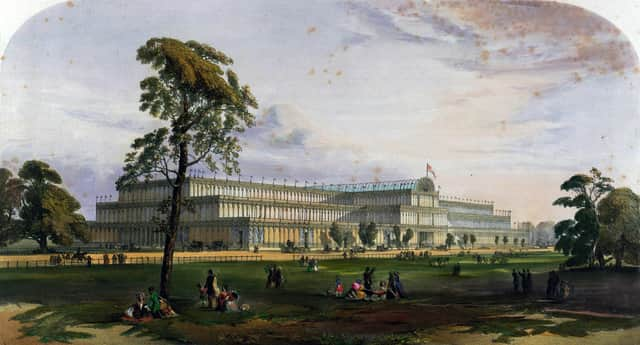
The architecturally innovative exhibition hall was constructed of glass with a cast-iron frame and designed by Joseph Paxton, the head gardener at Chatsworth who had created greenhouses for the 6th Duke of Devonshire.
The building was erected in just nine months by over 2,000 workers. It was huge, tall enough to accommodate full-grown elm trees, a pipe organ and an eight-metre glass fountain. It covered an area equivalent to 18 football pitches.
At the time it was by far the largest enclosed space ever built. The Crystal Palace was an engineering triumph in its own right. Punch dubbed it the ‘Crystal Palace’ and the name stuck.
Although billed as the ‘Great Exhibition of the Industries of All Nations’, in practice, the Great Exhibition glorified British manufacture: over half the 100,000 exhibits were from the UK or its overseas possessions.
The western half of the building was given over to Britain and its colonies. As ‘Linenopolis’, Belfast’s contribution to the great Exhibition included high-quality linens, highlighting the city's dominance in this sector. Belfast manufacturers contributed to the machinery section, reflecting the city's growing prowess in engineering.
The eastern half of the building was devoted to the rest of the world with 34 nations and over 14,000 exhibitors represented.
The exhibits were in four broad categories: raw materials, machinery, manufactures and fine-art objects. They ranged from steam-powered machines and giant engines to cutting-edge scientific tools and clever technological innovations. They also extended to beautiful silks, porcelain, tapestries and statuary.
Through Cole’s astute management the Great Exhibition proved a stunning popular and financial success.
Six million people – equivalent to a third of the entire population of Great Britain or more than 28% of the population of the UK at the time – visited the Great Exhibition. (They included Darwin, George Eliot, Charlotte Brontë, Tennyson and Marx.) The average daily attendance was 42,831 with a peak of 109,915 on October 7.
The comprehensive British railway network made this possible. Thomas Cook, the travel operator, expanded his business by organising excursions to the exhibition.
Financially, the exhibition generated a surplus of £186,000 (£33 million in 2023), which was used to fund the Victoria and Albert Museum, the Science Museum, and the Natural History Museum in South Kensington, the area to the south of the exhibition that was nicknamed ‘Albertopolis’. The remaining surplus was used to set up an educational trust to provide grants and scholarships for industrial research. It continues to do so today.
Being the first country in the world to experience the Industrial Revolution, Britain had achieved global pre-eminence in terms of industrial production and was enjoying an age of peace and unparalleled prosperity. The exhibition enabled Victorian Britain to celebrate its industrial successes and showcase them to the world.
As the 1851 exhibition was the first ever international exhibition of manufactured products, it inspired a succession of international fairs in other cities, including Paris, Dublin (in 1853), New York, Vienna, Philadelphia (in 1876 to mark the centenary of the Declaration of Independence) and Chicago – virtually one a year for the rest of the 19th century.
Although the Great Exhibition represented the pinnacle of British industrial dominance, exposure to international competition perhaps ought to have served as a wake-up call for British industry. British exhibits were upstaged by the French in terms of design flair, the Germans in terms of precision engineering, and the Americans in terms of large-scale manufacturing.
Within decades the UK would be overtaken by the US and Germany in terms of industrial production. By the 1870s the US was catching up fast and by the 1890s the US economy was larger than the British one. Following German unification, Germany experienced rapid industrial expansion, overtaking the UK’s share of world manufacturing output prior to the First World War.