
There was so much more to John Buchan than classic novel ‘The Thirty-Nine Steps’
John Buchan, the future Lord Tweedsmuir, combined a successful literary career as a novelist and biographer with a distinguished career in public life, culminating in his appointment as governor-general of Canada in 1935. As he often liked to observe: ‘Publishing is my business, writing my amusement and politics my duty.’
Born in Perth on August 26 1875, he was the son of a Free Church minister, also called John Buchan.
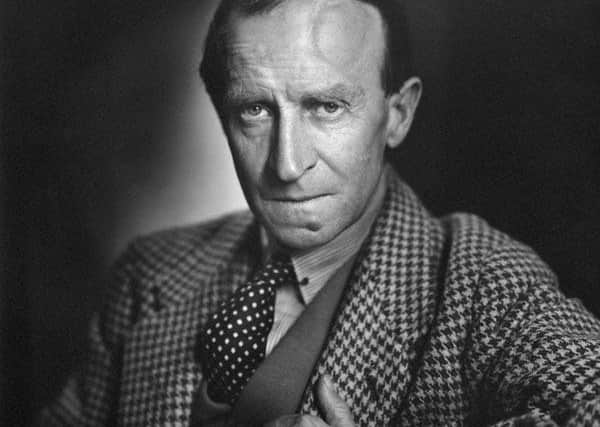

Although he was brought up near Kirkcaldy in Fife, he spent his summer holidays with his maternal grandparents in Broughton in the Scottish Borders, an area for which he retained life-long affection.
His love of its landscape and wildlife is evidenced in many of his novels. Sir Edward Leithen, whose surname is borrowed from the name of a tributary of the River Tweed, features in his later novels. Buchan’s affection for the area is also reflected in the choice of title for his peerage.
In 1888 his father’s ministry took him to the Gorbals in Glasgow and Hutcheson Grammar School. Aged 17, he obtained a scholarship to study classics and mathematics at Glasgow University. A second scholarship allowed Buchan to continue his studies at Brasenose College, Oxford.
He wrote his first books while still a student at Oxford: ‘Sir Quixote of the Moors’, a novel and ‘Scholar Gypsies’ (1896), a collection of essays.
On graduation, Buchan was called to the Bar but he only practised briefly. More importantly he became private secretary to Lord Milner, the High Commissioner for South Africa, between 1901 and 1903, thereby becoming a member of Milner’s Kindergarten, as Milner’s bright young protégés were known.
Milner also provided him with an entrée into the highest echelons of British society and brought him into contact with the Empire’s movers and shakers.
Much to the chagrin of his strict ‘Wee Free’ mother, in 1907 Buchan married Susan Grosvenor, an Anglican and a cousin of the Duke of Westminster.
He had been working for the Edinburgh publisher Thomas Nelson and Sons since 1903. To meet his new responsibilities, he now became the firm’s principal literary advisor. By 1915 he was a director of the firm. He also spent a great deal of time writing for and editing The Spectator.
Drawing on his South African experience, in 1910 he published ‘Prester John’, the story of David Crawfurd, a young Scot, and his adventures centring on a Zulu uprising linked to the medieval legend of Prester John, a Christian patriarch, presbyter and king.
In 1911 he was selected as the Unionist candidate for the Borders constituency of Peebles and Selkirk. A Liberal marginal, Buchan nursed it assiduously, expressing support for free trade, women’s suffrage and national insurance and deploring what he considered to be class hatred fostered by Lloyd George. The general election was due before the end of 1915 but was put on hold because of the Great War.
Buchan’s poor health precluded him from being a combatant but he did serve as war correspondent for The Times, on the Headquarters Staff of the Army in France as temporary Lieutenant Colonel (1916-17), as Director of Information (1917-18) and, briefly, as Director of Intelligence.
‘The Thirty-Nine Steps’ was written in 1915 when he was confined to bed with a duodenal ulcer, a condition which plagued him for rest of his life. His first novel featuring Richard Hannay, Buchan described it as a ‘shocker’ (which he defined as an adventure where the events in the story are unlikely and the reader is only just able to believe that they really happened).
Hannay was modelled on Edmund Ironside, an Edinburgh acquaintance who spied on German forces in South-West Africa (now Namibia) during the Second Boer War and who became Chief of the Imperial General Staff in 1939.
In ‘Greenmantle’ (1916) Hannay’s mission is to discover the identity of a Muslim prophet whom the Germans intend to manipulate to foment rebellion in the Islamic world. He was assisted by his friend Sandy Arbuthnot who was based on Aubrey Herbert, the second son of the 4th Earl of Carvarvon. In real life Herbert twice declined the Albanian throne. Hannay was also assisted by John Scantlebury Blenkiron, an American who, like Buchan, suffered from a duodenal ulcer.
Hannay is the principal character in three further novels: ‘Mr Standfast’ (1919), ‘The Three Hostages’ (1924) and ‘The Island of Sheep’ (1936).
John Buchan probably would be miffed that he is remembered for his Hannay ‘shockers’ rather than his more serious work but they have never been out of print since they were published.
Furthermore, ‘The Thirty-Nine Steps’ has been successfully transferred to the big screen in 1935, 1959 and 1978. Alfred Hitchcock’s 1935 version, starring Robert Donat, is widely regarded as a masterpiece.
Buchan was a prolific author, producing nearly 30 novels, seven collections of short stories and biographies of Montrose, Sir Walter Scott (his literary hero), Augustus and Oliver Cromwell.
A significant figure in the cultural life of Scotland, he was both president of the Scottish Historical Society and a trustee of the National Library of Scotland.
In 1927 he finally became an MP, being elected as a Unionist at a by-election for the Combined Scottish Universities seat.
King George V appointed him as Lord High Commissioner to the General Assembly of the Church of Scotland in both 1933 and 1934.
He was raised to the peerage prior to going to Canada as governor-general and made a point of travelling the length and breadth of the vast country, including the Arctic regions, to promote Canadian unity and to get to know all her people. Allegedly he became more Canadian than the Canadians.
As governor-general, he established an excellent rapport with President Roosevelt, an admirer of Buchan's work, seeking to develop closer relations between the British Empire and the United States, particularly in the face of rising threat of Nazi Germany. FDR valued Buchan's insights and sought his advice on international affairs, particularly as war loomed. Unfortunately, Buchan did not live long enough to see his ambition come to fruition.
When he died on February 11 1940, Mackenzie King, the Canadian prime minister, observed that Canada had lost ‘one of the greatest and most revered of their Governors-General’.