
There’s much more to David Crockett, 'King of the Wild Frontier', than the legend of the Alamo
David (rather than Davy) Crockett, ‘King of the Wild Frontier’, is an American folk hero and legend.
Joseph Louis Crockett and Sarah Stewart, his Ulster-Scots great-great grandparents, both hailed from north-west Ulster. Joseph grew up in either Castlederg or Donemana, while Sarah came from Manorcunningham. Joseph and Sarah arrived in America circa 1708.

Despite the ballad, David Crockett was not ‘born on a mountain top in Tennessee’. He was born on August 17 1786 in Greene County which was not yet part of Tennessee.
Crockett served in the Tennessee militia during the Creek War and the War of 1812. He often hunted wild game for hungry soldiers, believing that role better suited him than soldiering.
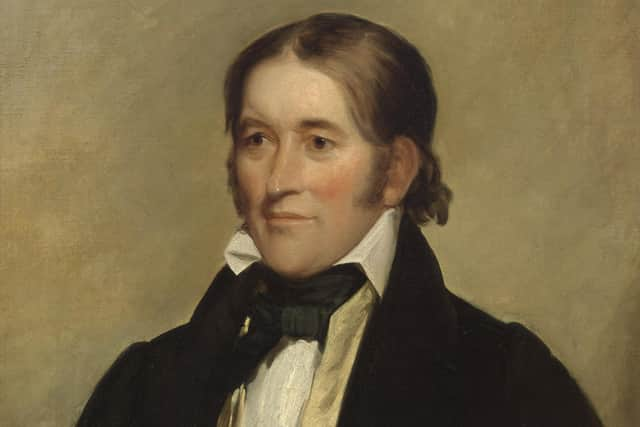
Although Crockett promoted himself as a simple but honest man who was an outstanding hunter and marksman, he did embellish his life with tall stories in his autobiography entitled ‘A Narrative of the Life of David Crockett of the State of Tennessee’ which was published in 1834.
While he never claimed to have killed a bear at the age of three, he did claim to have killed 105 bears in a single season which is perfectly credible.
The autobiography gave him a national profile which was reinforced by heavily publicised tours of eastern cities and admiring books and almanacs written by others.
But the real legend of Davy Crockett came about in the 1950s with a Disney television series about Crockett and a Disney movie about the Alamo.
In 1821, David was elected to the Tennessee General Assembly where he became a spokesman for the frontier people. He represented Tennessee in the US House of Representatives from 1827 to 1831 and again from 1833 to 1835.
Crockett was not a hick politician but a principled, courageous and humane one who opposed Andrew Jackson on land reform and the Indian removal bill which forced Native Americans off their land and resulted in the death of thousands through disease, starvation, and exposure during the ‘Trail of Tears’ to present-day Oklahoma.
President Jackson, of course, was a fellow Tennessean and Ulster Scot and a former political ally.
Crockett explained his opposition: ‘I believed it was a wicked, unjust measure ... I voted against this Indian bill, and my conscience yet tells me that I gave a good honest vote, and one that I believe will not make me ashamed in the day of judgement.’
To frustrate Crockett’s possible presidential ambitions, Jackson and the governor of Tennessee orchestrated Crockett’s defeat by 252 votes in his bid for re-election to the Congress in 1835.
In response, he said: ‘I told the people of my district that I would serve them as faithfully as I had done; but if not, they might go to hell, and I would go to Texas.’
He did not go specifically to join the fight for Texan independence from Mexico but went because all his life he kept moving west in search of better land and better opportunities as so many Ulster-Scots people did.
In February 1836 he joined Colonel William B Travis, a Texan army officer and lawyer, and Jim Bowie, a figure with much in common with Crockett, at San Antonio. On February 20 General Antonio Lopez de Santa Anna, the Mexican president, laid siege to the Alamo, a former Spanish mission station in San Antonio, occupied by Travis, Bowie and their tiny force of perhaps 200 men. By contrast, Santa Anna had an army of approximately 2,000.
During Santa Anna’s initial shelling of the Alamo, Travis noted that Crockett was ‘everywhere animating the men to do their duty’.
The Texans held out for 13 days against overwhelming odds and withstood two determined Mexican assaults but they could not repel the third assault on March 6. Before the battle the Mexicans had raised a red flag indicating that they would give no quarter. Thus, the Alamo’s brave defenders all perished.
It is impossible to determine exactly how Crockett died.
Joe, Travis's slave and the only adult male Texan to survive the battle, reported seeing Crockett lying dead with slain Mexicans around him and stated that only one man surrendered and he was promptly shot.
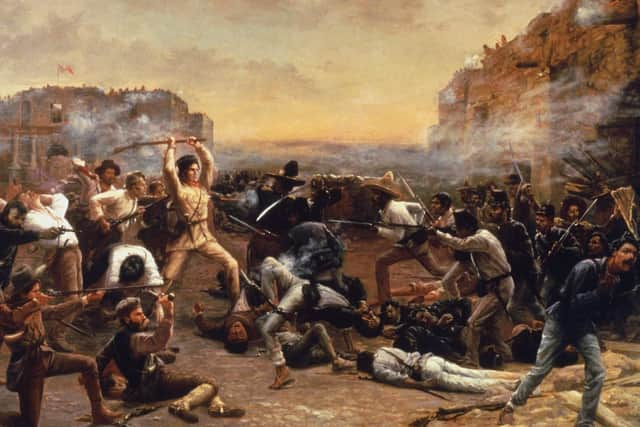
‘The Fall of the Alamo’ (1903), a famous painting by Robert Jenkins Onderdonk, depicts Crockett swinging his rifle at Mexican troops who have breached the south gate of the mission until cut down by bullets and bayonets.
A former slave named Ben, who had acted as cook for one of Santa Anna's officers, corroborates Joe’s testimony.
Ben maintained that Crockett's body was found surrounded by ‘no less than 16 Mexican corpses’, with Crockett's knife buried in one of them.
An alternative account asserts that Crockett did not die in battle but that he and five or six others surrendered, and they were executed soon afterwards.
The principal source for this is the memoirs of Lieutenant José Enrique de la Peña, a Mexican officer present at the Battle of the Alamo, and self-published as ‘La Rebelión de Texas – Manuscrito Inédito de 1836 por un Oficial de Santa Anna’ which came to light in 1955. An English translation, entitled ‘With Santa Anna in Texas: A Personal Narrative of the Revolution’, appeared in 1975.
Proud Texans repudiate this account and there are grounds to suggest that they may be right.
Significantly, no other officer under Santa Anna's command mentions Crockett's surrender, not even his personal secretary Ramon Caro. Santa Anna’s memoir only states that Crockett's body was ‘among the corpses’ without explaining how he died. Furthermore, Santa Anna observed: ‘Not one soldier showed signs of desiring to surrender.’
Although a defeat for the Texans, the Alamo became a rallying point for their cause and a symbol of courage and sacrifice. ‘Remember the Alamo’ was the battle cry of Sam Houston’s Texan army which defeated Santa Anna at San Jacinto, the decisive battle in Texan war for independence.
Without the Alamo there would have been no San Jacinto, thus it has become the central event in the history and mythology of ‘The Lone Star State’ and Crockett was the Alamo’s most famous defender and the place where history and legend fuse.