
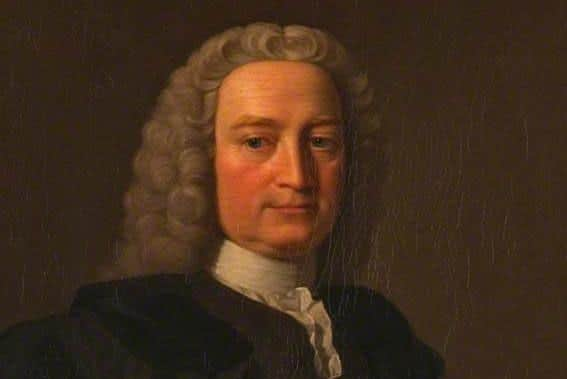
Ulster-born Francis Hutcheson, the unheralded influence on the US Declaration of Independence
Thomas Jefferson, a superb wordsmith, was the primary author and drafter of the Declaration of Independence rather than the document’s sole author and drafter.
By his own admission, Jefferson candidly conceded that the Declaration contained no original ideas, but was instead a statement of sentiments widely shared by supporters of the American Revolution.

As he explained in 1825: ‘Neither aiming at originality of principle or sentiment, nor yet copied from any particular and previous writing, it was intended to be an expression of the American mind, and to give to that expression the proper tone and spirit called for by the occasion’.
From where did these sentiments originate? John Locke, the 17th-century English political philosopher and author of ‘Two Treatises on Government’ is usually credited with being one of the primary influences. (Jefferson regarded Francis Bacon, John Locke and Isaac Newton ‘as the three greatest men that have ever lived’.)
However, in ‘Inventing America: Jefferson's Declaration of Independence’ (1978), the US historian Gary Wills contended that ‘the air of enlightened America was full of Hutcheson's politics, not Locke's’. In other words, Jefferson was more influenced by the ‘Scottish Enlightenment’, especially Francis Hutcheson, than by Locke.
Hutcheson championed ‘unalienable rights’ and thereby provided the moral justification to resist tyrannical government.
Hutcheson also popularised the concept of fundamental rights that individuals cannot surrender. He championed the concept of the ‘greatest happiness for the greatest numbers’, which may have inspired Jefferson's immortal phrase ‘Life, Liberty and the pursuit of Happiness’.
Like Locke, Hutcheson argued that government was a social contract. If a ruler violated the rights of the people, the contract was broken and the people had the moral authority to overthrow the tyrannical regime.
Hutcheson was Professor of Moral Philosophy at the University of Glasgow from 1729 to 1746 and used to be widely regarded as ‘the Father of the Scottish Enlightenment’. His most famous student, Adam Smith, author of ‘The Wealth of Nations’, referred to his mentor as ‘the never to be forgotten Hutcheson’.
Hutcheson was born on August 8 1694 at Drumalig, between Carryduff and The Temple. His grandfather, the Rev Alexander Hutcheson, came from Ayrshire and was appointed by the Commonwealth as the Puritan Pastor of Saintfield. After the restoration of Charles II in 1660 the Church of Ireland ejected him from the parish church but he became the village’s Presbyterian minister. Francis Hutcheson grew up in his grandfather’s home and was educated at a Presbyterian academy in Killyleagh.
Hutcheson’s father, the Rev John Hutcheson, was minister of Downpatrick between 1690 and 1697 and then received a call to Armagh.
Between 1711 and 1716 Francis Hutcheson studied philosophy, classics, and theology at the University of Glasgow where he came under the influence of John Simson, Professor of Divinity at the university. Simson was tried for heresy by the General Assembly in 1715. The controversy dragged on for years but eventually resulted in Simson’s suspension from academic teaching in 1729.
Hutcheson had imbibed Simson’s ‘New Light’ theology whereas John Hutcheson remained an ‘Old Light’ Presbyterian. Hutcheson, like Simson, subscribed to a more optimistic view of humanity than that suggested by the doctrine of the Fall and original sin.
Despite these views, suspect from an orthodox Calvinist perspective, the General Synod of Ulster licensed Hutcheson as a probationer in 1719.
He also received a call to Magherally in Co Down but never became minister of that congregation because he founded a very successful private academy in Dublin instead. He employed Thomas Drennan, father of Dr William Drennan, the founder of the United Irishmen, as his assistant.
During this period Hutcheson enjoyed the patronage of Viscount Molesworth, a member of the Royal Society, friend of John Locke and William Molyneux and leader of intellectual society in Dublin. After Molesworth’s death Hutcheson attracted the favourable attention of Lord Carteret, Ireland’s intellectually curious Lord Lieutenant, with the publication of his ‘Inquiry into the Original of our Ideas of Beauty and Virtue’ in 1725.
Hutcheson also found himself courted by several Church of Ireland bishops who wished him to conform to the Established Church. He even became friendly with Hugh Boulter, the Church of Ireland Archbishop of Armagh. Although sorely tempted by the prospect of preferment in the Established Church (and it is even alleged, somewhat improbably, that the Provostship of Trinity College, Dublin, was dangled before him) Hutcheson chose to remain a Presbyterian.
In 1729 he returned to Glasgow as professor of Moral Philosophy, a position he held until his death. A charismatic teacher, in a break with tradition he lectured in English rather than Latin. Although Hutcheson would have twice subscribed to the Westminster Confession of Faith, first as a licentiate of the General Synod of Ulster and then as professor of Moral Philosophy at Glasgow, his views were not strictly orthodox. Like Simson, his views attracted opposition. In 1738 the Glasgow presbytery challenged his assertion that people can have knowledge of good and evil without, and prior to, knowledge of God. However, Hutcheson did not suffer Simson’s fate and his popularity as a preacher remained undiminished.
Hutcheson’s ethical theory was propounded in his ‘Inquiry into the Original of Our Ideas of Beauty and Virtue’ (1725), in ‘An Essay on the Nature and Conduct of the Passions and Affections, with Illustrations upon the Moral Sense’ (1728), and in his posthumous ‘System of Moral Philosophy’ (1755).
Hutcheson’s influence was by no means confined to Scotland. The growth of ‘New Light’ Presbyterianism in Ulster owed much to Hutcheson, although other influences must be acknowledged. Through Thomas and William Drennan, his political thought greatly influenced that of the United Irishmen in Ulster, especially with respect to the centrality of parliamentary reform, secret ballots and frequent elections.
As we have already noted, Hutcheson’s assertion that men had an inalienable right to enjoy freedom of opinion and to resist the tyranny of oppressive rulers had a powerful appeal in the American colonies in the years before the outbreak of the American Revolution.
Francis Alison, a student of Hutcheson’s from Leck (near Letterkenny), played a significant role in transmitting Hutcheson’s ideas in America. As minister of the Presbyterian Church in New London, an early Ulster-Scots settlement in Chester County in Pennsylvania, Alison had established a school. The school’s first class had 10 students. Of the 10, three – George Read, Thomas McKean, and James Smith – would go on to sign the Declaration of Independence. As the Declaration only had 55 signatories, this is a rather impressive statistic.
In his ‘System of Moral Philosophy’ Hutcheson was one of the first to challenge the moral basis of slavery: ‘All men [without exception] have strong desires of liberty and property’, and ‘that no damage done or crime committed can change a rational creature into a piece of goods void of all right’. Adam Smith in his ‘The Theory of Moral Sentiments’ also propagated these views.