
Ulster-Scot general Richard Montgomery died in failed US bid to take Canada 250 years ago
There is a precedent for President Trump wishing to make Canada the 51st state.
Two hundred and fifty years ago the Americans sought to make Canada the 14th colony, an episode in American history recounted by Justin Harvey Smith in his immensely detailed two-volume work entitled ‘Our Struggle for the Fourteenth Colony: Canada and the American Revolution’ (1907).
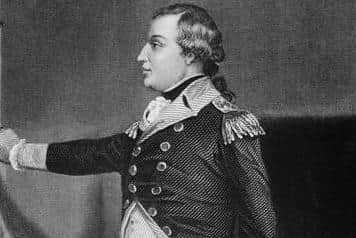

Ulster-Scot Richard Montgomery was a key figure tasked with responsibility for converting aspiration into reality.
Montgomery was born on December 2 1738 near Swords, Co Dublin, into a prominent landed and political Donegal family. His father Thomas Montgomery was the MP for Lifford, Co Donegal. His elder brother Captain Alexander Montgomery also served as an MP for the county, as did a cousin also called Alexander Montgomery.
Despite his academic prowess at TCD, he became a soldier and served in the Seven Years’ War against France in North America and the Caribbean.
At the end of the war he was stationed in New York, returning to England in 1765. Moving in political circles, he became friendly with prominent Whigs, notably Charles James Fox and Edmund Burke.
Disappointed at being passed over for promotion to major, he sold his commission in April 1772 and moved to New York where he embarked on the life of a gentleman farmer.
Although he had decided never to marry, in July 1773 he married Janet Livingston, whom he had met eight years earlier, the daughter of the immensely wealthy Judge Robert Livingston, and spent the first few years of his marriage at his wife's residence near Rhinebeck, New York.
The Livingston family held strong ‘Patriot’ views and Montgomery came to embrace the political outlook of his wife’s family. Arguably, his alignment with the Whig party would have taken him in the same direction because Fox and Burke sympathised with the cause of the American colonists. In May 1775 he was elected to represent Dutchess County in the New York provincial congress.
On account of his military experience, he was appointed a brigadier-general in the American continental army on June 22 1775, an appointment he accepted with reluctance because he was unwilling to leave his wife and the comforts of civilian life or to take arms against his countrymen, but he at length consented, in part because he believed that ‘the will of an oppressed people ... must be obeyed’.
A week later Congress instructed General Philip Schuyler, with Montgomery as his second-in-command, to invade Canada.
They enjoyed early success despite the poor quality of the men under their command. Montgomery regarded them as ill-disciplined and insubordinate. In a telling remark he observed: ‘Every man a general, and not one of them a soldier.’
In September 1775 Schuyler resigned his command due to illness and Montgomery assumed command of the army, capturing St John's and Chambly on October 19. These were the first successes for the American army during the revolutionary war, and on November 11 he seized Montreal after its evacuation by the British.
On December 2 he rendezvoused with General Benedict Arnold, and the combined army laid siege to Quebec. They were confronted with two serious problems: the outbreak of smallpox in their camp and the fact that their men’s enlistments were to end on December 31. Because they could not prevail on the British to surrender after a three-week siege, their only option was to attack but not in the optimal circumstances.
On the morning of December 31 1775 the two generals led their men in an unsuccessful bid to storm the city, under cover of a heavy snowstorm. Montgomery's men faltered when they reached a blockhouse at Cape Diamond on the outskirts of Quebec, and he was killed by artillery fire while trying to urge them forward.
With the death of Montgomery, the attack (and indeed the whole American campaign) began to disintegrate.
On January 4 Montgomery’s body was found and identified by British officers of the garrison and he was buried with full military honours. The British commander was distressed at the death of his ‘deluded friend’. Montgomery had been promoted to major-general on December 9 but had not received the news.
Described by an officer in the continental army as ‘a genteel appearing man, tall and slender of make ... of an agreeable temper, and a virtuous General’, his death was greeted with regret in New York, Philadelphia, and even London, where both Burke and Fox attempted to use Montgomery’s death to highlight the failure of the British policy with respect to the American colonies.
Although Prime Minister Lord North acknowledged Montgomery's military ability, he observed, ‘I cannot join in lamenting the death of Montgomery as a public loss. Curse on his virtues! They've undone his country. He was brave, he was able, he was humane, he was generous, but still, he was only a brave, able, humane, and generous rebel’.
A monument of Pyrenees marble was erected by Congress to his memory in St Paul's church in New York. Benjamin Franklin himself composed the inscription explaining Congress’s intent ‘to transmit to posterity a grateful remembrance of the patriotic conduct, enterprise and perseverance of General Richard Montgomery, who after a series of successes, amidst the most discouraging difficulties, fell in the attack on Quebec, December 31, 1775, aged 37 years.’
In 1818 his remains were returned to New York and reinterred in St Paul's. A memorial plaque was also placed at Cape Diamond where he died.
In the century after his death Montgomery was accorded the status of first hero of the American struggle for independence.
However, perhaps for most of the last 150 years his reputation does not stand quite so high, not least because America has acquired other military heroes. His involvement with the revolution was of very short duration. Furthermore, the invasion of Canada proved to be a minor and peripheral campaign in the War of Independence.
Despite being responsible for the first successes of the continental army during the revolutionary war, the American campaign against Canada was a failure.
Happily, scholarly biographies by Hal Shelton in 1994 and Michael Gabriel in 2002 have rehabilitated his reputation in more recent times.