
Ulster-Scots poet and writer Anne McMaster on her deep love for the hamely tongue
If Ulster-Scots poet Anne McMaster doesn’t write for a while, she freely admits to becoming a “wile carnaptious person” to be around.
It’s hard to imagine this funny, eloquent champion of Ulster-Scots being ill-tempered, but she’s adamant this is the case, and no other word in English comes close to describing how she feels.
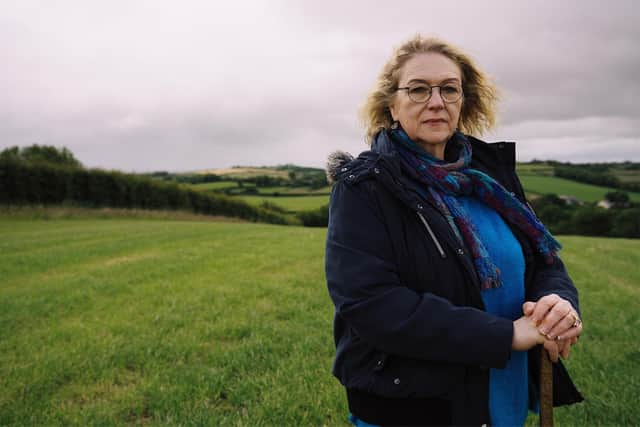

"Carnaptious is so expressive – I'm not being mildly annoyed, I'm being absolutely full-time crabbit. If I don't write, I feel the lack of it and I feel the want of it.”
Anne, who lives on her beloved family farm outside, Garvagh, Co Londonderry, is a leading voice in the creative resurgence in Ulster-Scots writing. In a recent BBC NI documentary, Out of the Silence, she explores how women’s writing in Ulster has moved from the margins into the mainstream – through an Ulster-Scots lens.
Ulster-Scots came over with the first lowland Scots settlers and has been spoken in Northern Ireland ever since, which means most folk will know a ‘wee’ bit, even if they think they don’t. Words in common parlance, like ‘aye’, ‘foundered’, ‘gulder’, ‘hallion’, ‘quare’ and ‘scallion’ – to name but a few.
"The word that was my gateway word back into writing in Ulster-Scots was used in my poem Hame, and it's the word ‘grieshochs’,” says Anne, whose debut poetry collection, Walking Off the Land, was published in 2021.
“Grieshochs were the wee red burning coals that were at the bottom of the range when you put the slack in overnight."
She writes: ‘The sound of childhood mornings/ My mother shaking out the grieshochs in the range/ as light spills into the kitchen like an early guest/and the day gets underway/ I sit at the same old table now and feel the day begin/Stirring this memory of language, buried things slowly rise.’

Hame, she amusingly describes, as an “Ulster-Scots sandwich”.
"It starts in English and when I recall the word grieshochs I go back into the past and write pure Ulster-Scots. And then I go back into English and say, ‘this is my language, this is my coming home’.”
Anne grew up in a Presbyterian family with two sisters on a farm her "great-great-great-great-great-grandfather built".
“When dad was working out in the fields, my sisters and I would have brought out pieces and a bottle of tea for the men, who’d be chatting and I'd hear these (Ulster-Scots) words.”

Describing herself as a “gack”, writing was always a compulsion for the accomplished poet.
"I was the quiet kid who, along with my sisters, went to the library, read the books, came back and got more. I was always writing. My lovely mum kept the wee essay jotters that we had in primary school.”
Anne studied at the University of Ulster in Coleraine and “fell in love” with theatre, which would go on to shape a huge part of her career. She ran the performing arts course at Northwest Regional College for a number of years, writing some 60 plays.
In 1990 she married and moved to California as a Navy wife, working in the local college in San Diego.
"My then-husband was an air traffic controller in the US Navy, he had trained at NAS, Naval Air Station Miramar, which became known, thanks to a small man, as Top Gun!”
Following the death of her mother in 1994 Anne returned to Garvagh to take care of her father, who had dementia and sadly died 48 weeks later. She writes poignantly about this in the poem, Walking Off The Land, which takes its name from an Ulster-Scots tradition of walking the deceased around the boundary of their land.
“Whenever parents die, everything changes. You move up a generation, whether you want to or not, which is a bit of a scunner. But, I'm just grateful for being here. It's a different world. It's head space. It's heart space. It's writing space. I loves the bones of it (the farm). I don't own it, it owns me."
The farm is nine miles from Aghadowey, where her mother, Jeannie, came from.
“I don't ever want to make this political, but I call Aghadowey the Gaeltacht of Ulster-Scots. I will walk through the village and have a chat with somebody, and I'm immediately going back into speaking in Ulster-Scots. Some people will say Ulster-Scots is a predominantly Protestant language, but it's not, it's absolutely everywhere. It doesn’t belong to one community.”
Days are spent writing, taking stunning photographs, doing readings, delving into her love of Ulster-Scots with fellow enthusiasts, and looking after her 23 cats!
“I write in Garvagh Community Building. I write under the sycamore tree (on the farm). During the winter, I’m in a yellow workman's jacket that you can probably see from Google Earth!
“What I love with Ulster-Scots is that the words can take me on a voyage of discovery. Sometimes I will just go through some of the words I remember, or I'll go through the Hamely Tongue (by James Fenton), or I'll look at the Uster-Scots glossary, which is online, and I'll discover a word that I've forgotten, and it takes me right back to something,” says Anne, whose book Poames - poetry in Ulster-Scots was published by the Ulster-Scots Agency in 2022.
“The thing about being a writer is you find that you have no choice in the matter. You've got to do it. I write about the farming community, and I write about the way that farms used to be run. I write a lot about nature. Ulster-Scots is the language of the land.
"I love it because there are things I can write in Ulster-Scots that will have more power, it has a resonance for me that nothing else comes close. That's what I love about it, it's a living language and it's really expressive.”
Anne’s book, Moments, was published in 2023 and Martha and the Vardo, a magical realism novel for children was published in 2024. She also runs creative Ulster-Scots writing courses, including an online group called The Shadows on the Page, which has published two anthologies.
"Not everybody who joined the group had grown up with Ulster-Scots, but they maybe remembered older family members and relatives using it. And some joined because they wanted to rediscover it for themselves”.
The resurgence in Ulster-Scots in recent years is, she believes, down to more opportunities for writers.
"Ulster-Scots events are happening all through the year – and there are more of us. I used to be able to name all the Ulster-Scots writers in Northern Ireland. I can’t do that anymore because there are more of them. The Linen Hall Library does an Ulster-Scots competition, the Ulster-Scots Agency is proactive with Yarns, an anthology of writing, there’s the Frances Browne Literary Festival in Donegal, and the annual Steinbeck Festival in Limavady.
“More people are being encouraged to write (in Ulster-Scots), and the more it's heard, the less it becomes something that's just sort of brought out on special occasions like your granny's good china.”
Later this year, Anne is bringing out a new collection of poems in Ulster-Scots, and in English. Children can also look forward to a book of nursery rhymes book called, Ma Shinin Star, published by the Ulster-Scots Agency, which she describes as a “gentle inroads into Ulster-Scots so that maybe mammys and daddys that used to know some words can rediscover them again.”
For Anne, Ulster-Scots seems as vital as the air she breathes and the nature that surrounds her: "I could talk all day about Ulster-Scots. I'm so energised by these words. It reminds me of where I came from, but it also celebrates who I am now,” she says, without even a hint of ‘carnaptiousness’
*Out of the Silence is on BBC iPlayer. Anne McMaster’s books are available on Amazon and bookshops.