
Wholly unnecessary Battle of New Orleans set Andrew Jackson on course to US presidency
The Anglo-American War of 1812 must count as one of the most unnecessary conflicts in world history.
Certainly, the Battle of New Orleans, the last major battle of the war, was wholly unnecessary. The war had been brought to a close a fortnight earlier by the Treaty of Ghent on December 24 1814.

Perhaps an even more obvious respect in which the Anglo-American war of 1812 was unnecessary lies in the fact that Lord Castlereagh, the foreign secretary, had removed the United States’ principal casus belli by announcing a relaxation of British trade restrictions six days before the US declaration of war.
Both the war of 1812 and the Battle of New Orleans were in large measure the product of the limitations of early 19th-century trans-Atlantic communications. It took five weeks for news of Britain’s repeal of trade restrictions in 1812 to reach the United States. News of the Treaty of Ghent being signed only reached the United States on February 12 1815.
In the autumn of 1814 the Royal Navy moved south to attack the Gulf Coast, arriving at Mobile in September.
The British intention was to relieve American pressure on Canada and (perhaps to a lesser extent) to seize the lower part of the Mississippi River with a view to using it as a bargaining chip in negotiations. Americans feared that the British were intending to rouse the Indians of the South and take over the Spanish colonies of east and west Florida.
The assault on New Orleans had to await the end of the hurricane season. By December the British had assembled some 7,500 troops. Preliminary actions went well for the British. Andrew Jackson, the American major-general, sent a small flotilla of gunboats to guard one of the approaches to the city but Royal Marines in small ships’ rowboats attacked them on December 14 and captured them all. The British succeeded in landing near the city with the help of Spanish and Portuguese fishermen.
On December 23 Jackson mounted a combined land and naval attack on the British camp but the Americans were repulsed. On December 28 the British made a reconnaissance in force against Jackson’s line. They very nearly succeeded in breaking one of the American flanks.
On January 1 1815 the British bombarded the Americans in an attempt to take out their guns but they had insufficient ammunition to do so. American artillery inflicted considerable damage on the British positions in return.
The British commander at New Orleans was Major-General Edward Pakenham, the Duke of Wellington’s brother-in-law. However, compared to Wellington, Pakenham was ‘rash and none too clever’.
On January 8 Pakenham foolishly mounted a frontal assault on the American earthworks outside the city but he had failed to bring up scaling ladders. Those troops who were not mown down in the open by American artillery were picked off as they clambered on the shoulders of their comrades.
The battle was a very one-sided affair and was regarded as a stunning American victory. The British lost nearly 300 men (including Pakenham and two other generals), with another 1,200 wounded and hundreds more taken prisoner or missing. The Americans repulsed the British attack at the cost of only 13 dead. A further 39 Americans were wounded.
Andrew Jackson attributed his victory to God’s Providence: ‘It appears that the unerring hand of Providence shielded my men from the powers of balls, bombs and rockets, when every ball and bomb from our guns carried with them the mission of death.’
Surveying the battlefield as the cannon smoke lifted, John Coffee, a Tennessee friend and confidant of Jackson’s, thought ‘the slaughter was shocking’.
Living British soldiers who had hidden beneath their fallen comrades’ red coats rose from the heaps of corpses, prompting Jackson subsequently to recall: ‘I never had so grand and awful an idea of the resurrection as on that day.’
David Reynolds, the British historian, is correct in observing that the Battle of New Orleans was ‘sweet revenge’ for the burning of Washington. By obscuring a succession of American failures, not least the Battle of Bladensburg, the burning of many of the principal public buildings in Washington (including the Capitol, the Library of Congress and White House) and the invasion of Canada, the battle allowed the Americans to end the war on an unexpectedly ‘triumphant note’.
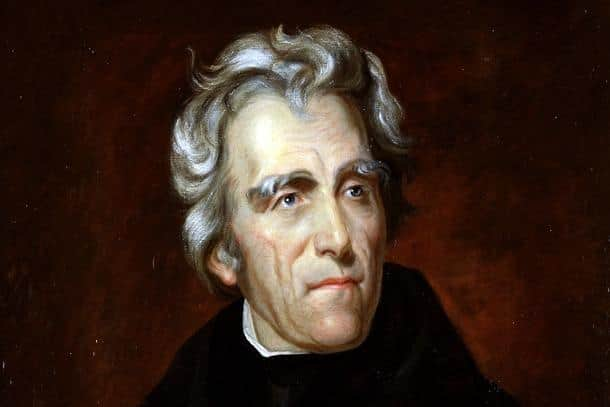
The Battle of New Orleans made Jackson a national hero and set him on the road to the White House, and he assumed office as the seventh president of the United States in 1829.
An Ulster-Scot, his parents hailed from Boneybefore, near Carrickfergus. ‘Old Hickory’ (as Jackson was nicknamed on account of his legendary toughness) was the first president to be elected from west of the Appalachians.
Unlike his six predecessors, he was not born to great privilege and was the first president to be born in a log cabin. Nor was he an intellectual like John Adams or Thomas Jefferson, the second and third presidents respectively.
As the founder of the Democratic Party, he was the first president to found a modern political party. After the Battle of New Orleans he was spoken of as ‘a second Washington’ but before 1822 he exhibited little interest in becoming president.
He first contested the presidency in 1824 and secured election in 1828. He was the first president to expand the role and powers of the presidency, so much so that his opponents bitterly denounced him as ‘King Andrew I’. Above all, Jackson was the first of a long line of Ulster-Scots presidents.
Jackson polarised contemporary opinion and continues to divide historians. His admirers applaud his forthrightness, fearlessness, generosity, and championing of ‘the common man’ whereas his detractors denounce him as reckless, intolerant, wrong-headed and dictatorial. Both assessments have merit.
During his first presidential term Donald Trump, a great admirer of Jackson’s patriotism and populism, chose to hang a portrait of Jackson in the Oval Office and within weeks of his inauguration visited The Hermitage, Jackson’s home in Tennessee and final resting place.