
Why the Ulster Unionist case against Home Rule made perfect sense
Why did Ulster Unionists oppose Home Rule? The best way of answering this important question is to examine the text of the Ulster Covenant drafted by Thomas Sinclair which sets out the unionist case very succinctly.
‘Disastrous to the material well-being of Ulster as well as the whole of Ireland’
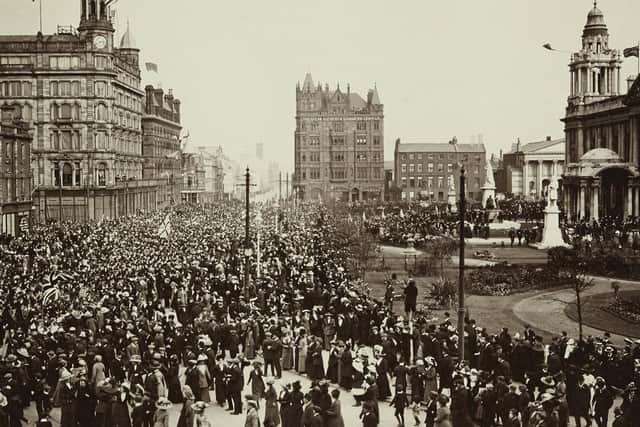

Ulster was the only part of the island to experience the full vigour of the Industrial Revolution. This set Ulster apart from the overwhelmingly agricultural south and west of the island. Unionists believed not only that Belfast and its environs flourished economically under the Union but also that they flourished because of the Union.
As early as 1834 Emerson Tennent, who was one of Belfast’s two MPs, eloquently countered Daniel O'Connell's speech in the House of Commons in favour of repeal of the Union with the observation: ‘The north of Ireland had, every five years, found its trade doubled since the Union’.

When the Union came under threat from the mid 1880s onwards, Belfast Chamber of Commerce played an important role in combating the Home Rule threat.
By the end of the 19th century Belfast was part of an industrial complex that stretched from Lancashire to Lanarkshire. By 1914 Belfast could boast ‘the greatest shipyard, rope works, tobacco factory, linen mill, dry dock and tea machinery works in the world’. In the late-19th and early-20th centuries Belfast was one of the major industrial powerhouses of the world.
Ulster unionists believed that Ulster’s prosperity would be jeopardised by Home Rule. Unionists believed that nationalists would raise tariff barriers and so provoking retaliatory tariffs that would impede or exclude Ulster exports from overseas markets. Unionists believed that the overwhelmingly agricultural south and west would be unsympathetic to Ulster’s industrial and commercial interests. They also feared that Ulster would be overtaxed, and that Ulster would end up shouldering the burden of a Home Rule parliament’s profligate expenditure.
‘Subversive of our civil and religious freedom’
The slogan ‘Home Rule is Rome Rule’ dates from the early 1870s. Unionists feared that a Home Rule parliament would be subject to strong clerical influence and that its legislation would be framed in conformity with Roman Catholic teaching and the promulgation of the Ne temere decree by Pope Pius X in 1908 and of Quantavis diligentia in 1911 underscored Ulster Protestant anxiety.
The former declared that marriages between Roman Catholics and Protestants not solemnised by the rites of the Roman Catholic Church were null and void. It also required the children of mixed marriages to be brought up as Roman Catholics. The notorious McCann case provided a solid example of the decree’s impact. In February 1911 the McCann case was the subject of a debate in the House of Commons. In June 1911 the General Assembly of the Presbyterian Church in Ireland debated the McCann case and unanimously called (in vain) for the withdrawal of Ne temere. comprehensive failure of nationalist politicians to make any effort to allay Protestant concerns or to challenge the Roman Catholic Church on the issue did not assist the cause of Home Rule.
Quantavis diligentia condemned those who took priests to lay courts and claimed that Roman Catholic clergy should be immune from ‘the process of civil or criminal law ... in any lay court’. Although Quantavis diligentia did not apply to Ireland, the expectation was that it would eventually.
J Milne Barbour, the President of the Belfast Chamber of Commerce and a substantial linen manufacturer, was prepared to concede that Ulster unionist opposition to Home Rule was ‘very largely religious’.
‘Destructive of our citizenship’ and ‘Equal citizenship’
Many prominent unionists would not have agreed with Barbour. Thomas Sinclair and Ronald McNeill MP would have said that citizenship was at the heart of the matter.
During ‘the Glorious Revolution’ Ulster Protestants had played a central role in the myth of the unfolding of the British constitution. Unionists did not wish to be deprived of the benefits of the British constitution nor of full representation in the United Kingdom parliament. They had no wish to be represented in a subordinate parliament in which they would be in a permanent minority.
‘Perilous to the unity of the Empire’
At the beginning of the twentieth century the British Empire was an ever-present reality. Ulster men and women were conscious that Ulster people had played an important part in the acquisition, defence and administration of Empire. Marquess of Dufferin and Ava (whose statue stands outside the City Hall in Donegall Square West), Brigadier John Nicholson (of whom there are statues in both Market Square, Lisburn, and in the grounds of his alma mater, the Royal School, Dungannon) and the Lawrence brothers from Londonderry are names which immediately spring to mind. In 1863 Sir John Lawrence became Viceroy of India. The Marquess of Dufferin and Ava was Viceroy of India from 1884 to 1888, having been previously Governor General of Canada. John Nicholson, a brigadier at the age of thirty-four, was mortally wounded storming Delhi and suppressing the Indian Mutiny in September 1857. During the course of 1912 William Ferguson Massey, originally from Limavady, became Prime Minister of New Zealand.
Many families would have had relations who either worked in the Empire or who had migrated and settled in various parts of it. Not every one would have prospered to the extent of Samuel McCaughey, one of the wealthiest men in Australia and ‘the King of Sheep’. He originally emigrated from Ballymena. He was one of those who bankrolled the Larne gunrunning. William Black of Ballyleck, a vice-president of North Monaghan Unionist Association, made his more modest fortune in South Africa and had returned to settle in his native county.
In advancing the argument that Home Rule would be ‘disastrous to the material well-being of Ulster as well as the whole of Ireland, Ulster unionists were opposing Home Rule for economic reasons. In stating that Home Rule would be ‘subversive of our civil and religious freedom’, unionists were making the religious case against Home Rule. In observing that Home Rule would be ‘destructive of our citizenship’ and ‘equal citizenship’ unionists were articulating a political argument against Home Rule. Finally, in claiming that Home Rule would be ‘perilous to the unity of the Empire’ unionists were setting out the Imperial argument against Home Rule. The Ulster unionist case against Home Rule was intelligent, coherent and perfectly rational.