
William Thomson: Child prodigy, committed Christian and scientific giant
William Thomson, 1st Baron Kelvin of Largs, was born on June 26 1824 at College Square East, Belfast, son of James Thomson who taught at Inst, and Margaret Thomson (née Gardner).
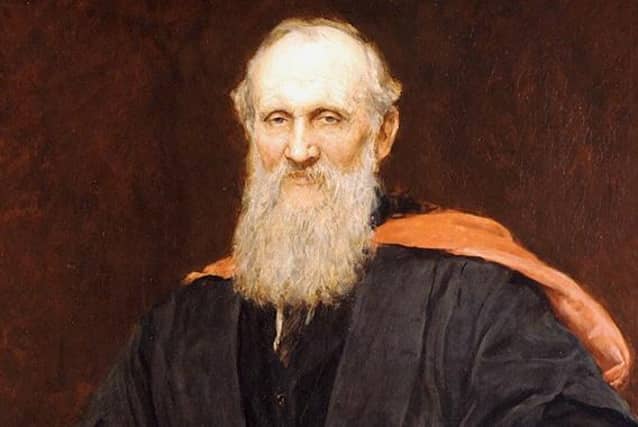

The Thomsons were Ulster-Scots of Covenanter stock and had a farm at Annaghmore, near Spa, Ballynahinch, until 1847. In 1831 James was appointed to the chair of mathematics at Glasgow University.
The dominant figure in William’s early life was his father because his mother died when he was only six. None of the family attended school, their father undertaking responsibility for their education. Thus, William was taught the most recent advances in mathematical scholarship before they ever appeared in university curricula.
In 1832, when William was eight, his father moved to Glasgow as Professor of Mathematics at the city’s university. Two years later William matriculated in the university and showed great promise, not least by publishing two impressive mathematical papers, before proceeding to Peterhouse, Cambridge. At 21 he graduated from Cambridge with a predictable first-class honours degree.
In 1846, one year after his graduation, the chair of Natural Philosophy – what today would be called Physics – at Glasgow fell vacant. Despite being only 22-years-old, he was encouraged to apply. Even more astonishingly he was chosen unanimously.
It would be unfair to attribute his success solely to his father’s campaign to secure the position for him because William had already published a dozen original papers and had acquired a formidable reputation for one so young. His application was supported by testimonials from eminent scientists from several universities. Declining the prestigious Cavendish professorship of Physics at Cambridge on three occasions, he was to occupy the chair at Glasgow for the next 53 years.
He established himself as an inspiring teacher, as a popular lecturer and pre-eminently as a great leader of research. Since he was liable to be carried away by his enthusiasm, his lectures were frequently an exhilarating experience: ‘His mind was extraordinarily fertile in ideas. Even in a lecture, if a new idea occurred to him, he would start off on a new tack. He [was] known to lecture for the hour before reaching the subject of the lecture.’
Among the many products of this fertile mind were a major role in the conservation law of energy; the absolute temperature scale (now cited in degrees Kelvin in his honour); the dynamical theory of heat; the mathematical analysis of electricity and magnetism, including basic ideas for the electromagnetic theory of light; the geophysical determination of the earth’s age; and the fundamentals of hydrodynamics.
Another measure of the fertility of his mind is the sheer volume of his published work which amounted to some 600 books and articles. These were collected and republished between 1882 and 1911 in several volumes entitled ‘Mathematical and Physical Papers’.
Kelvin’s work in transmitting electrical currents and laying submarine cables rank as outstanding examples of his application of science to the service of man. He played an active part in laying the first transatlantic cable in 1857; and although it was only a short-lived success, it presaged the enduring success of the cable put down in 1866, one of the great feats of the Victorian era. For his involvement in this venture, which helped revolutionise communications, Kelvin was knighted by Queen Victoria.
From his submarine cable patents he became an extremely wealthy man. The astonishing number of patents which he acquired is further evidence both of the fertility of his mind and his prodigious capacity for work. Eventually, he was to acquire some 70 patents.
Kelvin enjoyed both a national and international reputation. In addition to his knighthood in 1866, he was raised to the peerage in 1892, the first scientist to be ennobled.
He took the title Baron Kelvin of Largs in the County of Ayrshire. Kelvin was the name of the tributary of the River Clyde which flows past the University of Glasgow and Largs was the community on the north Ayrshire coast in which he had made his home. In 1902 he became one of the original 24 recipients of the Order of Merit.
Honoured by the nation, he was honoured by his profession. In 1890 he became president of the Royal Society. When in 1896 the golden jubilee of his professorship was celebrated with an exhibition of his many inventions, the event was attended by scientists from all over the world.
Honorary degrees were conferred on him by numerous British and foreign universities as well as decorations and orders from other countries. However, few honours were more highly prized than that conferred upon him by his election as chancellor of the University of Glasgow in 1904.
He had resigned his chair at the age of 75 in 1899 but had promptly enrolled himself as a research student at the university.
Until his death at home near Largs on December 17 1907, he was both physically and intellectually active. He was interred in Westminster, beside the grave of Sir Isaac Newton.
Like Newton, Kelvin was a devout Christian and saw his Christian faith as supporting his scientific work, as is evident from his address to the annual meeting of the Christian Evidence Society in May 1889. Church attendance was an important part of Kelvin’s daily routine as was daily study of the Bible.
In carving out an academic career in a Scottish university Kelvin had not merely followed in his father’s footsteps. An already long-established and intimate relationship existed between the Scottish universities, especially Glasgow and Edinburgh, and Ulster.
In the 18th century two Ulstermen in particular, Francis Hutcheson and Joseph Black, had made significant contributions to ‘the Scottish Enlightenment’. Indeed, the former is widely credited with launching the Scottish enlightenment and is often referred to as ‘the father of the Scottish Enlightenment’.
Hutcheson occupied the chair of Moral Philosophy at Glasgow between 1730 and 1746 while Black was Professor of Chemistry at Edinburgh between 1755 and 1795.
A statue of Kelvin, which needs refurbishment, was erected in Botanic Gardens in June 1913.
There is also an Ulster History Circle plaque commemorating Lord Kelvin at 21-25 College Square East, the site of the house in which he was born.