
Winston Churchill loathed John Dill, but Franklin Roosevelt was an admirer
John Greer Dill was born on Christmas Day 1881 in Lurgan, the only son and second child of John and Jane Dill.
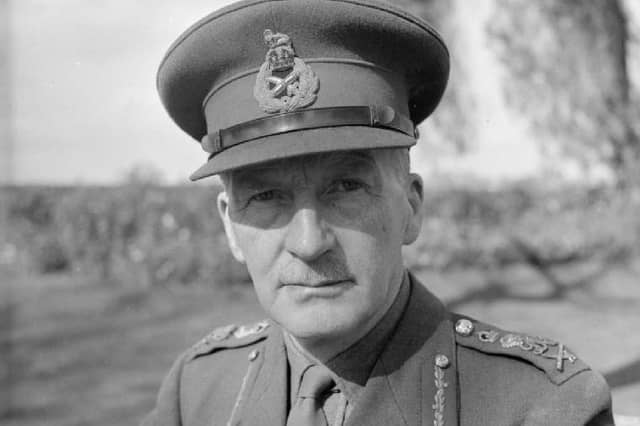

John Dill was the manager of the local branch of the Ulster Bank. Mrs Dill’s maiden name was Greer; hence the future field marshal's second Christian name.
Both the Dills and the Greers were families of Ulster-Scots ancestry. Dill’s parents died within months of each other when he was 12. The Rev Joseph Grundy Burton, the Church of Ireland rector of Killinchy (between 1891 and 1913 before moving to Dundonald) and his wife Anne Greer assumed responsibility for the upbringing of their young nephew and niece.
Dill reminisced about growing up in Killinchy in an address to the Pennsylvania Scotch-Irish Society in Philadelphia on March 3 1944: ‘My parents died when I was still very young and I went to live in Co Down, a lovely county of hills and lochs. I wonder if any of you have ever seen Strangford Loch [sic], with all its islands, where the sea-birds nest, or have you seen the wild shores of that county where the mountains of Mourne sweep down to the sea? It is a lovely country but very primitive [compared to life in the United States] ... And in that wild, green country we learned to ride, to shoot, to walk and to swim, and we got our fun out of the seas and out of the air, and the twentieth century had not touched that happy land.’
Dill was educated at Methodist College, Belfast, and Cheltenham College. The latter’s strong military tradition propelled him in the direction of an Army career.
He recalled the earliest days of his military career in his address: ‘I went to our Royal Military College … and I was not able to get a [Northern] Irish regiment, a Scotch-Irish regiment. There was not one vacancy for me, because the Boer War was on. They said, “You will have to wait.” I could not and wait. I said, “Give me [a Southern] Irish regiment,” the next best thing I thought, so they put me to a south Irish regiment, the Leinster Regiment, from the middle of King’s County, and it was a serious thing for a Black Northerner like me to be thrown among a lot of gossoons from King’s County but we mixed, we got to love each other in an extraordinary way …’
Evidently, in addressing the society Dill thought he was talking to his ‘ain folk’ (which he was) and enjoying the occasion but what was the context for this somewhat incongruous event taking place in the midst of the Second World War?
In the aftermath of Pearl Harbor Winston Churchill requested an immediate conference with Franklin Roosevelt and on December 12 1941 Churchill set off for Washington, DC, and over a three-week period (from December 22 1941 to January 14 1942) the two leaders hammered out a set of Anglo-American accords.
During a half-hour conversation in 10 Downing Street the day before Churchill and his party left for the United States, Brooke, Dill’s successor as chief of the Imperial General Staff (CIGS), persuaded an extremely recalcitrant Churchill to take Dill with him.
Churchill and Dill had an appalling relationship because the strongly opinionated Churchill viewed Dill with disdain and failed to appreciate the quality of the mild-mannered Dill’s mind and his soundly based strategic insights. This contributed to a sharp deterioration in Dill’s health.
Brooke regarded his brief conversation with Churchill as ‘one of the most important accomplishments during the war, or at any rate amongst those that bore most fruit’.
Dill had accompanied Churchill to Placentia Bay, Newfoundland, in August 1941 and had got on extremely well with George C Marshall, the US Chief of Staff. The ever-astute Brooke fully appreciated the potential of this friendship. Dill stayed on after the Arcadia Conference (Arcadia was the code name for the conference held in Washington between December 22 1941 and January 14 1942) to head the British Joint Chiefs of Staff Mission to Washington and to be the senior British representative on the combined British and US Joint Committee of the Chiefs of Staff and the representative of the minister of defence (ironically Churchill).
Dill’s health improved and he soon became one of the crucial figures in cementing Anglo-American relations. Field Marshal Lord Carver observed: ‘Dill’s straightforward and tactful manner, his clear mind and keen intelligence, and his experience impressed the Americans … On many occasions he was able to find an agreed solution when deadlock between the British and American Chiefs of Staff appeared imminent’.
When Dill died on November 4 1944, Roosevelt said of him that he had been ‘the most important figure in the remarkable accord which has been developed in the combined operations of our two countries’.
He was buried in Arlington National Cemetery, a unique distinction for a foreigner, and was posthumously awarded the Distinguished Service Medal.
The US Joint Chiefs of Staff sent a remarkable message of condolence to their British counterparts, mourning the ‘loss to our combined war effort resulting from the death of Field Marshal Sir John Dill. His character and wisdom, his selfless devotion to the Allied cause, made his contribution to the combined British-American war effort of outstanding importance. It is not too much to say that probably no other individual was more responsible for the achievement of complete co-operation in the work of the Combined Chiefs of Staff ... We mourn with you the passing of a great and wise soldier and a great gentleman. His task in this war has been well done.’
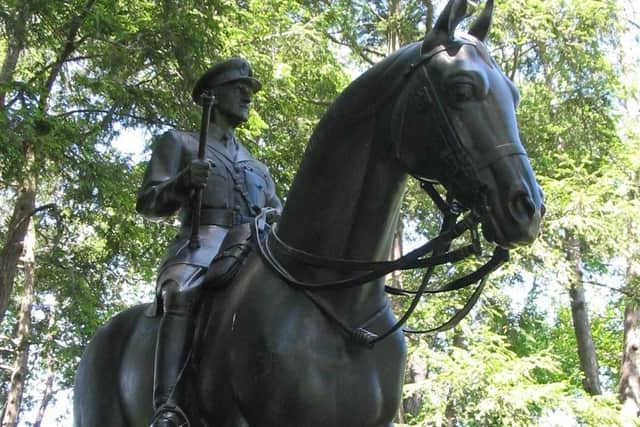
In due course Dill was honoured with a magnificent equestrian statue in Arlington National Cemetery. However, while there are statues of Brooke and Montgomery in Whitehall, there is none of Dill.
Dill’s vital role is rarely acknowledged or appreciated on this side of the Atlantic. Primarily, the reason why Dill is a largely forgotten figure was Churchill’s inability to share Roosevelt’s justly high regard for the man and his achievement. Yet, in Brooke’s estimation: ‘Few men did more in furthering our cause of final victory than Dill.’