
Aiken slams 'delusional' Dublin statement - saying UK now responsible for critical defence of Irish airspace and seas
The Irish government’s pretence that it is in a relationship of equals with the UK on defence is delusional – and Dublin is scrambling to avoid tech companies pulling out over fears about Ireland’s ability to defend key infrastructure, a UUP MLA has said.
Steve Aiken’s comments come as the Irish government signed a deal with London on the “enhancement of bilateral engagement” between the two countries on defence and security.
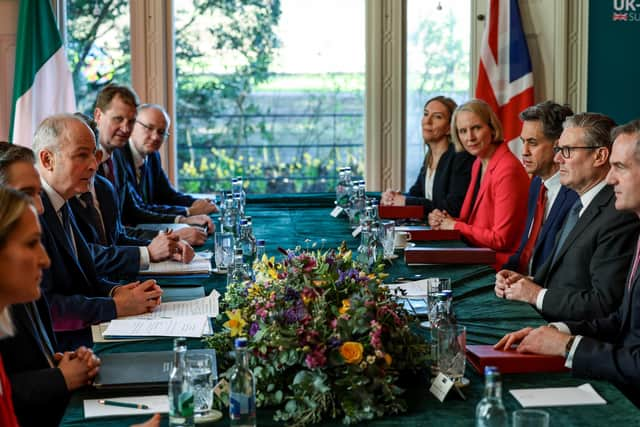

The Republic’s Defence Minister Helen McEntee presented the deal as involving “cooperation and exchanges involving both civil and military personnel” – and claimed it would put arrangements “on a more formal and transparent footing”.
However, Mr Aiken said Ireland is incapable of even monitoring its own air space, and that Russia’s ghost ship fleet has been operating “with impunity” in Ireland’s territorial waters.
He said that has raised concerns among tech firms about the security of undersea cables linking Europe and the US, prompting Ireland’s attempt to seek protection from the UK and France.
The UUP MLA said Ireland is “freeloading” on defence – and criticised the prime minister’s commitment to Dublin on security as “bizarre” given the country’s legal action against the UK on legacy.
Last year, Taoiseach Micheal Martin said an incident involving drones – believed to be Russian – during a visit by Ukraine’s President Volodymyr Zelensky was “very concerning”. Mr Martin said the drones identified over Dublin Bay were “suggestive of being part of an ongoing Russian inspired hybrid campaign against European and Ukrainian interests”.
Mr Aiken told the News Letter: “The very real concerns expressed behind the scenes over the Zelensky drone incident and Ireland’s failure to be able to even monitor its close airspace, in the approach to Dublin airport, and inability to shoot down those Russian drones – coupled with a spat between Irish authorities over who could authorise such a thing, even if it was impossible for them to do so – has raised massive security concerns in Brussels and Washington.
“Further to that, the ability of Russia’s ‘ghost shipping’ and intelligence ships like the Yantar being able to operate with impunity over vital power and internet cables has caused many of the tech companies that Ireland relies on for their FDI tax bonanzas, to seriously question their investments.
“The harsh reality is for a country very precious about its sovereignty, it has none over its sea and airspace,” he said.
“Bizarrely by taking the UK to court over legacy issues, Starmer has agreed – with our obviously limited resources – to take on the critical defence of all of Ireland’s sea and airspace. The Irish are similarly trying to get a similar agreement with France, you can be pretty sure that President Macron will exact a significant price for doing the same.
“Isn’t it remarkable how all those seeking a joined-up island consistently ignore the total reliance of the so called ‘triple lock’ neutral isle to even be able to put one fighter aircraft into the air. Yet another reason why Mary Lou McDonald and co’s 2030 [united Ireland] dream is ludicrous,” Mr Aiken added.
The South Antrim MLA said defence and security requires considerable investment – and “Ireland cannot freeload anymore”.
“To think that this is a relationship of equals is delusional. As the Irish have discovered with their discussions with President Macron, France’s security umbrella comes with a multi-billion euro price tag – it’s perhaps too much to expect Starmer extracted a similar commitment, but any sense of equality in defence when one ‘partner’ doesn’t even have primary military radar, is in the land of fantasy.”
The Irish Air Corps fleet currently consists of 10 helicopters, two twin-engine and four single-engine turboprop planes, one mid-size business jet, one transport aircraft which carries 16 troops and seven single-engine training aircraft. The Naval fleet consists of eight vessels.
The UK has around 640 active military aircraft, including over 150 combat aircraft. The Royal Navy has over 60 ships in its surface fleet, and nine submarines.
Speaking on Friday, Ms McEntee said a Memorandum of Understanding signed with the UK “provides a framework for developing and furthering bilateral co-operation and relations between the Department of Defence and the UK Ministry of Defence”.
She said the deal underpins “the longstanding and positive engagement” between the nations, “particularly in the area of training and staff to staff meetings”.
The UK government said both countries “will be better protected against common threats” due to the deal, which involves “enhanced maritime cooperation, cyber defence, air domain information sharing, and increased joint procurement”.