
Analysis: I was part of the BBC report on Stonewall that began the fightback against their reign of chaos on sex and gender - but Stormont is incapable of dealing with the mess they've left behind
For a decade, groups like Stonewall have wreaked havoc in workplaces across the UK, with diversity initiatives sowing confusion about sex and gender and employers going far beyond the law in their bid to be ‘inclusive’.
I know this, because I worked on a ground-breaking BBC podcast on Stonewall influence back in 2021. It has meant that men – whether they’d had surgery or not – were allowed in women’s toilets, changing rooms and sports. Anyone who spoke up – even trans people – was branded a bigot, and the brave women who wouldn’t accept it were effectively banned from the airwaves.
But this week, victory was theirs. It wasn’t ‘bigots’ or ‘dinosaurs’ celebrating on the steps of the Supreme Court. It was ordinary women from all over the UK, and from all political perspectives – left and right, unionist and nationalist, gay and straight.
The entire strategy of groups like Stonewall had just been demolished by the country’s top judges, who unanimously decided that when it comes to the law, trans women are not women. The Scottish government had bought into the LGBTQ+ lobby’s entire narrative – which can be boiled down to arguing that gender is an inner feeling, or can be changed by a certificate, and is not a biological reality. Not so under the law.

I first started reporting on the gulf between what employers were doing – often at Stonewall’s behest – and what the law actually said, five years ago when I worked at the BBC. In the Nolan Investigates: Stonewall podcast, Stephen Nolan and I examined the lobby group’s reach in detail.
We discovered the Scottish government had removed the word mother from maternity documents after Stonewall asked them to – and that the BBC had taken it upon itself to redefine terms like homosexuality in line with the lobby group’s interpretation. The media regulator Ofcom was far too close to the lobby group – reporting to Stonewall on rulings it had made on “transphobic comments” in TV shows, in a bid to gain points on one of its diversity schemes.
Across the UK, sex was stripped out of public policy, and replaced with the concept of gender identity. Except nobody ever voted for that, laws weren’t changed and nobody had thought through the implications on other groups – particularly on women.
Today, Stonewall says its advice “has always reflected the law”. But if you read the Supreme Court’s demolition of the Scottish government’s position, it could just as easily apply to them.

As is increasingly the case post-Brexit, it is unclear exactly how the landmark ruling will impact Northern Ireland. But if you think that our political class is on top of it all, think again.
Complexities of the Windsor Framework aside, Stormont hasn’t even begun to scratch the surface of how the qualified legal rights of transgender people to change sex should interact with women’s rights to single-sex spaces.
In fact, MLAs from Sinn Fein, Alliance and the SDLP have effectively just stuck their fingers in their ears and repeated mantras like ‘trans women are women’, avoiding the tough choices they will face if they legislate here.
There is no better example than the farce of an inquiry into “gaps” in equality legislation recently conducted by MLAs on the Executive Office committee, under the chair Paula Bradshaw. It is looking at the possibility of a single equality act for NI – something similar to the 2010 Equality Act which the judgement earlier this week clarified.
Only towards the end of the probe, and only because the TUV’s Timothy Gaston invited them, was any group concerned about single-sex spaces invited to speak. The Women’s Rights Network got a hostile reception – in stark contrast to how LGBTQ+ groups were treated.
They had argued that despite there being no ‘Self-ID’ policy here, it had been introduced by public bodies without consultation – a situation they described as unacceptable. Self-ID means the ability of anyone to declare themselves the sex they choose – and was a key Stonewall policy.
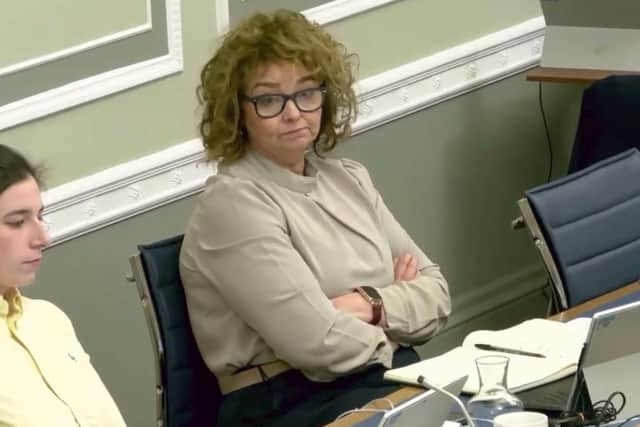
Sinn Fein’s Carál Ní Chuilín said that the women’s contribution was “disgraceful”. Arms folded, and visibly annoyed, she said: “We’ve had ‘no gays apply’ beforehand, and now it’s ‘no trans apply’”.
When she was told the group sought no reduction in trans rights – just that people were treated as their birth sex in certain settings – she said “I just find our whole history of LGBTQ+ is about inclusion rather than exclusion, and that’s my big problem. So. I’ll say no more”.
That’s about as deep as their engagement with the issue got.
It doesn’t matter whether you think trans women are women or not, the role of a scrutiny committee is to look at the difficult issues and decide how they want to write the law. The witnesses invited by Mr Gaston raised another crucial issue – which lawmakers and courts across the water have already wrestled with.
That was whether churches should have certain exemptions when it comes to homosexuality – and employing volunteers who don’t follow church teaching. Second to how trans rights affect women’s sex-based rights, it’s one of the thorniest issues thrown up by the equality act in Great Britain.
But rather than examine it in the public interest, like they’re paid to do, MLAs wheeled out the mantras again. Ms Ní Chuilín responded to the Christian Institute saying “gays don’t apply, that’s basically what you’re saying”.
“Yes!” agreed Ms Bradshaw.
No arguments were made that protections for religious freedom were less important than ensuring gay people could volunteer in churches – perhaps because they’d never thought about it, perhaps because all that really mattered was a bit of virtue signalling.
Just this week, Ms Bradshaw took to social media to call for a single equality act, because job applicants had been asked to state political opinions. Nothing though on the thorny issue of when a trans woman is a woman and when he isn’t. She says the committee will soon bring forward “recommendations for change”. Don’t count on the issue of what a woman is being addressed at all.
Stonewall’s grip on public bodies in the rest if the UK is almost gone. Yet in Northern Ireland, their advice is still sought by public bodies – including the Northern Ireland Civil Service and the Executive Office.
Self-styled progressives have long bemoaned the fact that Northern Ireland is far behind the rest of the country on rights legislation. They don’t have much to say about it being behind the curve when it comes to women’s right to privacy and dignity in spaces that are free from men.
David Thompson is News Letter political editor…