
Assembly announces Timothy Gaston faces two day suspension - but holds back full standards report, including his defence
Stormont officials won’t release the contents of a standards investigation into Timothy Gaston until MLAs debate it on Monday - despite the fact the Assembly has already revealed the key ruling of the report.
The TUV MLA is facing a two day ban following a complaint – understood to be from the Alliance politician Paula Bradshaw – in relation to his conduct following heated exchanges in a Stormont committee in 2024.
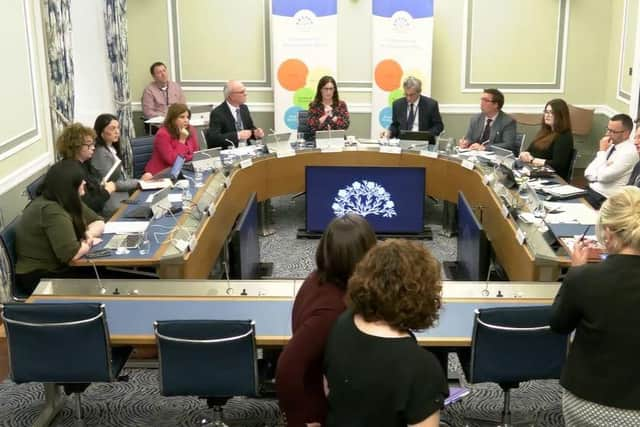

There was tension between the pair on the Executive Office committee in 2024, after Mr Gaston repeatedly questioned Ms Bradshaw’s chairing of the scrutiny body – particularly in relation to a meeting in which the First Minister Michelle O’Neill was facing questions on a Sinn Fein safeguarding scandal.
The full report from the former Standards Commissioner Dr Melissa McCullough has already been sent to journalists - but under an 'embargo' until MLAs discuss the matter on Monday.
It means that its central recommendation that Mr Gaston be excluded from the Assembly for two days is now in the public domain – but his defence of his position, and his criticisms of the report are not.
UUP MLA Steve Aiken says much about the way the issue has been handled “is unsettling”.
“That the recommendations are available, without the supporting information, may lend to a false interpretation. At the very least, information on the assembly website should be purely limited to what is on the order paper, not on the purported outcome. The recommendation made, is after all, to be debated in the Chamber and nothing is confirmed until after that”, he said.
However, Stormont officials say the arrangements are to ensure that the Assembly is the first place in which a committee’s recommendations are publicly discussed and considered.
They say that there is no way of the Assembly doing this without having first put on the order paper the relevant motion for the Assembly’s agreement – and that is the case for any report from an Assembly committee – in this case Standards and Privileges.
An embargoed copy of the Committee’s report has been given to the media to allow outlets to prepare stories for publication to coincide with the report’s publication, officials argue. The Assembly says it has the option not to do this – but is doing so to support the media in timely and accurate reporting of Assembly business.
Often, such reports are released for reporting in advance of any discussions in the assembly chamber.
On this occasion, the Northern Ireland Assembly has already placed the key conclusion of the complaint online – but the report remains embargoed.
Next week’s Assembly Order Paper notes a scheduled discussion on the ‘Report on a Complaint against Mr Timothy Gaston MLA’.
It states: “That this Assembly, having considered the report of the Committee on Standards and Privileges... notes its conclusion to recommend that a sanction be imposed on Mr Timothy Gaston MLA, and imposes upon Mr Gaston the sanction of exclusion from proceedings of the Assembly for a period of two sitting days, beginning on the first sitting day after the resolution”.
Media outlets were informed on Tuesday that the full report would be embargoed until the following Monday – but that details of a debate on the matter would be published on Friday.
The News Letter asked the NI Assembly a series of questions on the matter, including: how it can justify making the recommendation public in advance of the full facts being made public.
An official said that there is “nothing out-with” its normal practices. They cited last week’s standards commissioner report into Gordon Lyons as an example.
That complaint related to the ministerial code – as opposed to the code of conduct for MLAs. In that case, the standards and privileges committee has no power to recommend a sanction to the assembly, and therefore there is no requirement for MLAs to debate the issue in the assembly chamber. Therefore, officials argue, the question of embargoing material until a debate does not arise. They say the same circumstances would apply if it were a complaint about an MLA, and the committee had decided not to recommend a sanction.