
Assembly rejects DUP motion opposing new EU taxes on small parcels entering Northern Ireland
Stormont has heard concerns about a two tier economy within the UK and increased costs to Northern Ireland businesses and consumers from new EU import taxes on small parcels, imposed under the Windsor Framework.
It came as MLAs rejected a DUP motion opposing the move by Brussels and calling for the restoration of sovereignty and democratic decision making over all aspects of UK trade.

The motion had support from unionist parties but was opposed by nationalists and Alliance – who raised concerns about the standard of products entering the European Union.
Since Brexit, Northern Ireland remains under EU customs rules, unlike the rest of the UK – creating trade friction for businesses sourcing products from Great Britain and for consumers ordering products from retailers on the mainland.
In the latest development, EU governments have agreed to scrap a customs tax exemption on products with a value of less than €150 – meaning all e-commerce parcels entering the EU and NI will be subject to charges, regardless of their value.
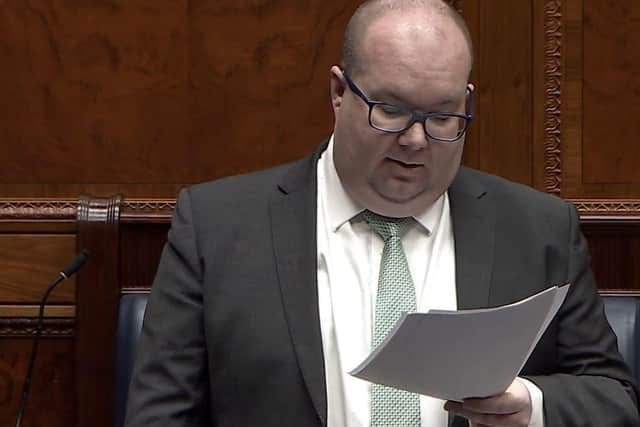
Bringing a motion to the Assembly on the matter, DUP MLA David Brooks accused nationalists and Alliance of posturing against tax rises – but tolerating Brussels picking the pockets of consumers here.
He also questioned why the rules must apply to Northern Ireland – and said any positive aims must be balanced against impact on businesses and consumers.
The East Belfast MLA said only an end to EU would solve the problems, but called on the government to take “practical and reasonable steps” now.
The motion was backed by the Ulster Unionist Party, with Diana Armstrong warning about a two tier economy developing within the UK.
“Local traders and consumers in Northern Ireland find themselves back on the back foot, facing yet another threat of divergence within our own United Kingdom. The European Union claims this new fixed customs fee on small, small parcels due from July 2026 is about tackling tackling unfair competition, but if it is imposed in Northern Ireland, the opposite will happen here. Prices will rise, choice will fall, and small businesses will be hit hardest”, the Fermanagh South Tyrone MLA said.
TUV MLA Timothy Gaston said the issue at hand was about parcels moving within the UK – with everyday transactions being treated as imports into a foreign territory. He said the return of unionists to the Executive with the Irish Sea border still in place signalled “acceptance” of its consequences.
Taking aim at the DUP he said: “You cannot accept foreign customs control in February, and then express alarm in July when new fees are introduced. You cannot brand Jim Allister a dead end unionist for spelling out the truth on these issues almost two years ago, and then later bring a motion to this house underscoring the fact that he was dead right all along”.
Unionist concerns were dismissed by Alliance – with deputy leader Eoin Tennyson telling the DUP “Lads, cheer up. You won the referendum”.
Mr Tennyson said the DUP has not always been consistent on these issues, saying that in January 2024 former DUP leader Sir Jeffrey Donaldson said, “For goods moving from the UK, our objective was to remove the Irish Sea border, and that is what we have achieved”.
He said a month later, current leader Gavin Robinson “crowing about what the DUP had delivered” had said the party had “resolved the unresolvable”. The Upper Bann MLA said “now we're being told quite openly by members from the same party that that wasn't true”.
The Alliance MLA called for a UK-EU customs arrangements.
The SDLP MLA Sinead McLaughlin said that business concerns over fragile supply chains are real and the government should address them, but said the arrangements were in place to avoid a hard border. DUP MLA Phillip Brett welcomed that the SDLP as the only party outside the unionist benches to acknowledge the difficulties faced by businesses.
Sinn Fein defended the policy as part of global efforts to remove exemptions for low value imports.