
Boyne Bridge Belfast: Authorities accused of 'departmental vandalism' after demolition of 'historic asset' is completed
Authorities have been accused of “departmental vandalism” after demolition was completed on the Boyne Bridge in south Belfast.
The bridge has been at the centre of controversy for months, having been held as a cherished part of the local heritage by the Sandy Row community.
Architectural heritage campaigners had also pressed to have the bridge retained due to its historical features, having taken out a legal challenge on the matter.
However, plans had been approved to remove the bridge to make way for access to the new Belfast Grand Central Station.
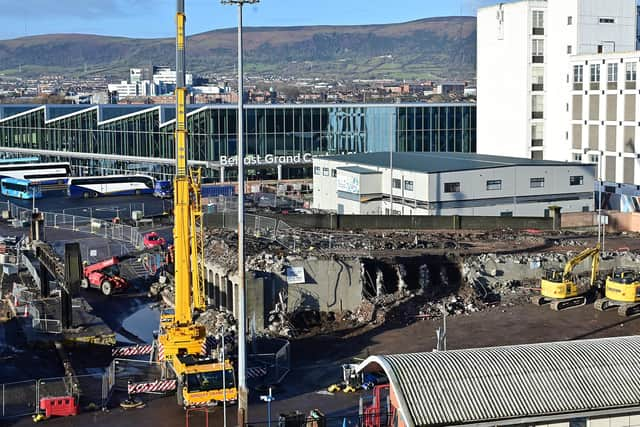

Dismantling work began in mid-December but was quickly halted.
The News Letter witnessed today that demolition work was well advanced.
John Anderson, Vice Chair of Ulster Architectural Heritage, had been campaigning for the preservation of the bridge.
He believes that work restarted on Friday 25 January, the day of Storm Eowyn.

The News Letter previously reported that the demolition work had been in breach of planning stipulations that required a traffic management system to be put in place around Sandy Row due to the disruption the demolition would cause.
However this did not happen, and after the matter became public demolition work ceased.
Mr Anderson noticed that the traffic management matter appeared to have been addressed on the Department for Infrastructure (DFI) website the day before demolition work restarted.
"The most bizarre 9 page DFI planning decision notice we have ever seen appeared on the planning portal the day before," he told the News Letter.
"Effectively [it was] a 'get out of jail free ' card for Translink which argued that major traffic disruption was actually minor!
"The decision notice also stated that it could be challenged by Judicial Review within a three month window, but as Translink immediately began damaging the bridge beyond repair this 'accountability' was meaningless."
"Unfortunately, the act of departmental vandalism in demolishing the last publicly accessible Railway/Industrial Heritage asset in central Belfast is now complete, with the demolition of the Boyne Bridge, leaving the city a poorer place and the local community wellbeing further disheartened by the cumulative stripping away of their tangible history."
He added that the "disgraceful" saga is now a case study in failure: of departments, civil servants, and politics.
"As for Translink transparency and accountability, there was, and is, no evidence of either.
"The unregulated stripping out of Belfast's tangible and visible history in favour of short-term developer profit illustrates the failure of policy makers and elected politicians to understand and respect that historic assets are a significant part of culture and identity, and the Sandy Row community is the latest victim of that lack of respect.
"The retention of the bridge would have delivered the most effective and best value solution to both traffic flow and passenger access to the new station while showcasing the City's historic engineering and design excellence."
Responding to questions at last Wednesday's Infrastructure Committee meeting, Mr Anderson said that Translink management claimed that "all options" regarding the bridge had been considered.
"There is no evidence in the planning files to show that this was true,” he said. “Repeated questions on the beach of planning conditions were evaded and unanswered."
A Translink spokeswoman responded: “The current phase of work, including the dismantling of the Boyne Bridge, is progressing in line with the relevant planning conditions.
“The works will be carried out as quickly as possible and works will then commence on the public realm space, Saltwater Square.”
DFI was also invited to respond.
William Dickson, chairman of the local Blackstaff Residents' Association, lamented the loss of the bridge.
“Well Translink have got their way,” he said in a social media post.
He said it was “a very sad sight” but added that he was hopeful that the ‘1642 Great Bridge’ – which he believed remained under the 1936 bridge – would be preserved.
He reiterated the local view that King William III crossed the original 1642 bridge, the existence of which he said, was confirmed in an Archaeological Evaluation & Bridge Coring by Fred Hamond, Industrial Archaeologist in 2019.
“As a result of the findings a planning condition came into force that the [1642] bridge is to remain in situ. I have a full copy of the 2019 report and the planning condition.”
However, he added that it is his group’s concern “that we are not being kept informed about ongoing mitigation measures relating to all aspects of the bridge dismantling and especially the safeguarding of the 1642 Great Bridge”.
At the time of going to press, neither Translink nor DfI had responded to his comments.