
British people unaware of financial crisis facing them as result of the UK national debt - former minister
The British people are unaware of the financial crisis facing them as a result of the UK's national debt, a Conservative former minister has told Parliament.
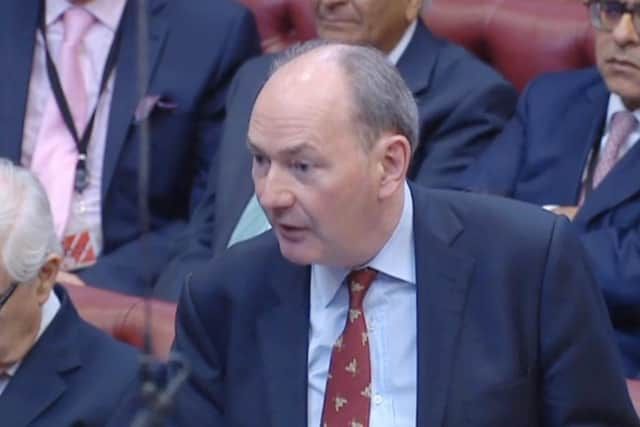

Lord Forsyth of Drumlean argued the UK is "paying the price" of quantitative easing and it has played a part in the country's current "vulnerable" position.
Fellow Conservative peer Lord Tugendhat claimed the raising of taxes is inevitable and urged the Government to "grasp the nettle" to avoid increasing debt levels.
Meanwhile, former governor of the Bank of England Lord King of Lothbury criticised Chancellor Rachel Reeves' fiscal rules, describing them as "Augustinian".
This came as members of the upper chamber discussed the economic affairs committee's report on national debt, which argues the UK's national debt risks becoming unsustainable unless tough decisions are taken in this Parliament.
Speaking on Friday, Lord Forsyth said: "Our people, the constituents of the members at the other end of this building, our families, have no idea of the crisis that is facing our country, looking ahead, and the threat that presents to our ability to deliver pensions, and important pubic services."
The peer added: "As the (economic affairs committee) report points out, there are fundamental, strategic reasons why we need to tackle this now, and the longer that we wait to bite the bullet then the bigger the problem will be."
Lord Forsyth continued: "There was a consensus on quantitative easing ,there was a consensus on lockdown, and now we are paying the price of that quantitative easing, of printing that money on a vast scale.
"And it has left us as a country more vulnerable to rises in interest rates, its left us more dependant on the kindness of strangers, on foreign investors, at a time when the world as a whole is under severe pressure."
He concluded: "We need a consensus in our country, we need to explain to our people the crisis we are facing, the crisis in the context of the world context, and we need to cut our cloth according to our ability to pay."
Later in the session, Lord Tugendhat said: "Sooner or later taxes will have to rise, the longer that it takes the Government to grasp the nettle, the worse it will look and the more the national debt will become unsustainable.
"Instead of reacting decisively to changing circumstances as they unfolded, as the Prime Minister has done on the international stage, the Government has delayed facing up to reality.
"In so doing, it is repeating a doom loop of the Attlee and Wilson governments."
Lord King described the Chancellor's new fiscal rules as "flawed", adding: "When non-negotiable fiscal rules reach reality, my money is on the latter."
The crossbench peer said the fiscal rules are "Augustinian", adding: "Make me fiscally stable, but not yet".
Lord King added: "Unlike the private sector, investment in the public sector does not in most cases generate an income to the government which can be used to pay the interest on the debt taken out to finance the investment.
"And the burden of servicing that debt, will fall on future generations."
He continued: "The choice between raising taxes or cutting spending should not be deferred by resort to a rolling horizon, we owe it to our grandchildren to take seriously the challenge of reducing the national debt."
Conservative peer Lord Lamont of Lerwick said the UK's "aging society" creates "significant risks" for the economy.
He told peers: "By 2070, one person in work will be equalled by one person in retirement. This poses huge problems fiscally, the dependency ratio will go up."
He added: "The fiscal challenge of an aging society is massive, there are no easy answers, as Lord Bridges said, we need to make some tough decisions.
"Nothing is inevitable, nothing is inevitably going to happen, but if something looks unsustainable, the chances are that it will prove unsustainable and that is the risk we face."
Responding on behalf of the Government, Treasury minister Lord Livermore said: "The Government shares the committee's view that tough decisions are required to put debt on a sustainable path.
"That is why in the budget last October we fixed the foundations of our economy, and then at the spring statement this May, we took the action needed to meet our fiscal rules, even when they were tested.
"The global instability we have seen over recent weeks demonstrates why this approach was necessary. It is only by delivering sustainable public finances that we can maintain resilience in the face of global shocks.
"The approach we are taking will continue to put debt on a sustainable path. It will provide certainty to families and businesses in an ever changing world, and it will generate the long term investment we need to grow our economy."