
Bryson 'pulled Jeffrey Donaldson into hardline position' on Protocol during private meetings about ex-DUP leader's conference speech
Jeffrey Donaldson met Jamie Bryson to discuss a hardening of the party’s position on the Irish Sea border, which was then delivered in an address to the DUP conference, the loyalist activist has said.
Since the former DUP leader was convicted of child sex offences this week, Mr Bryson has revealed details about the extent of the political relationship between the pair in the run up to a crunch deal on the Northern Ireland Protocol.
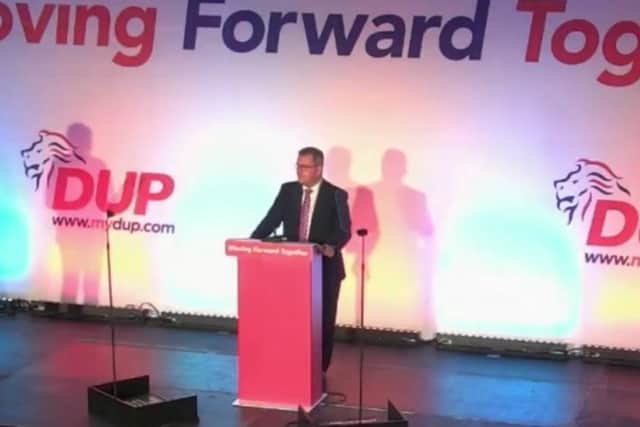

He has now said that a speech by Donaldson on the application of EU law at the party conference in 2022 was as a result of two meetings where the pair discussed the content of the address.
In the speech, Donaldson accepts EU law as the “underlying problem” – saying it was “not acceptable” and “incompatible with devolution”.
Mr Bryson says the former DUP boss “didn’t really understand” the issues around the Protocol, nor the extent of the commitments he was making.
One prominent DUP politician remembers the reference to EU law in the speech and said they had “welcomed the surprising clarity” on the issue.
In October 2022, Mr Bryson’s apparent influence over the DUP leader was the subject of media attention, including jokes that Donaldson’s conference speech had been delayed because it was still being written by the loyalist activist.
It comes after revelations in yesterday’s News Letter that Donaldson sent Jamie Bryson to meet EU representatives in Dublin to outline a more hard-line position on the Irish Sea border than his own negotiators during critical talks around the Windsor Framework.
He also gave his express authorisation for a back channel the loyalist activist had with Downing Street, where positions endorsed by party hardliners were promoted.
Now, Mr Bryson says that changes he persuaded the DUP leader to make to his October 2022 DUP conference speech tied the party to a policy position on EU law “which was far beyond where they had ever wanted to go”.
In that address, the DUP leader outlined the conditions for his party’s return to government to delegates.
“The truth, of course, is that the checks on the Irish Sea border are the symptom of the underlying problem, namely that Northern Ireland is subject to a different set of laws imposed upon us by a foreign entity without any say or vote by any elected representative of the people of Northern Ireland, and that is not acceptable.
“As Great Britain has secured its freedom to de-regulate or move in a different direction of travel on aid or taxation Northern Ireland is going to constantly face new barriers because we are tied to a different set of laws. That is simply not sustainable and is incompatible with devolution, which requires the support of unionists as well as nationalists if it is to function”, he said.
It received a rapturous response from the party faithful. But accepting EU law as an “underlying problem” was a shift from the party’s policy at the time – which had avoided any demand for the removal of EU law.
The DUP’s ‘seven tests’ for the Irish Sea border stopped short of calling for that, asking instead for people in Northern Ireland have “a role in any new regulations which impact them”.
While the part of Donaldson’s speech Mr Bryson says he influenced is caveated with a line about NI people not having “any say or vote” – its acceptance of EU law as the underlying problem was significant to hardliners in his party and across unionism.
The seven tests had been devised before the DUP quit government earlier that year, and were originally intended as a measure for any arrangements to amend the NI Protocol which created the sea border.
However, after the party pulled out of the Executive, they quickly became a measure of what the DUP would need to return to Stormont.
Donaldson had initially claimed that customs checks on goods entering Northern Ireland were not a constitutional matter. He had also claimed that Northern Ireland was not in the EU single market, but “aligned to it” – and been critical of the checks carried out on the frontier, rather than the legal framework requiring them, namely that Brussels set regulations for NI.
The DUP had avoided making the removal of EU law a demand, as senior figures knew that would not be agreed to in London or Brussels. Yet, the DUP leader was now saying it was the real problem.
Jamie Bryson told the News Letter: “I met Jeffrey in his office in Lisburn at the end of September 22 and again in first week of October. The discussion was his conference speech.
“He did not initially have a hardened position on EU law, this didn’t form part of the seven tests and DUP had avoided it. I made the case to him that it was necessary to properly diagnose the problem and the only way the DUP’s policy would make sense was if they committed to ending EU law.
“This was not the party position, they were still pursuing the ‘best of both worlds’ mantra. I persuaded him to include in his speech a suggested paragraph which clearly addressed this issue. He ultimately did this a few days later. This was crucial because it tied the DUP to a policy position on EU law which was far beyond where they had ever wanted to go - but they were now stuck with it. And ultimately some of his own negotiations spent the next two years trying to wriggle out of it.
“I had sight- long after they were sent- of some of the papers going to the Government from the DUP negotiatoors. They were abysmal and a world away from what he was having me tell to EU ambassadors, the Irish and in the papers that were being sent into Downing Street. And they were totally inconsistent with the policy position Donaldson committed himself to in that speech.
“He did the same on the principle of consent; in September 21 I wrote a policy paper for him arguing that he needed to adopt a position of saying that the principle of consent needed amended to make it more robust. This was a very fundamental anti-agreement doctrine developing as a way of undermining power sharing. In March 22 he announced this policy - as I understand it without any formal party consultation or process - via an article I helped him draft on Unionist Voice.
“To this day I cannot understand why he was allowing me to pull him into adopting such fundamentally hardline positions, which was constantly narrowing the path for the DUP. Part of me thinks he just didn’t really understand a lot of the Protocol and constitutional law stuff, and didn’t realise the extent of the commitments he was actually making.”
Earlier this week, the DUP said: “Jeffrey Donaldson is not a member of the Democratic Unionist Party. Following the guilty verdict it is clear that he led a double and duplicitous life.
“From a political perspective and throughout the years of negotiations on the Protocol and Windsor Framework, the DUP's position was determined through the Party's established internal decision-making structures. Those structures, rather than any one individual, guided the Party's approach and decisions.
“The DUP remains focused on securing the full restoration of Northern Ireland's place within the United Kingdom and addressing the ongoing challenges created by the continued application of EU law in Northern Ireland”.