
Committee closes down further scrutiny of private meeting - after First Minister's private office refuses to release contemporaneous notes
Notes taken in a controversial meeting between Paula Bradshaw and Michelle O’Neill ahead of an evidence session on recent scandals embroiling Sinn Fein cannot be released, according to the First Minister’s office.
A Freedom of Information request, submitted by the News Letter, sought contemporaneous notes of the meeting. Some MLAs had questioned why the official minutes weren’t written up by the Executive Office until five days after the meeting happened – and after they had already become a matter of controversy in the media.
On Wednesday afternoon, MLA Timothy Gaston proposed that the Executive Office committee seek copies of the notes. Although he had the support of the DUP, other parties blocked such a move.
The minutes, leaked to this newspaper last week, were provided by the Executive Office as part of the FOI request. Neither Ms Bradshaw nor her officials kept any record of the meeting.
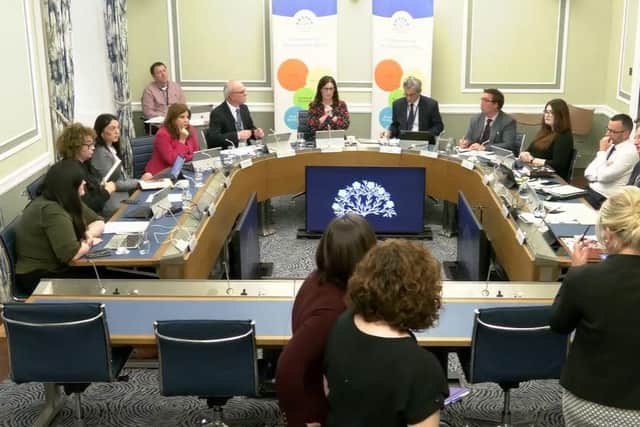

That decision was criticised again in the TEO committee on Wednesday – with DUP MLA Brian Kingston describing the minutes released by Michelle O’Neill’s office as a “narrative” – arguing that in future the committee should also take its own notes.
Paula Bradshaw rejected an assertion about the minutes being from the First Minister’s perspective, saying the Executive Office’s record was “bang on”.
Sinn Fein’s Carál Ní Chuilín interpreted Mr Gaston’s proposal as an attempt to help the News Letter with its FOI, rather than for the committee to have further detail. She said the proposal was “bonkers” and it was not the job of MLAs to “do a job for a journalist”.
Paula Bradshaw said the minutes were a “complete record of what happened that day” – and accused Mr Gaston of trying to “frustrate” the committee.
“We’re not here to do the job of the News Letter”, Ms Bradshaw said. “I’m not interested in that, I don’t think there’s anything to be gained from this – all you're trying to do is continually frustrate this committee”, she added.
The deputy chair, Alliance MLA Stewart Dickson, claimed it would “create a very serious chill factor” for a civil servant if their notes were released. He said the committee “have been given in good faith a minute, that minute has been accepted by those who were present at the meeting”.
The Executive Office account of the meeting shows that Michelle O’Neill came to the committee armed with the questions MLAs had sent in advance and attempted to deflect questions about safeguarding onto another department.
The document also reveals that at one stage Ms O’Neill’s top civil servant, the Executive Office permanent secretary, suggested “delaying or postponing the session” and asking MLAs to agree to “hold the meeting in closed session or with the Committee’s legal support present”.
Not only was the committee chair (Ms Bradshaw) invited by the witness (Ms O’Neill) to a private meeting in advance – but the witness had advance questions, prior knowledge of the committee’s legal advice and was able to help set boundaries about the conduct of the meeting.
In response to the News Letter’s FOI request, the first minister’s private office said contemporaneous notes are “being withheld” as they fall under an exemption which they say “relates to the operation of a Ministerial private office”.
The refusal letter continues: “Any note taken by the Minister’s Principal Private Secretary (PPS) clearly relates to the operation of a ministerial private office. Taking a handwritten note is a purely administrative task, being the necessary first step towards the production of the official note of the meeting. In TEO’s view the content of a handwritten note is therefore clearly exempt under section 35(1)(d).
“After weighing the various factors in favour of disclosing and withholding the information, on balance I believe that it is not in the public interest to disclose any contemporaneous notes. It is therefore the view of the Department that under section 35(1)(d) of the Freedom of Information Act, the arguments in favour of non-disclosure of this information outweigh the arguments in favour of disclosure”.
The evidence session last month was supposed to scrutinise the first minister over her party’s handling of child safeguarding issues and other scandals which have hit the party in recent months. However, Ms O’Neill refused to answer any questions she deemed not relevant – and a largely confused and chaotic committee struggled to respond.
The chairperson Paula Bradshaw ruled questions out of order, despite legal advice stating that it was for the witness to decide whether they wanted to answer them.