
Three 'iconic' Co Armagh red phone boxes given green light for listed status
Three traditional red phone boxes in Co Armagh have been approved for listed status.
Armagh City, Banbridge and Craigavon (ABC) Borough councillors have approved the listing of the three kiosks - at 37 Moyrourkan Road, Markethill; 63 Clare Road, Tandragee, and near 27 Main Street, Tynan.
The Department for Communities (DfC), in correspondence to ABC council describes the street fixtures as K6 telephone kiosks constructed to Sir Giles Gilbert Scott’s design of 1935.
The structures are cast iron construction, painted red with glazing to three elevations and a solid panel to the fourth.
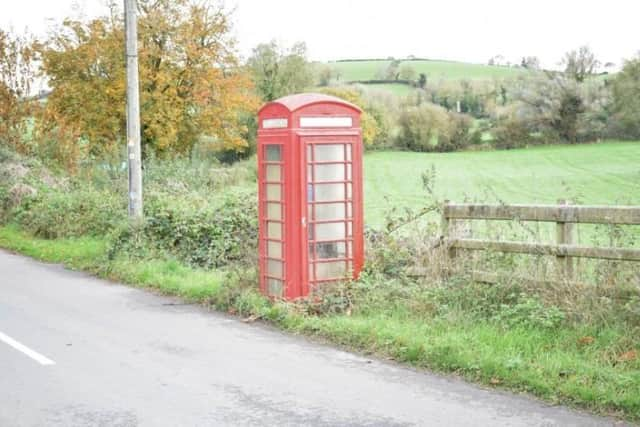

DfC, in their evaluation, consider that the kiosks are iconic pieces of street furniture which were once common, but are now almost entirely replaced by modern mobile phone use.
The kiosks are well maintained and structurally sound.
The Moyrourkan Road kiosk bears the St. Edward’s Crown within a slotted design, which means that it was manufactured between 1955 and 1968. That particular kiosk design was discontinued after that.
The kiosk occupies a prominent location adjacent to the crossroad junction of the Moyrourkan Road, Tandragee Road, Magherydogherty Road and Shanecrackan Road.
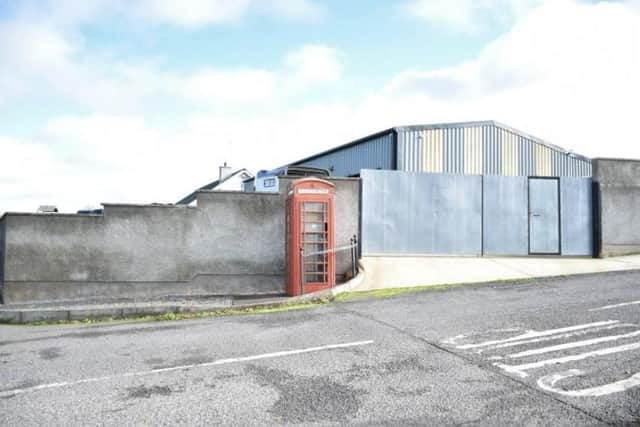
The glazing is predominantly glass with only a few Perspex panels, and the telephone equipment is present.
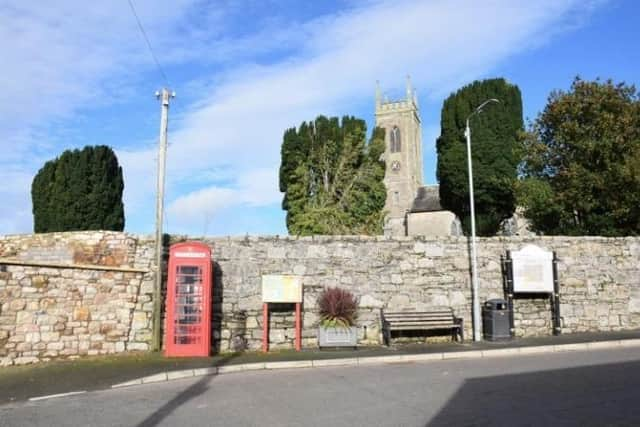
The Tynan phone kiosk also bears the St Edward’s Crown with a slot, which means that it was also manufactured between 1955 and 1968.
The kiosk is sited in a prominent location within the hilltop village of Tynan, next to the stone boundary wall of Tynan Parish Church.
Its location makes it suitable for continued community use. The telephone equipment within it has been removed.
The Clare Rd kiosk bears the Tudor Crown, which means it was manufactured between 1936 and 1953.
The kiosk is well intact, with both leather hinge straps and high-level signage.
ABC Planning officers, in their response, indicated that they had no objections to the proposed listings, but added that they “would be supportive of the [nearby] property owners, if they were to raise any concerns in relation to the proposed listing of these structures”.
The Department for Communities joined historical information to their listing requests, pointing to the extraordinary popularity of the traditional phone kiosks over many decades: “The K6 model was designed by Sir Giles Gilbert Scott in 1935 to celebrate the Silver Jubilee of King George V.
“Constructed in cast-iron with a teak door, compact in size and easily mass-produced, the design of the K6 was developed from Scott’s previous telephone kiosk models, the larger K2 (introduced in 1926) and K3 (1929).
“It was distributed throughout the UK from 1936, and represents the most successful and populous type of kiosk to be introduced, with some 60,000 being placed around the country.
“About 8,000 of these were installed as part of the ‘Jubilee Concession’, which allowed towns and villages with a post office to apply for a kiosk.”
The listing requests were mentioned at the January 7 ABC Planning & Regulatory Services committee meeting.
The recommendation to approve the council’s response in relation to the listing requests was proposed by Councillor Scott Armstrong (DUP) and seconded by Councillor Fergal Donnelly (SF).