
David Thompson: A bad night for the DUP as three unionist strongholds turn against the party
It was a bad result for the DUP at the general election as voters in three unionist heartlands turned against the party – with the once impenetrable North Antrim falling to the TUV leader Jim Allister.
The DUP now hold just five out of 18 Westminster seats, but unionism overall hasn’t lost out in terms of seats – returning eight MPs to the House of Commons.
Just seven years ago the DUP had 10 MPs – but the party has been punished after years of chaos caused by flip-flopping over its position on the Irish Sea border.
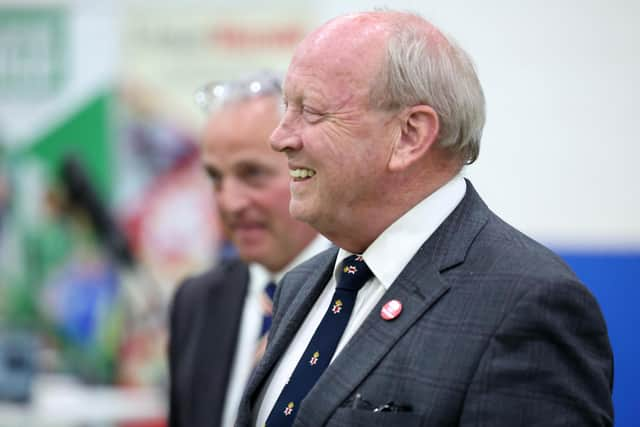
In a result that most of the political and media establishment – and seemingly the DUP itself – didn’t see coming, Jim Allister unseated Ian Paisley by 450 votes in North Antrim.

The seats the party lost are probably the most surprising aspect of the party’s continued electoral slide – they were not marginal unionist seats lost amid changing demographics.
They were all safe unionist seats – and in all three voters backed the candidate best placed to unseat the DUP.
There will be much soul-searching in Gavin Robinson’s party about the reasons why – as each lost constituency tells a different story. The DUP can’t pivot its policies to fight the TUV, UUP and Alliance all at once.
The most vocally anti-deal elements of the party will be keen to cement their position – but there are also credible arguments that Alliance pose a bigger threat to the party overall despite Gavin Robinson comfortably defeating Naomi Long.
It is hard to overstate the symbolism of the TUV leader’s victory in North Antrim, a seat which had been held by the Paisley family for 54 years.
Mr Allister had placed the Irish Sea border front and centre of his campaign – but trust was also a central message, and the unionist heartland decided it trusted him more than Ian Paisley.
In neighbouring South Antrim unionist voters turned to Robin Swann, who unseated the DUP’s Paul Girvan in a landslide victory.
The new Ulster Unionist Party MP has a majority of 7,512 after Doug Beattie’s risky strategy of moving him from North Antrim paid off.
As the News Letter reported last weekend, the TUV boss believed he would benefit from the UUP votes which would have previously gone to Robin Swann. The Ulster Unionists knew that, and seemed very comfortable with it.
The DUP had talked up the threat of Sinn Fein in South Antrim in a bid to galvanise support, and while they did run the DUP close in the end, republicans polled half the vote of Robin Swann.
And in Lagan Valley, Sorcha Eastwood became the first woman and the first non-unionist to take the seat – comfortably defeating the DUP’s Jonathan Buckley. The Alliance MP took a healthy vote in loyalist parts of the constituency.
Nationalism again comes out of the election with more MPs than unionism. Sinn Fein is now the largest party at Westminster – completing a hat-trick after already claiming that title at the assembly and at council level.
There has already been much commentary from within unionism about the cost of divisions, and the row over that will continue for months, perhaps years, to come.
While the DUP is still clearly the largest group within unionism – the three-way split is now more embedded than ever, with the TUV leader now sitting on the green benches at Westminster and the Ulster Unionist Party’s Robin Swann joining him.
Mr Allister told the BBC yesterday that the DUP has lost the confidence of unionist voters, saying “the responsibility is on their shoulders and I certainly won’t be carrying it for them”.
There was disappointment for the UUP’s Diana Armstrong in Fermanagh and South Tyrone who lost out to Sinn Fein’s Pat Cullen – who has a 4,500 majority.
The Alliance Party claimed they were the party leading change at this election – but came away with just one seat and a decreased vote share.
The Alliance surge of 2022 became more of a Sorcha surge, as years of relentless constituency work and campaigning paid off for Ms Eastwood in Lagan Valley, but the party had disappointing results elsewhere.
Deputy leader Stephen Farry lost his seat to the independent unionist Alex Easton in North Down by 7,305 votes, and leader Naomi Long failed to unseat Gavin Robinson who won East Belfast by 2,676 votes.