
Department pressed for ‘update’ on A1 dual carriageway scheme after A5 ruling
A call has been made for clarity on the A1 road project in Co Down now that a court has given the de facto green light to Co Tyrone’s A5 project.
DUP councillor Paul Rankin of Armagh, Banbridge and Craigavon Borough Council has written to the Department of Infrastructure in the wake of Tuesday’s landmark court ruling, demanding an “urgent update” on the dual carriageway junction improvement scheme.

He said that the A1 project “has experienced delays due to the wider legal implications of the A5 judgment”, and now that this appears to have been settled in law, he wants to see a “timeframe for the delivery and completion” of the A1 scheme.
The scheme to turn the A5 between Aughnacloy in south Tyrone and Londonderry into a dual carriageway is one of the biggest roads projects on the island of Ireland, and had been effectively halted by a legal challenge in 2025 – though the Court of Appeal said on Tuesday it can in fact go ahead.
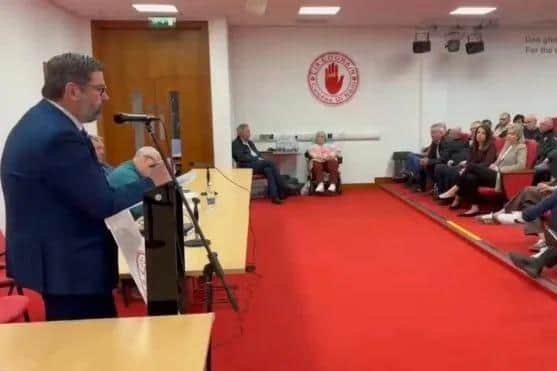
The A5 has a reputation as an accident blackspot and in the wake of the decision, relatives of people killed on the A5 joined members of the ‘A5 Enough is Enough’ campaign group at a gathering in Garvaghey on Tuesday night.
The meeting at the Tyrone GAA Centre came just hours after Court of Appeal’s ruling.
An estimated 57 people have died on the A5 over the past 18 years.
Among those attending Tuesday night's gathering were infrastructure minister Liz Kimmins.
The ‘A5 Enough is Enough’ campaign was established by the Tyrone GAA County Committee in November 2022, following mounting concern over the road's safety record.
Campaign chairman Niall McKenna outlined the history behind the formation of ‘A5 Enough is Enough’, recalling how the tragic death of John Rafferty proved to be the catalyst - the “tipping point” - which ignited the campaign.
“We couldn't remain passive any longer and simply enough was enough - enough of our membership were dying on this road,” he said.
Mr McKenna said the campaign had consistently attempted to cut through the complexity surrounding the project.
“We were trying to get the message across that the minutia of this case was largely irrelevant - environmental factors and planning procedures and things like that were not important to us when you consider that what we were trying to do was save lives, the only reason that should really matter...
He acknowledged that the campaign had experienced both highs and lows - from announcements that the road scheme was going ahead to decisions by judges which brought the project to a halt.
But throughout it all, campaigners had attempted to bring the human cost of the A5 into the public debate.
“We tried to put the argument into perspective, to bring it to the public forum and show there were real lives and human issues at stake and they were more important than anything else, more important than people losing land and things like that,” he said.
The meeting also gave bereaved families the opportunity to address those gathered, although representatives declined the invitation to speak.